
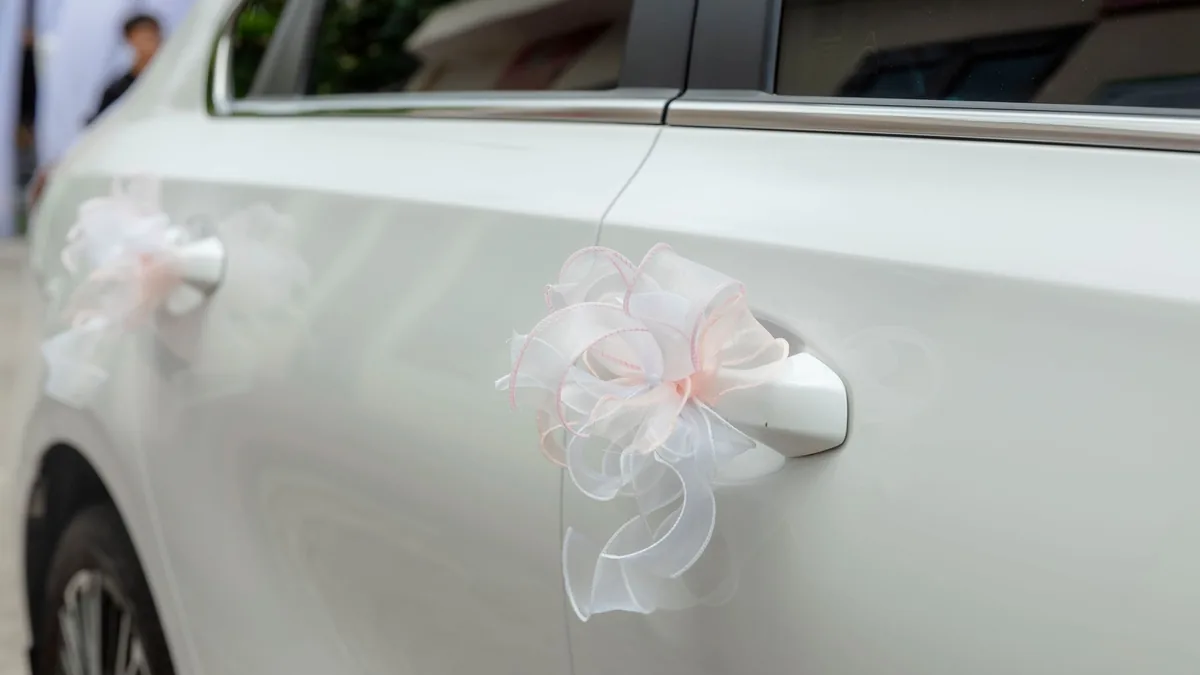
If you are working out how to attach ribbon to wedding car paintwork without leaving a mark, the short answer is this: nothing sticky and nothing hard should touch the paint. Anchor the ribbon at points that are designed to take a load (the door mirror arms, the bonnet shut line, the grille surround and the inside of the door frames), tie it with soft fabric loops or rubber-coated magnets placed on clean paint, and let the ribbon lie flat rather than pulled drum-tight. Keep the windscreen, both door mirrors, the lights and both number plates completely clear. Agree every fixing point with the car's operator before the decorator arrives, because on a hired car the paint belongs to someone else and they will inspect it when you hand it back.
Why the owner's side matters more than the look
Saved photos show the finished car at the venue gate, not the car the next morning. A wedding car is decorated in a hurry, driven through traffic, parked for hours in heat or damp, and stripped in the dark.
Modern car paint is built in layers. According to the reference summary on automotive paint (Wikipedia), the colour sits in a basecoat and a transparent clear coat on top acts as the final interface with the environment, designed to resist abrasion and UV. That clear coat is exactly what a wire twist, a staple, a grain of grit under a magnet or a strip of the wrong tape damages. A light scuff can sometimes be polished out; a deep scratch through to colour usually cannot, and on a hired vehicle the repair is the hirer's problem.
There is a history lesson hiding in the tape aisle, too. The masking tape article notes that masking tape was invented in the 1920s precisely because the strong adhesive tape used in car body shops was pulling fresh paint off when it was removed.
Paint-safe fixings: what to use and what to refuse
Here is the practical ranking, from safest to riskiest. Use it when you brief the decorator and when you check their kit bag.
| Fixing method | Paint risk | Best used for | What to watch |
|---|---|---|---|
| Soft fabric ties to mirror arms, door handles or grille | Low | Anchoring the ends of a ribbon run | Tie around the arm, never around the mirror glass housing edge where it can crack a cover |
| Ribbon ends trapped inside a closed door or boot | Low | Side ribbons and door bows | The door must still shut fully and the seal must not be pinched open |
| Rubber-coated or fabric-backed magnets on clean paint | Low to medium | Holding the centre of a bonnet V or bow | Only on steel panels, on paint wiped clean first; never slide them into place |
| Suction cups on glass only | Low to medium | Rear-window décor on the outside of side glass | They fall off in heat; never on the windscreen |
| Painter's or low-tack tape on paint | Medium | Short-term positioning only, if at all | Remove within hours; do not leave in sun overnight |
| Cello tape, packing tape, duct tape, electrical tape | High | Nothing on paint | Adhesive residue and lifted clear coat |
| Wire, cable ties, pins, staples | High | Nothing that touches the car | Scratches, and sharp ends at child height |
Magnets
A decoration magnet is fine on a clean, dry steel panel. The damage comes from grit trapped underneath when the magnet shifts. Wipe each spot with a microfibre cloth first and lift magnets straight off, never drag them. Magnets will not hold on non-steel panels, so ask the operator which panels are steel.
Suction cups
Suction cups let go as glass heats up. Keep them to side or rear windows, and treat them as decorative, never structural.
Tape
If a decorator insists on tape, only low-tack painter's tape, briefly and out of direct sun. Say no to anything else.
How to attach ribbon to wedding car mirrors and bonnet, step by step
The classic wedding car ribbon and bow is a wide satin ribbon running in a V from each door mirror to a bow near the front badge. This is the version that causes most of the damage, so here is how to do it properly.
- Start with a clean car. Ask the operator to have the vehicle washed and dried before it reaches you. Decorating over dust is how scratches happen.
- Pick the anchor points first. Usually the two door mirror arms at the back and the grille surround or badge area at the front. On many cars the ribbon can be tied through the grille slats; on others there is no gap and a magnet or a tie under the bonnet shut line does the job.
- Tie the rear ends to the mirror arms with a soft knot. Leave a tail that tucks neatly towards the door, not across the mirror glass.
- Run each side forward to the front anchor. The ribbon should lie on the bonnet with a little slack. A ribbon stretched tight like a guitar string will vibrate and rub at speed, and that rubbing is what dulls paint along a line.
- Place the bow over the front anchor. A ready-made bow on a soft tie or fabric-backed magnet is easier than tying one on the car.
- Check the bonnet still opens and closes normally if the ribbon passes under the shut line, and that nothing is trapped in the wipers.
- Sit in the driver's seat. If the driver can see the ribbon edge flicking in the corner of their eye, or if it touches the windscreen at any point, move it.
Door bows are simpler: open the rear doors, lay the ribbon tail inside the frame and close the door on it so the seal grips the fabric. Check the door closes fully, and tell the driver it is there so they do not wrestle with it at the venue.
How much ribbon for a wedding car: measure, do not guess
Answers to how much ribbon for wedding car decoration vary because cars vary. The reliable method is to measure the actual vehicle, or ask the operator to, a day ahead.
The simple formula
For a V-ribbon from both mirrors to one front bow:
- Measure from the left mirror arm, across the bonnet, to the front anchor point. Do the same on the right.
- Add both measurements together.
- Add an allowance for the two knots at the mirrors and the tie at the front (roughly the length of your forearm per knot is a reasonable working allowance).
- Add the length you want for the bow and its tails, or buy a ready-made bow.
- Add a spare length in case a run needs redoing.
Door bows and boot ribbons are extra and should be measured the same way.
A worked example (illustrative only)
Suppose, as an example, each mirror-to-badge run measures 1.5 m. Two runs make 3 m; three knots at 0.4 m add 1.2 m; a spare run adds 1.5 m. That is about 5.7 m, so with a ready-made bow you would buy around 6 m. These numbers only show the method; your tape measure decides the real figure.
Sedan versus SUV: the practical differences
| Consideration | Typical sedan | Typical SUV or large MPV |
|---|---|---|
| Bonnet shape | Longer and lower; ribbon lies flatter | Higher and often flatter-fronted; ribbon angle is steeper |
| Anchor points | Mirrors and grille are usually close to the bonnet line | Mirrors sit higher; ribbon may touch the A-pillar or windscreen edge unless routed carefully |
| Wind at speed | Lower profile, less lift on ribbon | More buffeting across a tall front |
| Bow placement | Centre of bonnet front | Often better on the grille itself than on the bonnet |
| Ribbon width | Standard wide ribbon usually looks balanced | A wider ribbon often looks more proportionate |
If you are still deciding between vehicle types, our guide to choosing a wedding vehicle for appearance and passenger fit covers the family and luggage side of that choice.
White ribbon for wedding car décor: colour and fabric
White ribbon for wedding car decoration is the default in many families, with red, gold and deep maroon common alternatives depending on the event. A few practical points about colour and fabric:
- Dye transfer. Cheap red or maroon ribbon can bleed when damp, from dew overnight or a sudden monsoon shower. On pale paint that can leave a pink line. White or colourfast satin avoids the problem; if you want colour, test a scrap on a wet white cloth first.
- White on white. A white ribbon on a white car can disappear in photos. A contrast edge or a coloured bow solves it without extra fixings.
- Satin versus organza. Satin lies flat and behaves in wind. Organza looks light and airy at rest but flutters more at speed, so it suits short, slow journeys better than a motorway leg.
Keep the windscreen, mirrors and number plates clear
A decorated car is still a car on a public road, often driven at night and in heavy wedding traffic, and the driver needs to see and be seen.
The windscreen and wipers
Nothing should sit on the windscreen or hang into the driver's view. That includes garlands draped across the top edge, strings of flowers down the A-pillars, and bows on the wiper arms. If rain or dust arrives mid-journey the driver has to be able to use the wipers without tearing the décor into the glass. For readers who drive in the UK, the principle will be familiar: the Highway Code's vehicle maintenance annex says windscreens and windows must be kept free from obstructions to vision, and lights and number plates must be kept clean and clear. It is a sound standard wherever the car is driven.
Door mirrors
Tying ribbon to the mirror arm is fine; covering the mirror glass is not. Check from the driver's seat that each mirror still shows a full view down the side of the car, and that nothing folds the mirror in when the ribbon is tensioned. Power-folding mirrors should be left alone electrically for the evening, so the ribbon is not tugged every time the car is locked.
Number plates and lights
Both plates must stay fully readable. That means no bows or flower sprays hanging over the front plate, no garland across the rear plate, and nothing over the headlights, indicators or brake lights. In Pakistan, registration plates are issued by a provincial or territorial agency, as the summary of Pakistan's vehicle registration plates explains, and plate compliance is a live enforcement subject: City Traffic Police Lahore lists road-safety campaigns aimed at non-pattern number plates and tinted glass. Rules and penalties differ by province and change over time, so if you want certainty, check with the traffic police in the city where the wedding is. A plate hidden under a bow is an easy reason for a driver to be stopped at exactly the wrong moment.
Wedding car flowers in Pakistani heat: timing and residue
Fresh wedding car flowers look wonderful for an hour and tired after four, especially in the hot months. The reference summary of the climate of Pakistan gives a mean June temperature of around 38°C in the plains, notes that heatwaves occur in May and June, and puts the monsoon from late June through September. A dark car bonnet in that sun gets hotter than the air around it.
Timing
- Decorate as late as the schedule allows. For an evening baraat, flowers added in the afternoon have already spent hours on a hot panel before anyone sees them.
- Park in shade while waiting. If the car must wait at a house or venue, agree a shaded or covered spot with the driver in advance.
- Keep a spare. A small replacement bunch in a cool box in the boot rescues a wilted front spray before photos.
- Winter is different. Flowers last better in the cooler months, but fog in Punjab and upper Sindh can bring damp overnight. Dew on flowers means water on paint.
Residue
Flowers leave more mess than people expect. Pollen from lilies stains; sap from cut stems is sticky; crushed petals left on a hot bonnet can mark the clear coat if they are baked on. Practical steps:
- Ask the florist to remove lily stamens before the flowers go near the car.
- Use flowers mounted on a foam or fabric base, so stems and wet foam never touch paint directly.
- Put a thin soft cloth or felt pad between any floral base and the paintwork.
- Never use florist's wire wrapped around a mirror arm or door handle without padding.
- Plan to remove fresh flowers the same night rather than leaving them until morning.
Artificial flowers avoid most of these problems and can look good in photographs. Many families use real flowers for the front spray and silk ones for the rest.
What the operator must approve before decorators start
If the car is hired with a driver, the operator's permission is the first thing to settle, not the last. Some operators are relaxed about décor, some provide their own, and some only allow certain fixings on certain vehicles. Settling it in writing, even in a short message thread, avoids an argument at the gate.
Ask the operator to confirm these points before the day:
- Whether decoration is allowed at all on the vehicle offered, and whether the operator prefers to arrange it themselves.
- Which fixing methods are acceptable: soft ties, magnets, suction cups, tape. Name them specifically.
- Which panels are steel if magnets are planned, and which areas are off limits, such as sensors, cameras or a panoramic roof.
- Where and when the decorator can work: the address, the time the car arrives, and how long the decorator has.
- Who removes the decoration, and when. Is it the family, the decorator, or the driver at the end of the night?
- How the car's condition is recorded at handover. Photos of each panel, taken with the driver present, protect everyone.
- What happens if the plan changes, for example if the confirmed car is swapped for a similar model and the ribbon measurements no longer fit.
That last point matters because the car you saw in a photo is not always the car that turns up. Our guide on the wedding vehicle handover between family, decorator and operator goes into model confirmation and the handover itself. If you are still at the quoting stage, it helps to mention decoration in your first message; the wedding car hire quote checklist lists what else to include.
For décor styles and arranging the car itself, our sister service iDrive, the network behind Pakistan Taxi, has an explainer on wedding car decoration and arranging the car.
A note for families organising from overseas
If you are organising from the UK, the Gulf or North America, you will probably not be there when the decorator starts. Nominate one person on the ground with the authority to say no to tape, wire or anything over the plates. Also check the UK FCDO travel advice for Pakistan for the wedding city and the roads to it: at the time of writing it advises against all travel to Balochistan and to a long list of Khyber Pakhtunkhwa districts, including Peshawar, advises against all but essential travel to other areas such as Sindh north of Nawabshah, and tells visitors to avoid large public events and expect short-notice road closures. It changes, so read the current page.
Removing the decoration after the event
The damage that nobody notices at night shows up in daylight. Removal deserves the same care as fitting.
The order of removal
- Flowers first. Lift sprays off their bases, then lift the bases straight up. Do not drag a floral base across the bonnet.
- Magnets next. Lift each one straight off. If one has shifted during the drive, wipe the area before touching it again.
- Untie, do not cut near paint. Scissors and blades near paint slip. Untie knots at the mirror arms, or cut the ribbon well away from the car.
- Open the doors to release trapped ribbon. Do not pull it through a closed door seal.
- Peel any tape slowly and low, folding it back on itself rather than pulling straight up. If it resists, stop and tell the operator rather than forcing it.
- Walk round the car with the driver. Look at the bonnet, mirror arms, door edges and grille in good light, or with a phone torch if it is late.
If you find a mark, say so immediately and photograph it with the driver present.
Your decoration plan on one page
Copy this into a message to the decorator and the operator the day before:
- Vehicle: make, model, colour, registration.
- Look: V-ribbon with front bow, door bows, front flower spray (real or silk).
- Ribbon: colour, width, fabric, length based on measured runs.
- Fixings allowed: soft ties at mirror arms and grille, fabric-backed magnets on named steel panels, ribbon trapped in rear doors. No wire, no ordinary tape, nothing on the windscreen, mirrors, lights or plates.
- Timing: decorator arrives at, car ready by, departure at.
- Parking while waiting: shaded spot agreed.
- Removal: who, where, and when.
- Condition photos: at handover and after removal.
When you are ready to plan the cars themselves, the Pakistan Taxi weddings service explains what can be arranged, and you can start planning your wedding journeys (planned link) with dates, pickup points and the number of cars you think you need. Share your decoration plan in your enquiry so the operator can say early whether the vehicle suits it. Vehicle availability and pricing are confirmed by the operator, not by the enquiry itself.