
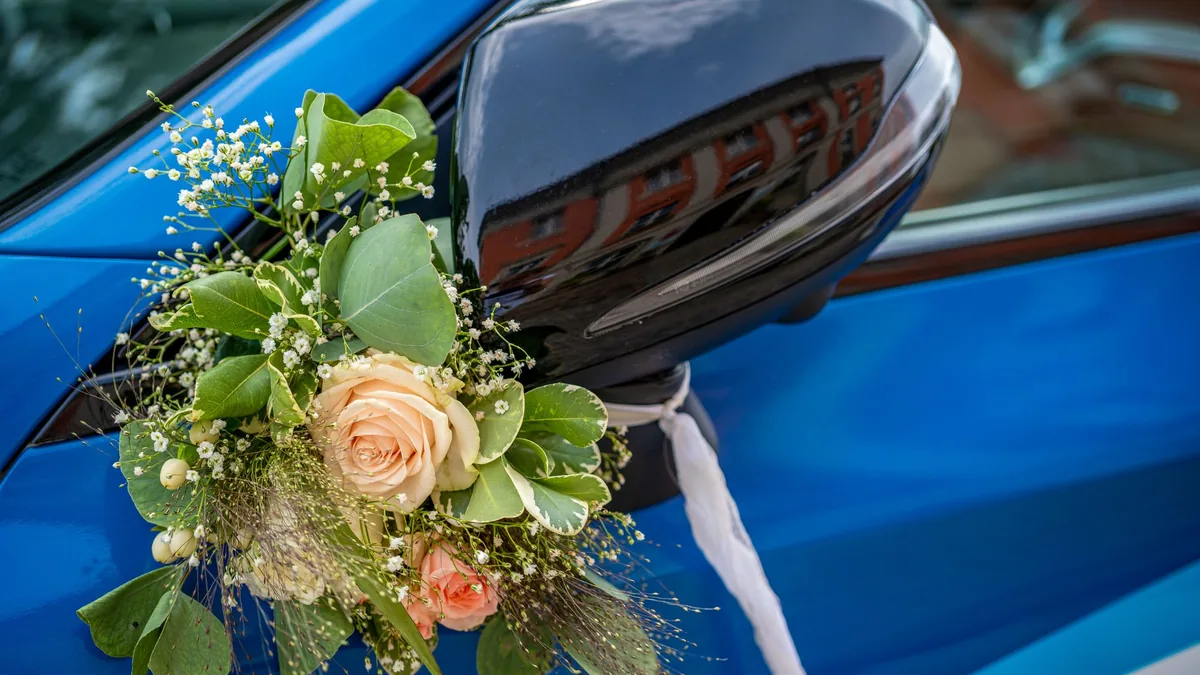
A wedding car kafila works when four things are settled before anyone starts an engine: one assembly point with a hard departure time, a fixed running order (lead car, groom's car, family cars, sweep car), a route every driver has seen with one or two named regrouping points, and a single person with authority to hold or release the convoy. Get those right and the baraat arrives together, on time, in the order the hall is expecting. Skip them and you get the familiar picture: the groom's car at the gate with half the family still at a petrol pump three kilometres back.
This checklist is for the organiser, usually a brother, cousin or family friend who has been handed the car list and a phone number for each driver. It covers the hour before departure, the drive itself and the arrival, plus the lines the law draws around convoys. Nothing here needs special kit. It needs a notebook, a charged phone and about twenty minutes of briefing.
The short version: what must be decided before the day
If you only have time to settle a handful of things, settle these. Everything else in this guide hangs off them.
- Assembly point. One address with space for every car to park off the carriageway. Not "outside the house" if the house is on a narrow street.
- Departure time. Pick the time the lead car leaves, not the time people should "start coming". Work back from the hall's expected arrival window.
- Running order. Numbered positions, written down, shared with drivers the day before.
- Route and regroup points. One primary route and one fallback, with named places to pull over and wait.
- Convoy lead. One person (not the groom, not the groom's father) who decides when to go, when to wait and when to leave a late car behind.
- Rules for the drive. No stunts, no firing, no blocking junctions. Said out loud at the briefing, not assumed.
If the baraat is collecting relatives from several homes before it assembles, sort that part first. Our guide to coordinating several family pickup points for the baraat deals with that stage; this one starts when the cars meet.
Baraat assembly: choosing the point and setting the clock
The baraat assembly is where most delays are born. Families tend to choose the groom's home by default, and then discover that twelve cars cannot line up on a street where two vehicles struggle to pass.
What a good assembly point looks like
- Off-road parking for the whole convoy. A school ground, a relative's larger plot, a mosque car park with permission, or the hall-side of a wide service road. Each car should be able to pull in, stop and pull out again without reversing into traffic.
- A clear exit in the direction of travel. If the convoy has to U-turn on a dual carriageway to begin the journey, choose somewhere else.
- Toilets and water nearby. Elderly relatives will have been dressed and waiting for a while.
- Somewhere the dhol can play without the band standing in the road.
Setting the departure time
Start from the hall. Ask the venue what time the baraat is expected at the gate and how long the reception team needs between the first car arriving and the groom walking in. Then work backwards:
| Step | Question to answer | Example (labelled as an example only) |
|---|---|---|
| Hall arrival window | When does the venue want the groom at the gate? | 8:30 pm |
| Drive time | Normal evening journey time from assembly to hall, plus a margin for wedding-season traffic | 35 min + 20 min margin |
| Lead car departs | Arrival minus drive time and margin | 7:35 pm |
| Assembly closes | Departure minus the time needed to line up and brief | 7:15 pm |
| Drivers on site | Assembly closes minus the time to check fuel and decorations | 6:45 pm |
Give families the "assembly closes" time, not the departure time. People arrive late to the latest time they are told.
Convoy order: lead car, groom's car and the sweep
A kafila without a fixed order turns into a race. Cars overtake each other to stay close to the groom, gaps open at every signal, and nobody knows whether the car behind is family or a stranger.
The positions that matter
Lead car (position 1). Driven by someone calm who knows the route without looking at a phone. It sets the pace, which should be the pace of the slowest vehicle in the convoy, not the fastest. The lead car's passenger holds the phone and speaks to the convoy lead.
Groom's car (position 2 or 3). Close enough to the front that it cannot be cut off by a long signal, but with one car ahead to clear the way and give it space. The decorated car usually has the most visibility restrictions, with flowers across the bonnet and sometimes on the rear window, so it should never be asked to overtake or change lane in a hurry. Check before the day that the groom, his sehra and whoever rides with him actually fit in the back once the decorations are on, and that the driver can still see through the rear window.
Close family (positions 3 to 5). Parents, grandparents and anyone carrying the gifts, the sehra box or the paperwork for the nikah.
Everyone else (middle positions). Numbered, not a free-for-all.
Sweep car (last position). The most important seat after the lead. Its job is to stay last, never overtake, and report when a car drops back, breaks down or gets separated at a signal. Give the sweep car a driver with patience and a passenger with a charged phone and the full car list.
Write it down
Print or share a simple table: position number, car make and colour, registration, driver name, driver phone, passengers. Hand a copy to the lead car, the sweep car and the convoy lead. Our pickup manifest template for events with several vehicles is a good starting format; add a "position" column for the convoy.
Baraat convoy route: picking roads a kafila can actually hold
The fastest route on a map is often the wrong baraat convoy route. What matters for a line of cars is how many times the convoy will be split, not how many minutes the drive takes.
What to prefer
- Fewer signalised junctions. Every red light can cut the convoy in half. A slightly longer road with fewer signals keeps cars together.
- Wide roads with a clear left lane. Somewhere the convoy can move steadily without squeezing past parked vehicles.
- Known U-turn and turning points. If the route needs a U-turn, choose one where the whole convoy can make it in one go.
- Avoid markets at peak hours. Bazaars and food streets fill up after Maghrib, which is exactly when most baraats move. Route around them.
What to check the day before
- Drive the route at roughly the same time of evening, or ask someone who does.
- Check the city traffic police channels for diversions. In Lahore, the City Traffic Police run helpline 15 and the Rasta app, which City Traffic Police Lahore describes as giving live jam updates and alternative routes.
- Ask the hall which gate the baraat should use and where the cars should park after drop-off.
Regrouping points
Name one or two places along the route where the lead car will pull over and wait if the convoy splits. A petrol station forecourt, a wide service road or a mosque car park all work. Tell drivers: "If you lose sight of the car ahead, go to the regroup point and wait. Do not speed to catch up."
Keep regroup stops short and off the carriageway. A line of cars waiting in the left lane of a main road is exactly the kind of obstruction that brings a traffic warden over.
If part of the journey is on a motorway
Some baraats travel between cities, for example from Lahore to a family home in Faisalabad or from Islamabad to a village off the M-1. Motorway legs change the plan:
- Do not try to hold formation at speed. On a motorway, give each driver the destination and the next exit, and regroup at a named service area or just after the toll plaza.
- Keep to the posted limits. In March 2026 the National Highways and Motorway Police cut the motorway limit for cars from 120 to 100 km/h as a fuel-saving measure, Dawn reported. Limits can change, so check what is posted on the day.
- Know the helpline. NHMP's helpline is 130, which it repeats in its travel advisories, as Business Recorder reported for the December 2025 fog advisory.
- Winter fog. Winter weddings in Punjab often coincide with fog season. NHMP has advised travelling between 10 am and 8 pm in dense fog. A late-evening kafila between cities in December or January may need a fallback plan, including an overnight stay.
A note on travel advice
If family are flying in on UK passports, read the FCDO's Pakistan travel advice before fixing the route. At the time of writing it advises against all travel to Balochistan, to areas within 10 miles of the Afghan border and to several Khyber Pakhtunkhwa districts, including Peshawar city. It advises against all but essential travel within 5 miles of the India border (the Wagah crossing and Kartarpur Corridor are treated separately), to Sindh north of and including Nawabshah, and to Dera Ghazi Khan in Punjab. Islamabad, Lahore and Karachi are not on those lists. If the wedding or any leg of the kafila falls in a listed area, this checklist is not enough: take specialist advice, and check whether travel insurance still applies.
Fuel, phones and the driver briefing
Most convoy problems are small and predictable. A car runs low on fuel. A driver's phone dies. Someone does not know the hall's name. Fix these before departure.
Fuel
- Ask every driver to fill up before arriving at the assembly point, not on the way.
- A car that stops for fuel mid-route will lose the convoy.
- If a car is hired, check whether fuel is included and who pays for a top-up.
Phones
- Every driver needs a charged phone and a car charger.
- Create one group chat for drivers only: convoy lead, lead car, sweep car and each driver. Keep family chatter out of it.
- Share the hall's pinned location, the regroup points and the assembly address in that chat the day before.
- Agree that drivers do not text while driving. The passenger in each car handles messages.
The briefing (ten minutes, at the assembly point)
Gather drivers, not passengers. Cover:
- Running order and each driver's number.
- The route, the fallback and the regroup points.
- Pace: steady, at the speed of the slowest car. No overtaking within the convoy.
- What to do if separated: go to the regroup point, call the sweep car.
- What to do in a breakdown: hazard lights, pull fully off the road, call the sweep car. The sweep stops; the convoy keeps going.
- The rules on stunts, firing and blocking roads (next section).
- Arrival: which gate, who gets out first, where to park.
Ask each driver to repeat their number and the first regroup point back to you. It feels formal. It works.
The line the law draws: no stunts, no firing, no blocking roads
Kafila videos online tend to show the things that get families into trouble: cars weaving across lanes, people standing out of sunroofs, a junction held shut while the dhol plays, and sometimes guns fired into the air. None of this belongs in a good baraat procession, and some of it ends in arrests.
Aerial firing
Celebratory firing kills people. In Karachi alone, aerial firing in 2023 left 10 people dead, seven of them children, and more than 200 injured, with a number of the incidents at wedding celebrations, according to The Express Tribune's year-end tally. Police do arrest people for it: in February 2024 Karachi police arrested two men after aerial firing at a student gathering in DHA went viral, with the DIG South saying such acts required swift action, as The Express Tribune reported.
For the organiser, the rule is simple. No weapons in the convoy, no firing at the assembly point, the hall gate or anywhere on the route. If a guest arrives armed, the convoy lead should ask them to leave the weapon at home or ride separately. Put it in the invitation message if you need to: a rule stated in advance is far easier to hold than one improvised at the gate.
Stunts and unsafe driving
- No one out of windows or sunroofs while the car is moving.
- No weaving, zig-zagging or racing between convoy cars.
- No motorcycle outriders doing wheelies. Lahore's traffic police have run campaigns against one-wheeling and against motorbikes without silencers, as City Traffic Police Lahore sets out on its site.
- No tinted glass or non-pattern plates on hired or family cars. The same Lahore campaign targets both.
Blocking roads and noise
Holding a junction shut so the whole kafila can pass together feels harmless on the day. To everyone else on the road it is an obstruction, and ambulances use those junctions too. Let the convoy split at a signal and regroup at the next named point instead.
Noise is the other complaint. Residents in Hyderabad told The Express Tribune that loud music from baraats, fireworks and vehicles with silencers removed were among their main grievances in wedding season, and that enforcement was patchy (The Express Tribune, October 2023). Patchy enforcement is not permission. Keep the dhol and the speakers for the assembly point and the hall gate.
A quick "yes and no" table for drivers
| During the drive | Yes | No |
|---|---|---|
| Speed | Steady, at the slowest car's pace | Racing to keep up |
| Lane | Keep left where possible, one lane | Spreading across all lanes |
| Signals | Stop at red, regroup later | Blocking the junction for the convoy |
| Horn | Short, when needed | Continuous horn chains |
| Passengers | Seated, belted | Standing in sunroofs, leaning out |
| Celebration | At the hall gate, on foot | Firing, fireworks from moving cars |
Arrival order at the hall
A well-run baraat procession can still fall apart in the last hundred metres. The hall gate is usually narrow, the parking attendants are busy, and every car wants to stop right in front.
Before you arrive
- The lead car's passenger calls the hall contact about five minutes out: "We are five minutes away, eight cars, groom in car two."
- Confirm which gate the groom uses and where the other cars should go after drop-off.
- Check that the reception party (the bride's side) knows the baraat is coming, so the welcome is ready and the groom is not left waiting in the car.
The arrival sequence
- Lead car pulls past the gate and parks, leaving space for the groom's car at the entrance.
- Groom's car stops at the gate. The groom and his immediate escort step out. The driver waits for the welcome to begin, then moves to the parking the hall has set aside.
- Close family cars drop elders at the gate first, then park.
- Remaining cars drop passengers in order and park.
- Sweep car arrives last, confirms every car is accounted for and tells the convoy lead.
After drop-off
Drivers usually wait through the function, or leave and return. Agree this before the day. If the rukhsati is later than planned, the same cars will be needed for the return, sometimes with the bride's luggage and gifts on board. Our guide to wedding transport when the reception finishes late covers overtime, waiting time and what to agree with drivers.
Getting help with the cars
Pakistan Taxi's wedding transport service is a planning and enquiry route: you describe the day, the number of cars and the timings, and we come back to you. We do not promise fixed fares or guaranteed vehicles at the enquiry stage. For corporate or larger event bookings, our sister service iDrive, the network behind Pakistan Taxi, runs a separate weddings and events booking page.
The one-page kafila checklist
Copy this into your phone or print it for the convoy lead.
The day before
- Assembly point confirmed, with off-road parking for every car
- Departure time and "assembly closes" time sent to all families
- Running order numbered and shared with every driver
- Primary route, fallback route and regroup points shared as pins
- Drivers-only group chat set up
- Hall contact name and number saved; gate and parking confirmed
- Motorway leg (if any): service-area regroup point agreed, fog forecast checked
At the assembly point
- Every car fuelled before arrival
- Every driver has a charged phone and charger
- Ten-minute driver briefing done; each driver repeats their number
- Rules stated: no firing, no stunts, no blocking junctions
- Lead car and sweep car have the full car list
On the road
- Lead car sets the pace of the slowest vehicle
- Separated cars go to the regroup point, not chase the convoy
- Sweep car reports any breakdown or gap to the convoy lead
At the hall
- Five-minute call to the hall contact
- Groom's car at the gate, others drop and park in order
- Sweep car confirms all cars arrived
- Return timings and waiting time agreed with drivers
If you would like help arranging cars and drivers for the day, start with Pakistan Taxi's journey planner (planned link) and tell us the date, city, number of vehicles and timings. We will come back to you with what is possible.