
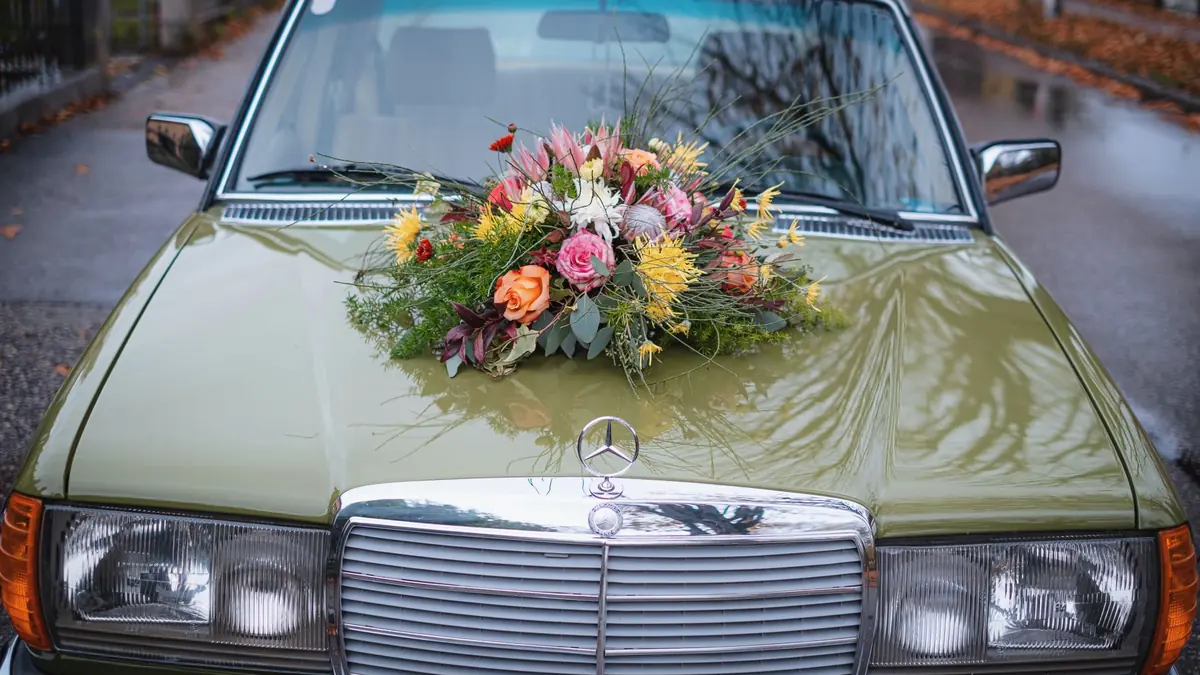
A vintage car for baraat entry can be the photograph everyone remembers, but it is also the one vehicle in your wedding plan most likely to overheat, stall or arrive late. Before you pay anyone, ask five things: exactly which car you will get (make, year, colour, registration), whether it has working air conditioning, how far it will actually drive, what happens if it will not start, and who is responsible for a backup vehicle. The price depends mostly on the car's rarity and condition, the hours it is held for you, the distance and the date. If the operator cannot answer those questions clearly and in writing, treat the booking as a hope rather than a plan.
The rest of this guide goes through each question in turn, with a checklist you can send to the operator and a simple way to split the day between the old car and a modern one.
What "vintage" usually means when you are hiring
In the wedding hire trade, "vintage" is a loose word. You might be offered any of these under the same label:
- A genuinely old, restored car kept by a private owner or a small collector, driven only for events and photoshoots.
- A classic model that has been heavily modified: modern engine, new wiring, sometimes added air conditioning, with the original body.
- A retro-styled or replica body built on a newer chassis, which looks old in photos but behaves like a recent car.
- An older luxury saloon or convertible that is simply not current, described as vintage because it looks special.
None of these is wrong. What matters is that you know which one you are getting, because they behave very differently on a hot evening in slow traffic. A restored original may be beautiful and temperamental; a replica may be less authentic but far more dependable.
The questions that pin the car down
Ask the operator to confirm, in a message you can keep:
- The make, model and year of the car.
- The colour of the body and the interior.
- The registration number.
- Whether the roof opens and, if it is a convertible, whether the roof can be closed quickly if it rains or gets dusty.
- Two or three recent photos of that exact car, not a gallery image.
- Whether it has been fitted with a newer engine, air conditioning or electric fans.
The registration number is useful for more than peace of mind. In Punjab, the Excise, Taxation and Narcotics Control Department lists online verification of registered vehicles among its services. Checking the number against the car you were shown takes a few minutes and tells you whether the listing matches a real, registered vehicle. Other provinces run their own excise departments, so use the one where the car is registered.
What drives the vintage car for baraat price
People search "vintage car for baraat price" hoping for a number. We are not going to give one, because prices for these cars are set by individual owners, change with the wedding calendar and vary a lot between cities. What we can do is tell you what moves the quote up or down, so you can compare two offers fairly.
| Factor | Why it changes the price | What to ask |
|---|---|---|
| Rarity and condition | A well-restored original is harder to replace and costlier to maintain than a replica. | "Is this an original restoration, a modified classic or a replica?" |
| Hours held for you | The car is often booked for a block of time, not a distance. Waiting counts. | "When does the clock start and stop? What is the charge per extra hour?" |
| Distance driven | Old engines are driven gently; long runs add fuel, wear and risk. | "Is there a distance limit? What happens if we go over it?" |
| Date and season | Peak wedding dates fill quickly and owners know it. | "Is this your price for this specific date?" |
| Decoration | Flowers, ribbons and lights may be included, extra, or not allowed on original paint. | "Who decorates, what is included, and what is not allowed on the body?" |
| Driver | Many owners will only let their own driver handle the car. | "Is the driver included? Who pays for their meals and waiting time?" |
| Backup car | A standby modern car is a separate cost unless stated. | "Is a backup included, and what exactly is it?" |
When two quotes look far apart, lay them side by side against this table. Very often the cheaper one has a shorter time block, no driver waiting allowance or no backup at all. Our wedding car hire quote checklist covers the wider set of details to put in any wedding vehicle request, and it works just as well for a classic car as for a modern one.
Deposits and cancellation
Ask what deposit is expected, when the balance is due and what happens if the car breaks down before the day or on the day. "The owner will sort something out" is not an answer. You want to know, in writing, whether you get a replacement car, a partial refund or nothing. If the operator will not put this down, decide now whether you can live with losing the deposit.
Reliability, heat and no air conditioning
This is the part vintage-car listings tend to skip, and it is the part that decides how the day actually goes.
Heat is the biggest risk
Many older cars were built for cooler climates and lighter traffic. From late spring through the monsoon, evenings in Punjab and Sindh often stay hot long after sunset, so check the Pakistan Meteorological Department forecast for your wedding week rather than assuming. An old engine creeping through wedding traffic at walking pace, with no airflow through the radiator, is exactly the situation in which old cars overheat.
Ask the owner directly:
- Has the cooling system been overhauled recently?
- Has the car been driven in summer traffic, or only for short winter shoots?
- How long can it idle before it needs to rest?
- What does the driver do if the temperature gauge climbs?
An honest owner will tell you the car's limits. Be more wary of one who says it has no limits at all.
No air conditioning is a comfort issue, not a small one
Think about who is riding in the car. The groom is usually in a heavy sherwani, possibly with a turban or sehra. A sister or young nephew may be in the back. In an old car with no air conditioning and closed windows (to keep the flowers and the outfit in place), it can become uncomfortable within minutes.
Practical ways to handle it:
- Keep the ride short. Use the vintage car for the final stretch only (more on this below).
- Keep the modern car's air conditioning running nearby so the groom can wait in it until the last moment.
- Carry water, tissues and a small towel in the vintage car.
- Avoid the hottest window. If the entry time is flexible, a later arrival is usually cooler.
- Ask whether the windows open and whether the roof can be opened safely with the decoration on.
For winter weddings the risk shifts. Cold starts can be harder on old engines, and fog in Punjab can slow everything down, so the backup plan still matters.
Breakdowns and starting trouble
Old cars can refuse to start after sitting in the sun, or after a long wait outside a house while the family finishes photographs. Ask the owner whether the driver carries basic tools, a jump pack, coolant and a spare tyre that actually fits. Ask whether a mechanic is on call. None of this guarantees the car will run, but it tells you how seriously the owner treats the job.
Short baraat vintage car entry vs the full journey
This is the most useful decision you will make. There are really two ways to use a baraat vintage car.
Option 1: entry run only
The groom travels most of the way in a comfortable modern car. The vintage car waits at an agreed point a short distance from the venue. The groom changes cars, and the vintage car does the final, visible part of the arrival: the drive up to the gate, the dhol, the photographs and the welcome.
This is usually the safer choice because:
- The old car spends minutes, not hours, in traffic.
- Heat and air conditioning matter much less.
- If the vintage car will not start, the groom simply arrives in the modern car and the day carries on.
- The distance charge (if any) stays low.
Option 2: the full journey
The vintage car collects the groom from home and drives the whole route to the venue, sometimes with a stop for photographs on the way.
This works best when the route is short, mostly clear of heavy traffic and the weather is mild. It also makes sense if the house departure is itself a big moment the family wants filmed. The trade-off is that every extra kilometre and every traffic jam is more time for something to go wrong.
| Entry run only | Full journey | |
|---|---|---|
| Time in the vintage car | Short | Long |
| Heat and comfort risk | Low | Higher, especially in summer |
| If the car fails | Groom stays in modern car | Needs a quick swap on the roadside |
| Photo moments | Arrival at the venue | Departure, route and arrival |
| Likely cost | Usually lower | Usually higher (more hours and distance) |
| Best for | Summer weddings, long routes, busy cities | Short routes, mild weather, reliable car |
If you are unsure, choose the entry run. You still get the photographs that matter most, and you are not relying on a decades-old engine for the whole evening.
The backup modern car on standby
Whichever option you choose, plan a backup. This is not pessimism; it is the same thinking as packing a spare shirt.
What a good backup looks like
- A modern, air-conditioned car with enough space for the groom and whoever rides with him.
- Clean and presentable, so that if it becomes the arrival car, the photos still look right. Our guide to choosing a wedding vehicle for appearance and passenger fit helps you pick one that suits the outfit and the number of people.
- Following the vintage car, or waiting at the changeover point, not sitting at home across town.
- A driver who knows the plan: where to go, who to call, and what to do if the vintage car stops.
Who arranges it?
Some vintage car owners offer a backup car. Many do not. If yours does, ask what the car is and whether it is actually with you on the day or only "available if needed". If they do not, arrange it yourself. We can help you plan a modern car with a driver alongside the rest of your wedding transport through our wedding transport service, and if you need a larger event set-up across several vehicles, our sister platform iDrive handles weddings and events booking as the network behind Pakistan Taxi. Either way, the operator will confirm what vehicles and drivers are actually available for your date; nothing is guaranteed until it is confirmed.
A simple swap plan
Write it down and share it with both drivers and one family contact:
- Trigger: if the vintage car will not start, overheats or breaks down.
- Who decides: one named person (not the groom, who has enough to do).
- Where: the groom moves into the backup car at the nearest safe spot.
- Then: the backup car continues to the venue; the vintage car driver deals with the old car.
- Tell: a quick message to the venue contact and the photographer.
It takes five minutes to agree this in advance and saves a lot of shouting on the roadside.
Photos, route and timing for the vintage car baraat entry
The vintage car baraat entry is a staged moment. Treat it like one.
Agree the route before the day
- Drive or map the route from the changeover point to the venue gate. Look for speed breakers, narrow lanes, sharp turns and steep ramps that a low old car might scrape.
- Check where the car will stop. Is there space at the gate for the car, the dhol players and the photographer? Will the venue allow the car inside the compound?
- Plan where the car waits afterwards. Many venues have limited parking, and the car may need to leave quickly to free the gate.
- Watch for closures. Protests and events can close roads in larger cities at short notice. The UK Foreign, Commonwealth & Development Office's Pakistan travel advice notes that protests and marches can bring road closures and transport disruption in cities including Islamabad and Rawalpindi.
For help on the day, the Islamabad Capital Territory Police list a traffic helpline, 1915, alongside police emergency 15. Other cities run their own traffic police lines, so save the right number for your city in both drivers' phones.
The same FCDO page advises against all travel to some areas, including Balochistan and many districts of Khyber Pakhtunkhwa including Peshawar, and against all but essential travel to others, such as Dera Ghazi Khan in Punjab and all of Sindh north of and including Nawabshah. If the wedding is in one of those areas, read the current advice before making any travel plans and speak to your insurer; a vintage car is not something to plan around there.
Timing the entry
Build the timing backwards from the moment the car should reach the gate:
- Arrival at gate: the agreed time with the venue and photographer.
- Leave changeover point: allow a few extra minutes for slow driving; old cars are rarely hurried.
- Groom arrives at changeover: at least 15-20 minutes earlier, so there is time to adjust the outfit and for the vintage car to be checked and started.
- Vintage car arrives at changeover: earlier still, so the driver can cool the engine, tidy the flowers and do a test start.
Check whether the venue has a finishing time. Many halls run to a fixed schedule, and a late baraat entry eats into the whole function. Our guide to coordinating several baraat pickup points shows how to fit the family's cars into the same timetable so the vintage car is not left waiting for everyone else.
Getting the photographs right
- Tell the photographer the plan, including the changeover spot, so they are at the gate before the car arrives.
- Agree the car's final stopping point with the photographer, so the light and background work.
- Ask whether the owner allows people to stand on or lean against the car. Many owners of original cars do not.
- Keep the decoration light on original paint. Ask the owner what can and cannot touch the body. Our note on the wedding vehicle handover between family, decorator and operator explains who should agree the decoration and when.
- Have one person hold the groom's phone and anything else he needs, so nothing gets left in the old car.
A checklist to send the operator
Copy this into a message and ask the owner or operator to reply to each point:
- Make, model, year, colour and registration number of the car.
- Recent photos of this exact car.
- Original, modified or replica? Air conditioning: yes or no?
- Start and end time of the booking, and the charge for extra time.
- Distance limit, if any, and the charge beyond it.
- Driver included? Their meals and waiting covered?
- Decoration: included, extra, or restricted?
- Backup car: included? Which car, and will it be with us or on call?
- Deposit amount, balance due date, and what happens if the car fails before or on the day.
- The driver's name and mobile number, and a second contact number.
If you are arranging this from abroad, send the same checklist to one trusted relative in Pakistan and ask them to see the car in person before the balance is paid. Photos can be old; a visit a week before the wedding is much harder to fake.
How we can help plan the rest of the baraat
A vintage car is one piece of a bigger picture: the groom's family, the dhol, guests coming from different parts of the city and relatives arriving from abroad. When you are ready, you can plan the wedding journeys with Pakistan Taxi (planned link) by telling us the date, the pickup points, the venue and the kind of cars you have in mind, including a modern backup for the vintage car. We will come back to you with what can be arranged; nothing is booked or fixed until it has been confirmed with you.
Questions people ask
Is a vintage car worth it for a summer baraat?
It can be, if you keep the vintage part short. In the hottest months, use a modern air-conditioned car for most of the journey and the vintage car only for the entry run. That gives you the photos without putting the groom, or an old engine, through a long, hot drive.
How early should I book a vintage car for the baraat?
Early, especially for popular wedding dates. Genuine classic cars are few, and each can only do one wedding at a time. Book the car and the backup together, and confirm the details in writing well before the day.
Can the vintage car carry more than the groom?
Usually one or two passengers at most, depending on the car. Some classic cars have small back seats, and older cars may not have rear seat belts at all. Ask the owner how many people the car can carry comfortably and safely, and plan other cars for everyone else.