
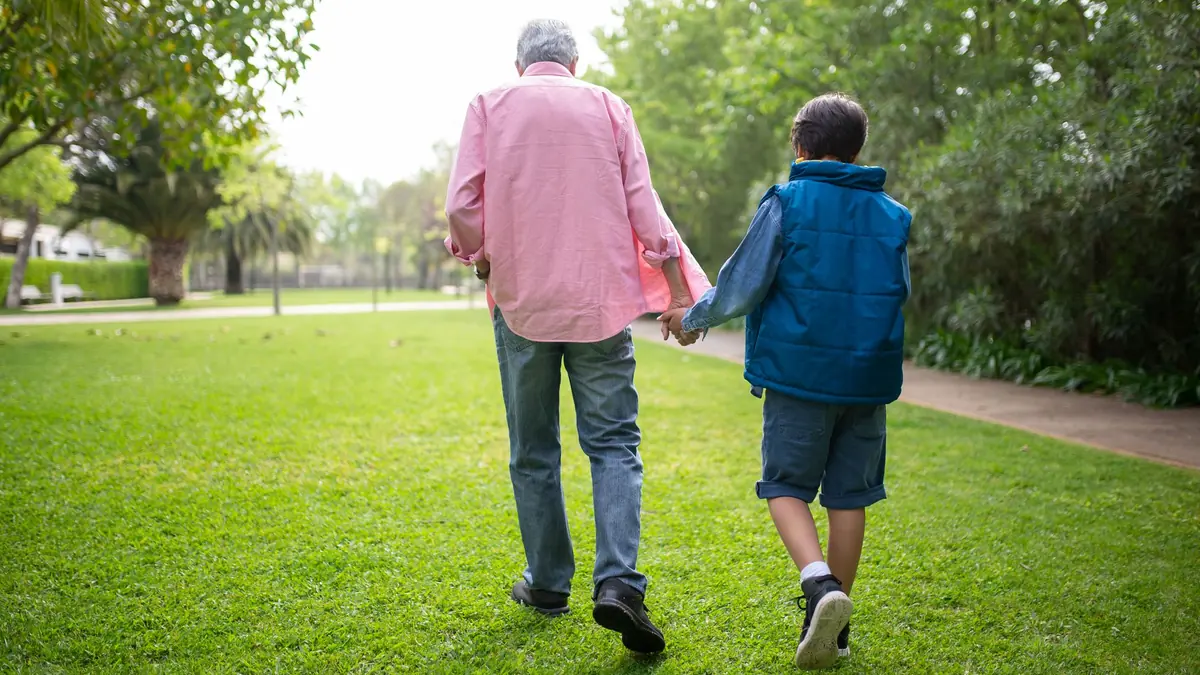
Travelling with grandparents and grandchildren in the same car works when you plan the ride around the two people who have the least slack: the youngest child and the oldest adult. Give the grandparent the seat with the easiest door and the most legroom, put young children in the rear with a proper child seat you bring or arrange yourself, and plan a stop roughly every hour and a half to two hours rather than "when someone asks". Travel early in the day in the hot months, carry more water than feels sensible, and ask for a pickup at the actual front door, not the nearest main road. If the passengers, the pram, the walking frame and the suitcases will not fit comfortably in one vehicle, two smaller cars travelling together is often calmer than one crowded van.
Travelling with grandparents and toddlers: why the mix is harder
A toddler needs frequent short breaks; a grandparent needs fewer, longer, gentler ones. Put both in one car and you have two clocks running at once.
The simple rule that saves most multigenerational family trips: the slowest traveller sets the pace, and the seating plan decides whether everyone arrives calm. Nobody minds leaving ten minutes later. Everybody minds a grandmother squeezed into the middle of the back row next to a car seat for three hours.
Two health points are worth knowing before you plan the timings:
- The NHS lists people aged over 60 among those more likely to get DVT (a blood clot in the leg), and says that on journeys of more than four hours, walking around when possible and drinking plenty of water help lower the risk. Many intercity drives in Pakistan are longer than that.
- The NHS also names older people, especially those aged 65 and over, and babies and children aged five and under among the groups most at risk in hot weather. In a three-generation car you may have both at once.
Neither point is a reason not to travel. Both are reasons to plan the stops and the air-conditioning properly.
Who sits where: a seating plan for a family car
Before anyone books anything, write down every passenger and their needs. It sounds fussy. It is the single most useful ten minutes of the whole plan.
Step 1: list everyone honestly
For each person, note their age (and a child's height), whether they need a child seat or booster, their mobility (walks freely, uses a stick, a frame or a wheelchair), anything that affects seating such as a knee that will not bend far or travel sickness, and who must sit next to whom: the toddler who will only settle beside Nano, for instance.
Step 2: give the front seat to the right person
In most family cars the front passenger seat has the widest door opening, the most legroom and the easiest step in and out. For a grandparent with stiff knees or hips, that often makes it the only seat that works.
There is one clear exception. Children and front seats do not mix well, and a rear-facing baby seat is a particular concern: UK rules, which make a good benchmark, say you must deactivate any front airbag before fitting a rear-facing baby seat in a front seat. You cannot count on knowing whether a hired car's passenger airbag can be switched off, so the practical answer is: grandparent in front, children in the back.
Step 3: plan the back row around the child seats
The same UK guidance says children normally use a child car seat until they are 12 years old or 135 cm tall, whichever comes first, and that height-based seats must be rear facing until a child is over 15 months old. Use that as your family standard even if the rules and habits you see on the road in Pakistan are looser.
Practical points for the back row:
- Do not assume a child seat comes with the car. Ask when you enquire, and if nobody can confirm one in writing, bring your own. If you are flying in from the UK or the Gulf, check your airline's allowance for a travel seat or booster in the hold.
- Put the child seat behind the passenger seat, not in the middle, if the grandparent in front can live with their seat a notch further forward. It keeps the child reachable from the kerb side at stops.
- The adult who manages the children sits in the back with them. Usually a parent. Not the grandparent, unless they genuinely want to and can reach across easily.
- Keep the middle back seat for the smallest adult or an older child in a booster, not for a grandparent.
Step 4: sample seating plans
These are examples of how families commonly arrange themselves, not rules. Adjust to your own people.
| Group | Vehicle type | Front passenger | Back row | Third row / boot |
|---|---|---|---|---|
| 2 grandparents, 1 parent, 1 toddler | Saloon or small SUV (plus a second car, see below) | Grandfather | Grandmother by the door, parent beside the child seat | Luggage only |
| 1 grandparent, 2 parents, 2 children under 8 | MPV / family vehicle | Grandparent | Parent, two child seats or booster | Fold-flat or luggage |
| 2 grandparents, 2 parents, 3 children | Group van | Grandparent with the worse mobility | Second grandparent and one parent in the widest row | Children and second parent in rear rows, luggage behind |
If a grandparent uses a wheelchair, say so at the very start. Folding a wheelchair into a boot that is already full of suitcases is a common and completely avoidable source of stress.
Door-to-door pickup versus walking to the main road
The easy option for a driver is often to wait on the main road and ask you to walk out. For three generations that is rarely a small ask: a grandparent walking slowly, a toddler on one hip, a pram, three bags and a narrow, uneven gully.
Ask for a door-to-door pickup, and make it easy for the driver to find the door:
- Share a live location pin for the gate, not just the area name.
- Add a landmark the driver can see from the car: a mosque, a school, a shop sign, the colour of the gate.
- Say whether a larger vehicle can physically get into the street. A van that cannot turn round is a van that will ask you to walk.
- Name one adult as the contact on the day, with a phone that will be answered.
- Have the grandparent and children ready indoors, not waiting in the sun at the gate, and bring them out only when the car has arrived.
The same logic applies at the other end. If you are going to a relative's house, a wedding hall or a hotel, find out where the vehicle can stop closest to the entrance. At airports, agree the meeting point before the flight lands.
Stop rhythm: toilet and rest stops for young and old
The trick is to plan stops that serve both clocks at once: a clean toilet near where the car parks, somewhere to sit, and space for a toddler to run.
A workable rhythm
A sensible default for toilet and rest stops for young and old is a short stop every 90 minutes to two hours, and one longer stop of 30 to 45 minutes in the middle of any drive over about four hours. Treat these as starting points and adjust for your own family.
- Short stop (10-15 minutes): toilet, nappy change, a short walk round the car park, a refill of water.
- Long stop (30-45 minutes): proper sit-down, food, prayers if the timing falls, a slower walk for the grandparent to get the legs moving. This is also the stop that answers the NHS point about moving around on long journeys.
Use the planned stopping places
On the motorways, planned service areas make this much easier. On the M-2 between Islamabad and Lahore, for example, Wikipedia lists five service areas at Sukheki, Sial, Bhera, Kallar Kahar and Chakri, on average 60 to 80 km apart and on both sides of the carriageway; they are the only places to refuel, and the same article lists mosques, food outlets and washrooms among the roadside facilities. That spacing fits the rhythm above almost exactly. On older national highways, stopping places are less predictable, so agree likely stops with the driver before you set off rather than waiting until a child needs one urgently.
Our guide to asking for breaks and stops on an intercity journey covers how to raise this with a driver before you leave, so it is part of the plan and not a favour you ask for on the road.
Stop checklist for the "stop bag"
Keep one small bag that comes out of the car at every stop, so nobody has to dig through the boot:
- Nappies, wipes, a change mat and nappy bags
- Tissues and a small pack of toilet paper (not every washroom has it)
- Hand sanitiser
- The grandparent's medicines for the day, in their original packaging
- Two refillable water bottles
- A light shawl or cardigan for air-conditioned places
- Snacks that do not melt
Heat, air-conditioning and water
Pakistan's plains get very hot. Wikipedia's summary of the climate of Pakistan notes that heat waves occur in May and June, especially in southern Punjab, central Balochistan and upper Sindh, and that summer temperatures in the plains can exceed 53 °C. The monsoon follows, from late June to late September, and swaps dry heat for humidity. For a car carrying both a baby and a grandparent, heat is the planning issue that matters most from late spring to early autumn.
What to do about it
- Leave early. Starting soon after Fajr on a summer drive means the hardest hours of the day are spent at your destination, not on the road. The NHS advice for hot weather is to stay in the shade especially between 11am and 3pm; plan the drive so you can.
- Ask about the air-conditioning when you enquire, not on the doorstep. In a larger van, ask specifically whether the rear rows get cooled air or only the front. A back row with no vents can be far warmer than the driver's seat.
- Pre-cool the car. Ask the driver to run the AC for a few minutes before the family gets in, and keep the grandparent and children indoors until then.
- Sun shades for the rear windows. Cheap, light, and they make a real difference to a child seat facing the window.
- Never leave anyone in the parked car while you run into a shop or a service area, not even for a moment with the engine running.
- Water for everyone, and more than you think. The NHS advice is to drink extra fluids in hot weather. Older people may not feel thirsty; offer water at every stop rather than waiting to be asked. For young children, carry what they already drink at home.
On water, keep it simple: use sealed bottled water from a shop you trust for drinking and for mixing formula, and follow the food and water hygiene guidance that the UK government's Pakistan health advice points to, which includes taking care when buying bottled water. That same page warns that there are often shortages of medicine in Pakistan and that some imported medical supplies may be restricted. For a grandparent on regular tablets, pack the full trip's supply plus spare, and keep a day's worth in the stop bag.
Winter is different, not easier
In winter the issue flips. The same climate summary notes that fog can remain for weeks across Punjab, upper Sindh and central Khyber Pakhtunkhwa, and the FCDO flags air pollution as a health hazard from October to February, with Punjab, and Lahore in particular, among the worst affected. Fog can slow or hold up road journeys, so build in slack, avoid planning a long drive that ends after dark, and carry blankets and warm layers for the grandparents in the back.
Luggage, prams and walking aids in one boot
Parents bring the pram, the cot and the child seats. Grandparents bring a suitcase heavier than it looks, a walking aid and, very often, gifts. Write the boot list first, then choose the vehicle.
- Count the large suitcases and the cabin bags separately.
- Add the "awkward items": pram or pushchair, travel cot, walking frame, folding wheelchair, a cooler bag.
- Add any child seats that are not already fitted.
- Note which items need to come out at stops (the pram, perhaps the walking stick) and which can stay buried.
Then pack the boot in reverse order of need: suitcases at the bottom and back, the pram or wheelchair on top where it can come out without unloading everything, and the stop bag inside the cabin.
A grandparent's stick or frame should be the first thing out when the car stops, not the last. And be honest about the third row: in many seven-seat vehicles, using it leaves very little boot.
Our family vehicle (planned link) and group van (planned link) pages explain what each type of vehicle is typically suited to, which helps when you are matching the list to a car.
One family van for three generations, or two smaller cars?
Keeping the whole family in one vehicle feels right. Often it is not.
When one family van for three generations works
- The group is too big for one car but everyone is going to the same place at the same time.
- The van has a sliding side door and a step that the grandparents can manage. A high step into a van can be harder for a stiff knee than lowering into a saloon.
- Every row has air-conditioning and there is still room for the luggage behind the last row.
- Nobody minds that a stop for one is a stop for all.
When two smaller cars beat one full van
- One car can carry the grandparents at a gentle pace with fewer, longer stops, while the other carries the children and stops as often as they need.
- The luggage, pram and walking aids will not fit in the van alongside every passenger.
- A grandparent needs the front seat of a car for the easier step in and out.
- Part of the family wants to arrive earlier, or leave later, than the rest.
- You want a backup: if one vehicle is delayed, half the family is still moving.
The downside of two cars is simple coordination. Agree the stop points in advance, have both drivers' numbers in one message, and decide who travels with the grandparents' medicines.
| Question | One van | Two cars |
|---|---|---|
| Is everyone leaving and arriving together? | Easier | Needs agreed meeting points |
| Can the grandparents get in and out easily? | Check the step height | Front seat of a saloon is often easier |
| Can each group stop at its own pace? | No, one pace for all | Yes |
| Is there room for prams, walking aids and cases? | Only if the rear rows are not all in use | Usually, split across two boots |
| What if one vehicle is late or has a problem? | Everyone waits | Half the family keeps moving |
If you are still weighing up vehicle sizes, our sister network iDrive, the platform that runs Pakistan Taxi, has a page describing the family MPV options it lists, which can help you picture what fits a seven-seat plan.
Safety and advice checks before you travel
A few checks belong on every three-generation trip, however familiar the road.
- Check the UK travel advice for your route. The FCDO safety and security advice for Pakistan says it advises against all travel, or all but essential travel, to parts of Pakistan, and that local driving standards are erratic, especially at night. Read the regional detail for every place on your itinerary, not just the destination, and check what your travel insurance says about areas under an FCDO warning.
- Avoid long drives at night. The same FCDO page notes driving standards are worse at night and road conditions can be poor away from major motorways. With a sleeping toddler and a tired grandparent, daylight driving is the kinder plan anyway.
- Seat belts for everyone, every row. Including the grandparent who "is only going round the corner", and the older child who says the booster is for babies.
- Mountain roads need extra care. For trips north, the FCDO recommends experienced local drivers and travel only in clear weather. Build in a spare day so no one feels pressure to push on in bad conditions.
- Tell the driver about the passengers. A driver who knows there is a baby and an 80-year-old aboard can brake gently, choose the smoother lane and wait patiently at stops.
If your older relatives also make long intercity trips on their own, our guide to planning intercity travel with older relatives goes deeper on their side of things. Families who also make the Umrah journey may find it useful that our sister company Saudi Cab Co has a guide to travelling with older passengers in Saudi Arabia, which looks at choosing the vehicle and planning the stops on journeys there.
Planning your journey with Pakistan Taxi
When you are ready, you can plan a family journey with Pakistan Taxi (planned link) and include everything from this guide in the enquiry: the number of passengers, ages of the children, whether you are bringing your own child seats, any walking aids or wheelchair, the pickup gate and the stops you would like. The team will come back to you about suitable vehicles and timings. Nothing is confirmed until you have that reply, so send the enquiry early, particularly if your dates fall around Eid, a family wedding or the school holidays.