
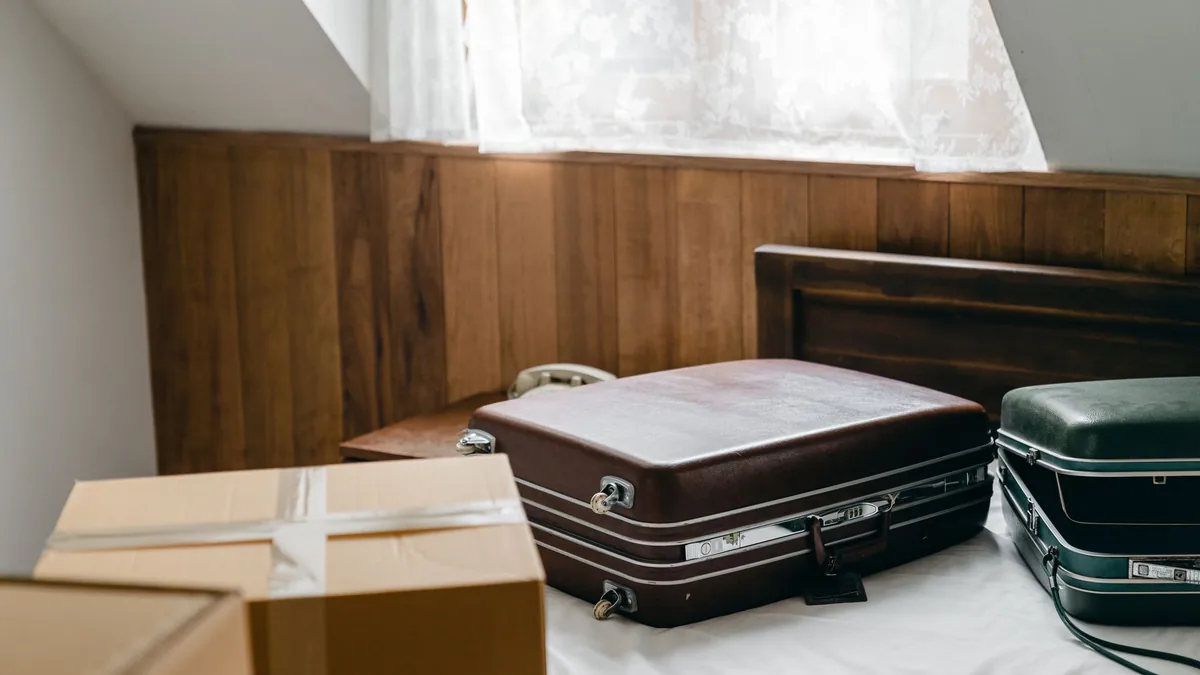
If your visit to Pakistan is split between two households, say a fortnight with your parents in one part of Lahore and a week with your in-laws across the city, the day you change homes is a small move of its own. For most visiting families the right answer is one house shifting van: a passenger van with a driver, big enough to take everyone and every suitcase in a single trip. Two cars only make sense when the group is small, the luggage is modest, or the two homes want to host a meal on the way. The decision comes down to three counts (people, suitcases, gift boxes), the width of the street at each end, and when the family actually wants to leave, which is rarely the time first mentioned.
Why a mid-visit move is different from moving house
Removal companies are built for furniture: sofas, fridges, beds, boxes that go into a truck and come out at a new address. What you are doing is lighter and more human. A visiting household is relocating from one relative's home to another, with its people, its suitcases, and usually a stack of things that were not in the suitcases when you landed: wedding clothes, sweets for the next house, shopping from the bazaar, a child's new cricket bat.
You do not need a loading crew. You need seats, space for full-size suitcases, a driver who can wait while the goodbyes run long, and a vehicle that fits down the second street. Moving between relatives' homes is rarely a straight line either: someone wants the sweet shop, and there is always an aunt on the way who will be offended if you drive past. Treat it as a passenger journey with heavy luggage, not freight.
Start with the counts: people, suitcases, gift boxes
Before you compare vehicles, write down three numbers. It takes five minutes and saves most of the problems that happen on the day.
1. People
Count every person moving, including children and anyone who is coming along to help and then going home. A cousin who "just comes to help lift" still needs a seat. Note anyone who needs the front seat, a seat near the door, or extra time getting in and out, such as an older relative or someone with a knee problem.
2. Suitcases
Count by size, not by total:
- Large checked cases (the ones you flew in with, often at the airline's full weight)
- Cabin-size cases and holdalls
- Soft bags that squash into gaps
Large cases are what decide the vehicle. Six people with six large cases is a very different job from six people with two.
3. Gift boxes and extras
This is the count families forget. Mithai boxes, fruit crates, folded clothes wrapped in cloth, a new pressure cooker for your mother-in-law, bags of shopping. Write them down separately, because some of them should not go under a suitcase and some should travel on a lap. Anything fragile or liquid (a glass dish, bottles of oil or honey) needs its own place.
A simple planning list might look like this:
| Item | Count | Notes |
|---|---|---|
| Adults | 4 | One elderly, needs front seat |
| Children | 3 | One needs a child seat (bring your own) |
| Large checked cases | 5 | Two at full airline weight |
| Cabin cases and holdalls | 4 | |
| Gift boxes and extras | 6 | Two mithai boxes, keep flat |
*This is an example only.* Your own list is what you send when you plan the journey, and it is the single most useful thing a booking team can see.
One house shifting van or a car plus a luggage run?
With the counts in hand, there are three realistic ways to do the move.
| Option | Works best when | Watch out for |
|---|---|---|
| One passenger van with driver | 6 or more people, or 4 or more large cases; you want everyone to arrive together | Narrow lanes at either end; a van needs somewhere to stop and load |
| Two cars travelling together | Up to about 6 people with light luggage; one car can drop someone elsewhere | Large cases may not fit in a sedan boot; two drivers to coordinate |
| Car for people, separate luggage run | Big luggage load but only a few passengers; people want to leave at a different time | Luggage arrives separately; someone must be at the new home to receive it |
The case for one van
A van with driver for a move of this kind has one big advantage: everything arrives at the same time. Nobody is waiting at the new house wondering whether the blue suitcase with the passports went in the other car. Loading happens once, at one door, with the whole family there to check.
Larger passenger vans give you real flexibility. Toyota's HiAce, for example, has been built in commuter versions with up to 15 seats and in lower-seat, higher-comfort layouts, according to its model history on Wikipedia. In practice, when you are moving luggage, you do not want every seat filled with people: a van with some seats free, or a layout with a proper luggage area, is what lets full-size cases travel safely rather than stacked on laps. When you plan, say how many people *and* how many large cases, so the vehicle offered has space for both. You can see the kind of vehicles in this class on our van journeys page (planned link).
When two cars are better
Two cars are the better answer when the group is small and the luggage is light, or when the family will split up during the day anyway. A common pattern: the older relatives leave early with a few bags in one car so they can rest, and the rest follow later with the remaining luggage. Two cars also help when one home is down a lane where a van simply will not go.
The weak point is the boot. A standard sedan takes far fewer large cases than people imagine, and a boot full of suitcases leaves no room for gift boxes. If you go the two-car route, make sure at least one of them is a family vehicle with real luggage space. We cover this in more depth in our guide to choosing a vehicle when your family has lots of luggage, and there is a wider comparison in a group van or several cars.
The split: people in a car, luggage on its own
Sometimes shifting suitcases across the city works best as a separate job. If the luggage load is large but only two or three people are moving, a car for the people and a separate vehicle for the bags can be simpler than finding one van for everything. The catch is trust and timing. Someone you trust must travel with the luggage or be waiting at the new home, and the suitcases with documents, medicine and valuables must stay with you, not in the luggage vehicle.
Timing the move around meals and prayers
In most families the move will not start when you planned it. The first house will want to feed you before you go. The second house will have cooked for your arrival. Build your timing around those two meals rather than fighting them.
Work backwards from the arrival meal
Ask the receiving home when they plan to eat, then work backwards: journey time across the city, plus loading time at both ends, plus the goodbyes, which in many families are a sizeable part of the day. Give yourself more buffer than seems polite. City traffic in Lahore, Karachi or Rawalpindi can vary a lot between a quiet morning and the evening rush, and a school run or a wedding procession can close a road for a while.
Friday
Friday prayer is held at midday and, for Muslim men, is an obligation that replaces the usual Zuhr prayer, as the Wikipedia entry on Friday prayer explains. If your driver or the men in your family will want to attend, do not plan to be loading or on the road across that window. A Friday morning move that finishes before midday, or one that starts in the afternoon, is usually easier for everyone.
Maghrib and the evening
Maghrib, the sunset prayer, begins just after sunset (Wikipedia). Many households like to be settled by then, and the evening is often when roads are busiest. If the new home is in an unfamiliar area, arriving in daylight also makes finding the gate, the lane and the right house much easier.
Ramadan
During Ramadan, the whole rhythm changes. The hour before iftar can be a poor time to be on the road, and families will want to be at the table, not unloading suitcases. A late-morning move often suits everyone better.
Access at narrow streets and gates
This is where a same day move during a visit most often goes wrong. Families know their own street by heart and forget that a driver is seeing it for the first time.
Describe both ends honestly
For each address, tell the booking team:
- How wide the lane is. Can a van get to the gate, or does it have to stop at the main road?
- Where it can stop. Is there space to pull in while loading, or will it block the lane?
- Gates and barriers. Many housing societies and gated communities have a security gate where visiting vehicles are stopped and checked. Tell the family at the new home to let the guard know a vehicle is coming, with its driver's name if you have it.
- Stairs. Are the suitcases coming down from a second or third floor? That adds time, and it may mean you want a couple of family members on hand to carry.
- A landmark. A mosque, a school, a pharmacy on the corner. Dropped pins are useful, but a landmark is what gets a driver to the right door in an older neighbourhood.
The main-road handover
If a van cannot reach one of the homes, plan a short relay: the van waits at the nearest wide road, and suitcases come to it by hand, by trolley, or in a family car. It sounds awkward, but it is often far quicker than a van trying to reverse down a lane full of parked motorbikes. Decide this in advance, not when the driver phones to say he cannot get through.
We walk through similar address problems, with examples, in our guide to transport between a hotel and a family home.
Who stays behind to hand over keys?
When a visiting family leaves a home, there is often an empty house or flat left behind: a family property you stayed in while the owners are abroad, a relative's place you borrowed, or a rented flat.
Before the vehicle arrives, agree:
- Who holds the keys and who they are handing them to. If it is a neighbour or the chowkidar, tell them the time.
- Who does the last walk-round. Chargers, adaptors, medicines in the fridge, passports in a drawer. One person, not "everyone", should check every room once the suitcases are out.
- Who stays and who goes. If someone has to wait for the owner or a caretaker, they may need their own ride later. Plan it now so they are not stranded.
- Meters and switches. Water pump, geyser, gas, lights. Whoever locks up should know which are to be left on.
This small job is why a move sometimes needs two vehicles even when the van could take everyone: one person stays an extra hour and follows later.
What is not a passenger vehicle job
A passenger van is for people and their luggage. It is not the right vehicle for furniture, appliances or anything that needs lifting by a team.
If your move includes a bed, a washing machine, a fridge, a sofa, or boxed goods beyond personal luggage, that is a goods job. It needs a goods vehicle and usually people to load it, and it is best arranged separately from the passenger journey. Small vans and pickups do much of this work in Pakistan; Pak Suzuki's Bolan van and its Ravi pickup sibling were familiar examples for decades, with the Bolan assembled until 2024, according to Wikipedia's Suzuki Carry article. If you hire a separate goods vehicle privately, it is sensible to check that it is properly registered. In Punjab, the Excise, Taxation and Narcotics Control Department offers online verification of registered vehicles; other provinces have their own excise departments.
Keep the two jobs apart on the day. The passenger vehicle takes the family and suitcases; the goods vehicle takes the furniture. Suitcases, gift boxes, a folded pushchair and a few shopping bags are fine with the family; a crate of tiles or a year's supply of rice is not.
Check the travel advice for both addresses
Most of these moves happen inside one city, but it is worth checking both addresses against the official advice before you plan. The UK Foreign, Commonwealth & Development Office keeps travel advice for Pakistan that lists areas it advises against all travel, or all but essential travel. At the time of writing, the all-travel list includes Peshawar city and many other Khyber Pakhtunkhwa districts, all of Balochistan, and areas close to the Afghanistan and India borders and the Line of Control. The all-but-essential list reaches further than many families expect, taking in Mardan and Nowshera, Dera Ghazi Khan in Punjab, parts of Sindh north of Nawabshah, and Azad Jammu and Kashmir. Islamabad, Lahore and Karachi are not on those lists, but general cautions apply everywhere.
If either family home is in an area on those lists, do not treat the move as a routine errand. Read the advice in full, talk to your family about how they manage local travel, and check what your travel insurance covers. The advice changes, so look at it again close to the day.
For city moves, the FCDO's safety and security page is practical reading. It warns that street crime is a risk in crowded areas and that local driving standards are erratic, especially at night. It also advises against street taxis, e-taxis and app-based taxi services, recommending reputable, licensed companies where you call and the operator contacts the driver. For a move, that translates into simple habits: keep passports, phones and cash in a bag that stays on your lap, not in the back with the suitcases, and avoid loading on a busy road after dark if you can help it.
A plan for the day itself
The day before
- Send your counts (people, large cases, cabin cases, gift boxes) and both full addresses with landmarks.
- Confirm the arrival meal time with the receiving home, and set your departure time from that.
- Pack a "first night" bag for each person: nightclothes, toiletries, medicines, chargers. It travels on your lap or at your feet, so you are not unpacking three suitcases at 11pm to find a toothbrush.
- Tell the gate. Ask the new home to let their society guard or chowkidar know a vehicle is coming.
On the morning
- Stage the suitcases by the door before the vehicle arrives, largest first. Loading goes much faster when nothing is still upstairs.
- Photograph the pile. One quick photo of all the suitcases and boxes gives you a checklist at the other end.
- Hand over keys and do the last walk-round, as agreed.
- Load heavy cases first, gift boxes last. Mithai and anything fragile go on top or on laps.
On arrival
- Count everything out against your photo before the driver leaves.
- Keep the first-night bags separate from the suitcases going upstairs.
- Let the old home know you have arrived. It is polite, and it closes the loop on the keys.
How to plan it with us
If you would like help arranging the vehicle, plan your journey with Pakistan Taxi (planned link). Tell us the date, both addresses, your counts and any constraints, such as a narrow lane, a Friday, or an older relative who needs the front seat. We will come back to you about suitable vehicle options and what can be arranged. Nothing is fixed until you have seen the details and agreed, and availability depends on the date and the city.
Behind Pakistan Taxi sits iDrive, our sister platform and the network that connects us with vehicle operators across the country. If you would like to look at van types and their layouts in more detail before you decide, iDrive keeps a page on group vans and their seating.
Questions families often ask
How big a van do we need for a family of six with luggage?
It depends on the suitcases more than the people. Six people with a few cabin bags can fit in a large family vehicle; six people with six full-size checked cases usually need a van where some seats or a rear area are left free for luggage. Send your counts and let the vehicle be matched to them.
Can we stop at another relative's house on the way?
Usually, yes, if you say so when you plan. A stop adds time, and the driver needs to know whether you will be five minutes or an hour, so be realistic about how long a quick hello tends to last.
What if the new house is down a lane the van cannot enter?
Plan a relay from the nearest wide road. Tell us about the lane in advance, so the driver knows where to wait and your family can have a car or helpers ready to bring suitcases up.