
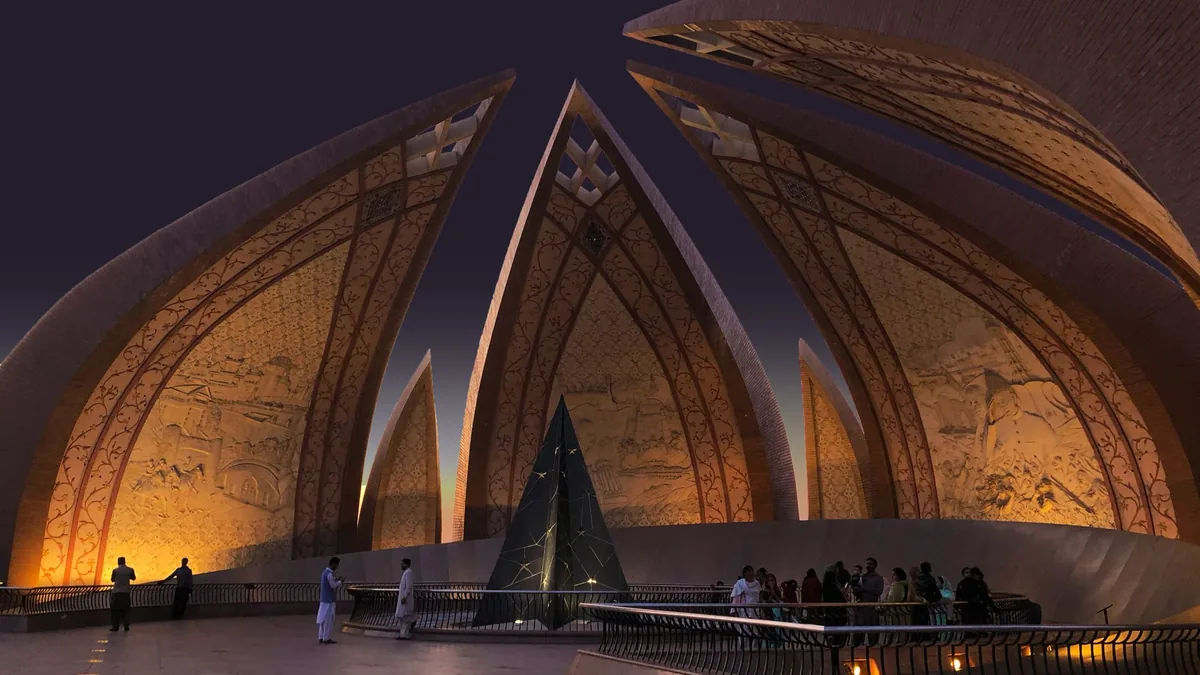
The best places to visit in Islamabad with kids sit in three clusters, and the trick is to visit them in the right order rather than all at once. Start the morning on the Shakarparian hills, where the Pakistan Monument, Lok Virsa's heritage museum and the Pakistan Museum of Natural History all share Garden Avenue. Go back to your hotel or family home for lunch and a proper rest while the sun is at its fiercest. In the late afternoon, pick one green space: Fatima Jinnah Park in F-9, or Lake View Park beside Rawal Lake. If anyone still has energy, finish at Daman-e-Koh in the Margalla Hills as the city lights come on.
That shape gives a child two short outings with a nap in between, and spares the adult a long walk across a hot car park with a tired four-year-old on one hip. With a car and driver, the vehicle waits while you are inside and the cool bag stays in the boot.
Places to visit in Islamabad with kids: why the order matters
Islamabad gets properly hot. Pakistan Meteorological Department data summarised on the climate of Islamabad page puts the mean daily maximum at about 36°C in May and 38°C in June, and records a reading of 48°C in May 2024. The monsoon runs from about June to September and brings heavy downpours and thunderstorms, with July the wettest month. Either way, the middle of the day is the part to spend indoors.
So the plan is built on three rules:
- Indoor, air-conditioned stops in the morning. Museums first, while children are fresh and curious.
- A real rest at midday. Not a café table, but a bed, a sofa or a hotel room.
- Open-air stops late in the day. Parks and the hilltop viewpoint when the heat has eased and the light is kind.
If you are visiting in the cool months, from roughly November to February, you can stretch the morning and shorten the rest. The order still helps, because it keeps the driving in short hops.
Before you set off: a quick check
A little admin the night before saves a lot of disappointment at a locked gate.
- Confirm opening hours by phone or WhatsApp. Published times for these venues differ between sources (more on that below). Lok Virsa lists its numbers and a WhatsApp line on its official site.
- Check the day of the week. Monday and Friday are the two days that most often change the plan.
- Look at the weather. A monsoon afternoon can wash out the park and viewpoint; have an indoor fallback.
- Read the latest travel advice. Islamabad is not in an area the UK government advises against visiting, but the FCDO Pakistan travel advice warns about protests and marches in the city and asks visitors to stay away from demonstrations. Its safety and security page also records a suicide bombing at an Islamabad mosque on 6 February 2026 and advises avoiding public transport, including the Metro Bus between Rawalpindi and Islamabad. A private car with a known driver fits that advice better than improvising.
Morning: Pakistan Monument and the Shakarparian museums
Pakistan Monument with children
The monument is the natural first stop. It stands on the Shakarparian hills and, as its Wikipedia entry notes, it is visible from across the Islamabad and Rawalpindi area, so children usually spot it from the car and ask what it is before you arrive.
It was inaugurated on 23 March 2007 and designed by architect Arif Masoud. The shape is built from petals: four large ones stand for the Punjabi, Baloch, Sindhi and Pashtun cultures, and three smaller ones represent minorities and territories including Azad Kashmir and Gilgit-Baltistan. That turns the visit into a simple game for older children: find the big petals, count the small ones, then find the crescent and star.
Beside it is the Pakistan Monument Museum, which includes a wax museum on the independence movement. Children who find a stone monument dull often perk up at life-sized figures.
A few practical points for a pakistan monument visit with children:
- The monument platform is open and exposed. Go early, before the stone warms up.
- Hold hands on the steps and edges; it is a place where people stop to take photographs and small children dart.
- Lok Virsa's site lists the Pakistan Monument Museum as open Tuesday to Sunday, 10am to 8pm, and closed on Mondays. If your only free day is a Monday, see the monument from outside and put the museum time into Lok Virsa instead.
Lok Virsa: timings and what holds a child's attention
Lok Virsa, the National Museum of Ethnology (its site also calls it the Heritage Museum), is on Garden Avenue in Shakarparian, a short drive from the monument. Paced well, it holds children's attention better than most museums, because so much of it is colour, costume and objects they can recognise. The displays cover embroidered costumes, jewellery, woodwork, metalwork, block printing, pottery and musical instruments, with statues and room settings that show how people lived in different regions. There is also a Sufis and Shrines Hall.
On Lok Virsa museum timings, the official site currently says the Heritage Museum is open all week, 10am to 8pm, and the craft bazaar and food court are also listed as open daily, 10am to 8pm. The Lok Virsa Museum article gives an older pattern, with a Monday closure and a Friday break from 1pm to 2pm. Treat the official site as the starting point and ring or message before you go, particularly on a Monday, a Friday or a public holiday.
How to make it work with children:
- Give them a mission. "Find three musical instruments" or "find some mirror work" works better than walking every gallery.
- Keep it to about an hour for under-sevens. Older children who like making things may enjoy the crafts much longer.
- Use the bazaar and food court as the reward, not the starting point, and leave while they are still enjoying it.
Pakistan Museum of Natural History: timings and highlights
If your child is more dinosaurs than embroidery, swap Lok Virsa for the Pakistan Museum of Natural History, also on Garden Avenue, Shakarparian. It is run by the Pakistan Science Foundation, and its Wikipedia entry describes galleries covering wildlife in natural settings, ecology, gemstones, fossils and palaeontology, and a Tethys gallery on the oceans and minerals that includes a whale skeleton.
The Pakistan Museum of Natural History timings are another case where sources disagree. The museum's own website lists 10am to 8pm, Monday to Sunday, with a Friday prayer break from 12:30pm to 2pm. Wikipedia says the museum is closed on Fridays and open 10am to 5pm on other days. The safe plan is to avoid Friday, or to call the number on the museum's site before setting off.
Doing both museums in one morning is possible for older children. For toddlers, pick one. A fidgety three-year-old in a second museum is not an education; it is an endurance test.
Midday: go back and rest
Around 12:30 or 1pm, head back to your hotel or family home. Have lunch there, put small children down for a nap, let everyone cool off, charge phones and refill water bottles. Plan on two to three hours in summer. In winter, an hour may be enough.
Why go back rather than stay out:
- Heat. Late May and June noon in Islamabad is no time for a playground.
- Friday prayers. On a Friday, many men will be at jumu'ah around midday, some venues pause, and traffic near mosques changes. Resting through that window avoids the disruption. If you or your driver wish to pray, this is the natural time.
Agree with the driver whether they wait near your hotel or come back at a set time. If your hourly booking has a set number of hours, ask how waiting time and the gap between the morning and afternoon outings are handled before you confirm; our guide to what an hourly chauffeur duty includes lists the questions to settle.
Afternoon: Fatima Jinnah Park or Lake View Park
Choose one park, not both. They are in different parts of the city, and each needs time to enjoy.
Fatima Jinnah Park (F-9)
The F-9 Park, officially Fatima Jinnah Park, is huge: around 750 acres, according to its Wikipedia entry, which describes it as just smaller than New York's Central Park. It is run by the Capital Development Authority (CDA) and has four main gates:
- Mehran Gate on the south side, off Jinnah Avenue
- Bolan Gate on the west, facing F-10
- Khyber Gate on the north, facing E-9
- Ravi Gate on the east, facing F-8
The same source lists jogging tracks linking the gates, parking, public toilets and a mosque at each entrance, and an entertainment hub inside. Because the park is so big, the gate matters. Tell your driver which gate you want and agree to be collected from the same one; "meet you at F-9 Park" is not a meeting point.
Lake View Park (Rawal Lake)
Lake View Park sits on the edge of Rawal Lake near Malpur village, also managed by the CDA. Its Wikipedia entry lists a walk-in bird aviary opened in 2013, alongside boating, horse riding, carousel rides, a road train and children's play areas. For most children the aviary alone justifies the trip.
Choosing between them
| Question | Fatima Jinnah Park (F-9) | Lake View Park |
|---|---|---|
| Best for | Space to run, a picnic, a gentle walk | Birds, boats, rides and a sense of occasion |
| Where it is | Central, between F-8 and F-10 | East, beside Rawal Lake |
| Fits well with | A short evening, or a quick hop to Daman-e-Koh | A longer afternoon with no viewpoint after |
| Watch out for | Choosing the right gate for pickup | Crowds on weekends and holidays |
| Facilities listed | Toilets, mosque and parking at the gates | Play areas and activities inside the park |
As a rough rule, if you plan to finish at Daman-e-Koh, F-9 is the better afternoon partner because it keeps you in the centre and closer to the foot of the Margallas. If the lake is the highlight of the day, give it the whole afternoon and skip the viewpoint.
Daman-e-Koh at sunset: road access and what to expect
Daman-e-Koh is a viewpoint and garden in the Margalla Hills north of the city, about 2,400 feet above sea level and roughly 500 feet above Islamabad, according to its Wikipedia entry. From the terrace you can see the Faisal Mosque, Seventh Avenue and, on a clear evening, Rawal Lake. The CDA has installed viewing telescopes on the terrace, which tend to hold a child's attention longer than the view itself.
On road access, the drive up is the hill road towards Pir Sohawa, which the same source describes as slender and winding. It also notes heavy congestion in peak season and no real public transport alternative, and the CDA has added electric vehicles and extra parking to cope. For a family, that has three consequences:
- Go before the sunset crowd. Arriving a little ahead of golden hour means an easier climb and a better spot at the railing.
- Plan for the drop-off. Agree with your driver where you will be set down and where they will wait, because stopping on a narrow hill road is not always possible.
- Children who get carsick may struggle on the bends. Sit them by a window, keep a bag handy and avoid a heavy snack just before.
Two more points about the hilltop:
- Monkeys. They are drawn to visitors' food. Keep snacks zipped in a bag, do not feed them and keep small children close.
- A spare layer. Evenings on the hill can turn breezy, so a light top in the day bag costs nothing.
For keen walkers, Trail 2 runs up to the viewpoint, but with small children the road is the sensible choice.
Snacks, toilets and prayer stops along the way
This is where a family day is won or lost, so it is worth planning precisely.
Snacks and water
- Carry more water than you think you need, especially from May to September.
- Pack snacks that do not melt: crackers, fruit, dates, cereal bars.
- Lok Virsa's food court is a handy mid-morning stop; its site lists it as open daily from 10am.
Toilets
- Museums are the most comfortable toilet stops in the morning. Use them before you leave, even if nobody asks.
- F-9 Park has public toilets at each gate, according to its Wikipedia entry.
- The midday rest at base is your reset: nappies, bathroom trips, a change of clothes.
- For a child who is toilet training, pack a travel potty or spare clothes in the car, and mention it when you plan the day so short unplanned stops are expected.
Prayer stops
- F-9 has a mosque at each entrance.
- The Pakistan Museum of Natural History lists a Friday prayer break from 12:30pm to 2pm, which is also why the midday rest suits Fridays so well.
- If you would like to pray at the Faisal Mosque, tell your driver in advance so the day's order can be adjusted.
Car seats and child comfort
Child car seats are the question parents from the UK, Gulf and North America ask most, and the honest answer is that you should not assume one will be in the car.
- Ask when you plan the journey. Say how many children, their ages and weights, and what seat each needs.
- Bring your own if you can. Many families fly with a travel car seat or a booster; check the airline's rules before you pack it.
- Check the fittings. Confirm the car has seat belts that work in the rear seats and, if your seat needs it, ISOFIX points. Ask, and check again when the car arrives.
- Choose the right vehicle. A family with a pushchair, a car seat and a day bag needs more boot space than a couple. Our page on family vehicles (planned link) explains what to ask for.
A sample family day out in Islamabad by car
Here is one way the day could run in summer. It is an example only; your times will depend on the season, the day of the week, your base and what the venues confirm when you call.
| Time (example) | Stop | Notes |
|---|---|---|
| 9:30am | Pickup from hotel or home | Car seats fitted, water and snacks loaded |
| 10:00am | Pakistan Monument | Outside first, before the stone heats up |
| 10:45am | Pakistan Monument Museum or Lok Virsa | About an hour; skip the monument museum on a Monday |
| 12:00pm | Lok Virsa food court, or straight on | Toilet stop before leaving |
| 12:30pm | Back to base | Lunch, nap, cool down |
| 4:00pm | Fatima Jinnah Park (F-9) | Agree the gate for pickup |
| 5:45pm | Drive up to Daman-e-Koh | Arrive ahead of sunset |
| 7:30pm | Back to base | Tired, happy, done |
In winter, you might start later, take a shorter break and move everything an hour or so earlier because the sun sets sooner.
Arriving in Islamabad and fitting the day in
If you are flying in, do not put this day on the afternoon you land. Give children a night to adjust, then do the museums the next morning.
Our Islamabad Airport journey guide (planned link) explains how arrivals and meeting points work, and if the city is only one leg of a longer family trip, planning an onward road journey after landing in Islamabad covers how to fit a sightseeing day between the airport and the next drive.
For a straightforward local ride on another day, such as a hotel transfer or a hop across to Rawalpindi, our sister service iDrive, the network behind Pakistan Taxi, has a page on getting around Islamabad and Rawalpindi by car.
Planning the day with a car and driver
A day like this suits a car and driver better than a string of separate rides, because the same vehicle, seats and bags stay with you from morning to evening and the midday return is built in.
When you send your enquiry, include:
- Your base address and a pin, plus a landmark the driver will recognise.
- The date, so the Monday and Friday points can be checked.
- The outline: morning museums, midday return, afternoon park, optional Daman-e-Koh.
- Who is travelling: adults, children and their ages, and anyone with limited mobility.
- Seats and luggage: car seats you are bringing or asking about, a pushchair, a cool bag.
- Timing preferences: your ideal start, rest window and finish.
- A contact number for the adult who will be in the car.
You can start that through plan your journey (planned link). The team will review the request and come back to you about vehicle options, timings and costs; nothing is fixed until you have confirmed the details with them.
Questions parents usually ask
What if a venue is closed when we arrive?
Swap it. The three Shakarparian museums are close together, so a closed door at one usually means a short hop to another.
Can we do Daman-e-Koh in the morning instead?
You can, and on a cool day it can be pleasant. In summer, though, the heat and the midday light make the evening better for views and comfort.
Is Islamabad safe for a family day out?
The UK government's advice does not place Islamabad in an area where it advises against travel, but it does warn about demonstrations, terrorism (including the February 2026 mosque bombing in the city) and risks on public transport. Check the latest advice before your trip, avoid gatherings and keep your day plan with someone at home.