
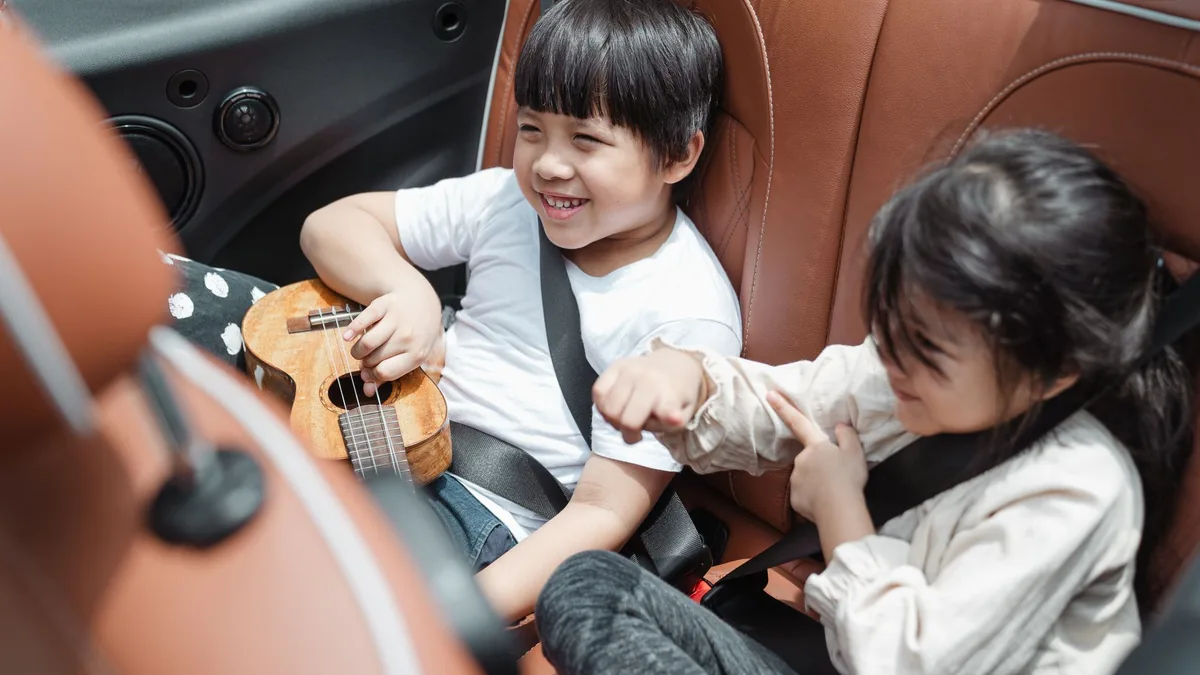
When a large family moves across town in four or five cars, the children rarely end up next to their own parents. A niece rides with an aunt, two cousins squeeze in with the grandparents, and a toddler gets handed through a window to whoever has a spare lap. That is normal, and it can be perfectly safe, but children travelling without parents in a car need three things settled before the first engine starts: a named adult responsible for each child for the whole day, a headcount before every departure, and a way for any child to reach a parent if the group splits. Add a proper seat and belt for every child, and a plan for the moment everyone spills out of a wedding hall at midnight, and most of the risk goes away.
This guide is about supervision, not car-seat fitting, for families arranging a mehndi, baraat, walima or a day of visiting relatives in Pakistan, often with half the family flying in from the UK or the Gulf.
Why children travelling without parents in a car need a plan, not just goodwill
In a family convoy, everyone assumes someone else has the children. The mother thinks the child is with her sister. The sister thinks the child went back to the grandparents' car. The drivers, who were given a list of addresses rather than a list of people, have no idea who should be on board. Nobody is careless; the gap comes from too many kind adults and no single owner.
Three moments cause most of the trouble:
- Departure from a house, when people drift out in small groups and cars leave as soon as they are full.
- Arrival at a venue, when children run ahead through the gate before adults have locked up and caught up.
- Leaving the venue, when everyone is tired, the car park is dark and crowded, and the order of cars is different from the morning.
The UK government's travel advice for Pakistan says local driving standards are erratic, especially at night, and asks visitors to be cautious when moving around urban areas after dark, particularly on foot. You can read the full position on the FCDO Pakistan safety and security page. A late wedding finish, with children walking through a dark car park to cars on a busy road, ticks both boxes, which is why the plan matters most at the end of the night.
Step one: decide which adult rides with which child
Before the day starts, sit down with the family organiser and write out which adult rides with which child. Not "the kids go with the Lahore cousins", but a name against a name.
Rules that make the pairing work
- One responsible adult per child, for the whole day. The pairing does not change between legs unless it is changed out loud and both adults agree.
- The adult must be in the same car as the child. Being "right behind in the next car" does not count.
- No more than three young children per adult. Under-fives count double; a toddler and a baby are a full load for one person.
- Parents first where possible. If a parent can ride with their own children, do that. Children travelling without parents are the exception you are managing, not the default.
- Teenagers are passengers, not supervisors. A sensible sixteen-year-old can help, but an adult still owns the headcount for that car.
- The driver is never the responsible adult. Your driver's job is the road. Supervision belongs to a family member.
A simple pairing sheet
Write it on one page, photograph it and send it to the family WhatsApp group. Here is an example layout for a hypothetical four-car family day:
| Car | Driver | Responsible adult | Children in this car | Parent's mobile |
|---|---|---|---|---|
| Car 1 | Operator driver | Aunt Samina | Ayaan (7), Hira (4) | Mother's number |
| Car 2 | Operator driver | Grandfather | Zara (10) | Father's number |
| Car 3 | Uncle (family car) | Mother | Baby Musa (1), Inaya (5) | Father's number |
| Car 4 | Operator driver | Cousin Bilal | None (adults only) | — |
The names are examples. The point is that every child appears once, next to one adult, and the parent's number is on the same line.
If you are also sharing the sheet with the transport operator, fold it into the wider list of passengers and pickup points. Our guide to building a pickup manifest for an event with several vehicles shows how to lay that out so drivers see names, not just addresses.
Step two: a headcount before every departure
A headcount before every departure sounds fussy until the first time it catches someone. Make it a habit that nobody argues with, the way nobody argues about checking for passports at the airport.
How to run it
- The responsible adult in each car counts their own children, in the car, doors shut, belts on. Not in the doorway, not "they're just coming".
- They send one message to the family group: "Car 2: Zara in, 3 adults, ready." Keep it that short so it actually happens.
- The family organiser waits for every car to report before anyone moves. The first car does not leave because it is full and the air conditioning is on.
- Repeat on arrival. Before anyone walks into the venue, each adult confirms their children are out of the car and with them. Children should not be sent ahead with "go and find Nani".
- Repeat at every stop in between, including fuel stops and the quick detour to pick up sweets. Children get out to stretch their legs, and short stops are when a child climbs into the wrong car.
Step three: a parent phone number in the child's pocket
Mobile phones die, get handed to cousins for games, or stay in a handbag in another car. The low-tech fix is a card with a parent's number in each child's pocket.
What goes on the card
- The child's first name.
- Two mobile numbers, ideally a parent and one adult who is staying in Pakistan with a local SIM. Overseas numbers are fine as a second line, but a local number is easier for a guard or shopkeeper to dial.
- The venue name and area, written the way a local would say it.
- The car number from your sheet.
Leave off the home address and the child's surname if you prefer; the aim is to get the child back to a parent, not to hand out personal details. Put the card in a zipped pocket or pin it inside a jacket, and tell older children what it is for: "If you can't find us, show this to a lady with children, a security guard or a police officer."
Teach the one rule
Young children remember one instruction better than five. Most families use a version of this: if you are lost, stop where you are and wait, and show your card to a safe adult. A child who keeps walking to find you moves away from the place you will search first.
For families flying in, write the cards before you leave home, when you have printer and patience, and include the local number of the relative you will be staying with.
Seat belts and child seats in every car, not just the parents' car
The car with the parents usually gets the good seats: the family's own vehicle with its child seat, the booster, the spare blanket. The cars carrying children without their parents are the ones where a four-year-old ends up on an aunt's lap in the back of a sedan. That is the wrong way round.
The World Health Organization's road traffic injuries fact sheet states that road traffic injuries are the leading cause of death for children and young adults aged 5 to 29, that wearing a seat belt can reduce the risk of death among vehicle occupants by up to 50%, and that child restraints can lead to a 71% reduction in deaths among infants. Those numbers do not change because the trip is only fifteen minutes to the marquee.
A practical rule for every car
- One belt per person. If a car has four belts in the back, it carries four people in the back. Count belts before you count seats.
- No child on a lap, even for a short hop. An adult's arms cannot hold a child in a sudden stop.
- Child seats and boosters travel with the child, not with the parent. If the toddler is in car 3, the toddler's seat goes in car 3.
- Children in the back. Keep young children out of the front passenger seat.
- Ask for child seats early. If you are hiring vehicles, tell the operator the number of children and their ages when you first ask for a quote. Availability varies, so treat a child seat as a request to confirm, not an assumption. If you are bringing your own seat from the UK or the Gulf, check the belt routing in the hired car before the day.
Our sister company Saudi Cab Co has written a useful checklist on what to check about a child car seat in a taxi. The advice about asking early and checking the fit carries across well, even though that page is about Saudi Arabia.
If the belt count does not work with the cars you have, the answer may be a bigger vehicle rather than more cars. Our comparison of a group van or several cars walks through that choice, including the supervision advantage of keeping more of the family in one vehicle.
Children at a crowded venue exit
Children at a crowded venue exit are where a family plan is tested hardest, and it is usually on the return leg. Arrival is staggered and daylight is often on your side. The exit happens all at once: hundreds of guests, cars double-parked on the road outside, drivers calling passengers, children overexcited and past bedtime.
Before the event ends
- Agree a gathering point inside the venue, away from the gate. A named table, a pillar by the stage, the ladies' seating area. Not "outside".
- Tell the drivers where to wait and in what order. If you have several cars, the lead car should be the one carrying the youngest children, so they leave first and spend the least time in the crowd.
- Set a leaving time and message it thirty minutes ahead. Families who "leave when it finishes" leave in fragments.
- Check the pairing sheet again. People swap during a long evening. If a child is now going home with a different adult, say so in the group.
At the exit itself
- Children stay inside with their responsible adult until their car is at the kerb. Nobody waits on the roadside with children in the dark while the driver finds a gap.
- One adult goes out to find each car, confirms it by number and driver name, and then brings the children out.
- Hold hands through the car park. Small children should be holding an adult's hand, not a teenager's sleeve.
- Headcount in the car, doors shut, before moving, then the message to the group.
- The last adult out checks the gathering point for anyone left behind, including the child asleep on two chairs under a shawl.
Late finishes make all of this harder, because drivers may have been waiting for hours and everyone wants to go at once. If the reception is likely to run long, plan the return separately; our guide to wedding transport when the reception finishes late covers overtime and staggered return cars.
What to do if a child is missing
In a family group, a "missing" child is often asleep in another car or playing behind the stage. Act quickly anyway. The early minutes are when a child is closest to where they were last seen.
The first ten minutes
- Stop every car. Use the agreed wait signal in the family group. Nobody drives off, because the child may be in or near one of the cars.
- Check every car first, including the boot area of vans and the footwells. Ask each responsible adult to recount their own children, out loud.
- Send one adult back to the last place the child was seen, and one to the gathering point. Leave someone standing still at each spot, because a child who follows the "stop and wait" rule will be there.
- Tell venue security and the management, with a clear description: name, age, height, clothing colour, and a recent photo from someone's phone. Ask them to watch the gates.
- Call the parents' phones and the second number on the child's card, in case someone has already found the child and is calling you.
When to call the police and emergency services
If the child is not found quickly, call the police. Do not wait until you have "searched everywhere". In Punjab, the police emergency number is 15, and the Punjab Police website has dedicated missing persons and missing children sections. 1122 is the Rescue 1122 emergency number; the Punjab service's official site also lists 1192 as its lost helpline. Other provinces run their own police and rescue services, so save the local numbers for the city you are in before the day.
Speed matters to the authorities too. When the National Assembly approved the Zainab Alert bill in January 2020, Dawn reported that officials who fail to respond to an alert within two hours may face action, and that the bill's measures were limited to the Islamabad Capital Territory. Whatever the coverage where you are, the lesson for families is the same: report early, with a photo and a description, rather than after an hour of searching on your own.
Keep a recent photo of every child on at least two adult phones before the day starts. Taking one in the morning, in the clothes they are wearing, is the single most useful thing you can hand to security or police.
Extra points for families flying in from abroad
Overseas families bring a particular set of gaps. Children may still be running on UK or Gulf time after a long travel day from Manchester, Birmingham, Dubai or Riyadh. They may not speak much Urdu or Punjabi, which makes "ask a safe adult" harder. And they may be meeting relatives for the first time, so "go with Chachu" means little when there are four uncles.
- Introduce the responsible adult properly, face to face, before the day, not in the car park.
- Write the card in English and Urdu if you can, so a local guard can read it.
- Get a local SIM or eSIM for at least one parent before the event, so the number on the card works without international dialling.
- Plan a light first day. A jet-lagged child at a crowded mehndi is more likely to wander, and more likely to fall asleep somewhere nobody expects.
Telling your transport operator about the children
Whoever provides the vehicles can only help with what they know. When you plan the day, tell them:
- How many children, and their ages, including babies. This decides belt counts and child-seat requests.
- Which cars carry children without parents, so drivers know to wait for the responsible adult's go-ahead before moving.
- The gathering point and exit order at each venue, so the car with the youngest children comes to the kerb first.
- Who is allowed to change the plan. One organiser, one number. Drivers should not take instructions from whoever is standing nearest the car.
- The latest you expect to leave, so there is time built in for a slow, careful exit rather than a rush.
If you are arranging several vehicles for a family event, our group travel planning page explains what we need from you to put the day together, and you can start planning your family journey (planned link) with the pairing sheet and passenger list already in hand. Journey requests are planning enquiries: vehicle types, child seats and timings are confirmed with you before anything is arranged, not guaranteed at the point you send the details.
For very large movements, such as a full baraat with dozens of vehicles, you may want the booking handled centrally. iDrive, the network behind Pakistan Taxi, takes enquiries for wedding and event car and driver bookings, which suits the day when the vehicle list gets long.
Questions families ask
Is it safe for my children to ride in a different car from me?
It can be, if a named adult you trust is in the same car, every child has a proper belt or child seat, and the whole group runs a headcount at each departure and arrival. The risk is not the separate car; it is the lack of a clear owner for each child.
Should the child's card include our home address?
It does not need to. Two phone numbers, the child's first name, the venue and the car number are enough to reunite them. Leaving the address off keeps personal details private if the card is lost.
Can the driver keep an eye on the children?
No. The driver's job is the road, and at a venue exit they are usually looking for a gap in traffic. Put a named family adult in every car that carries children, and tell the driver who that adult is.
What if we have more children than adults?
Reduce the number of cars rather than stretching adults thin. One larger vehicle with two adults and six children is easier to supervise than three cars with one adult each and a child in the front seat.