
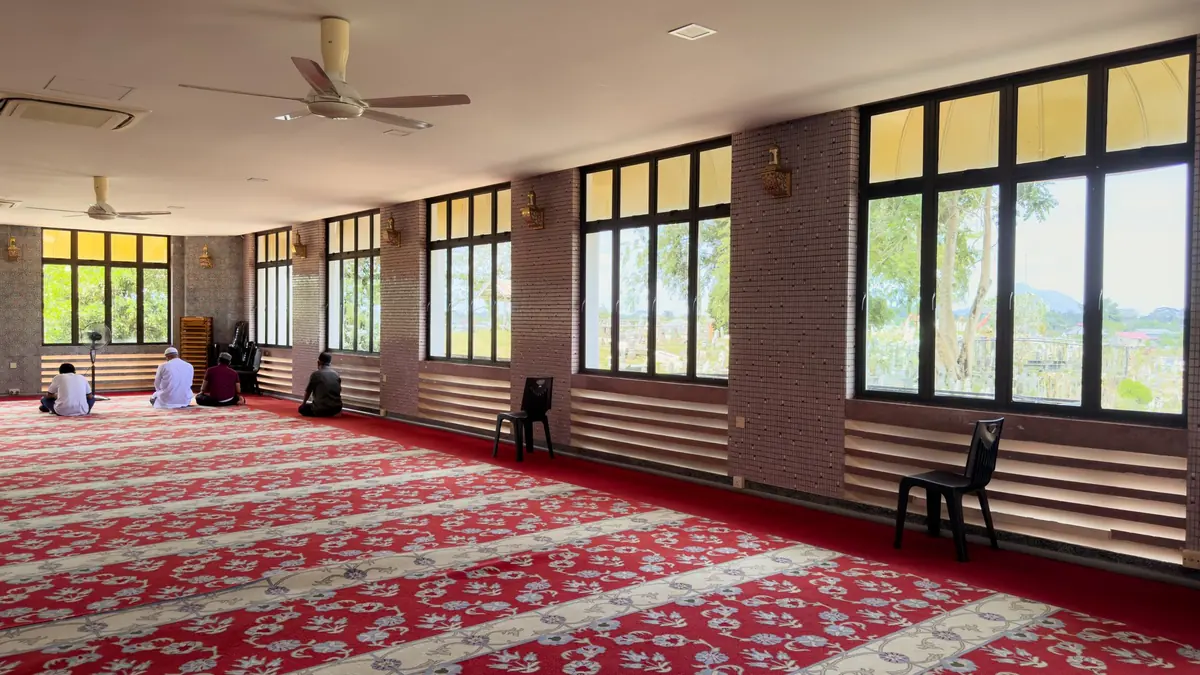
Looking for the Lahore airport mosque because a parent wants to pray the moment they land? The Pakistan Airports Authority does not name a single mosque at Allama Iqbal International Airport. What it publishes is Muslim prayer rooms and ablution areas for women and men "throughout the airport". Add the airline wheelchair service, a separate immigration queue for older and special passengers, and designated washrooms, and a tired or less mobile traveller can pray, freshen up and move at their own pace before reaching you in the concourse. The catch is time. Each of those steps is sensible, and each adds minutes you cannot see from outside. So the useful question is not only "where is the prayer room" but "how much longer will my mother be, and has the driver agreed to wait?" This guide answers both.
The short answer for the person waiting outside
You will be waiting in the Arrival Concourse Hall or the car park, and your passenger will be somewhere inside a sequence you cannot watch. The official arrival process at Lahore runs like this for international flights: the arrival lounge (by boarding bridge or bus), immigration, the baggage belt, customs, and then out to the Arrival Concourse Hall, the car park or the cab service. The same page notes a special desk for overseas Pakistani passengers, staffed around the clock, if your relative gets stuck on paperwork.
For a passenger who needs longer, three things stretch that sequence:
- Prayer and ablution. Wudu, prayer and a moment to sit afterwards is not a two-minute stop for an older person in travel clothes.
- Assistance. A wheelchair has to be requested, allocated and pushed, and assisted passengers move when the helper is free, not when the aircraft door opens.
- Washroom and rest. After a long overnight flight, most older travellers will want a washroom before they face the car journey.
None of this is a problem if the people outside expect it. It becomes one when the driver was told "be ready twenty minutes after landing" and a relative is still at the belt an hour later.
Lahore airport mosque and prayer rooms: what is published, what to ask
The airport's own services page is short and clear: prayer rooms and ablution areas are provided for both men and women, spread through the airport. It does not publish a floor plan showing which rooms sit before immigration and which sit after customs, and facilities in any terminal get moved during building work. PAA said in December 2025 that the Lahore terminal expansion was due to be completed by September 2026, so treat any older description you have read, including relatives' memories of "the room by the belt", with some caution.
What works better than a map is a question, asked on the spot:
- Airline ground staff meeting the flight, or the person pushing the wheelchair, should be able to point to the nearest prayer room on the route.
- PAA says its facilitation counter and its "For your Help" team are there to assist passengers, as set out on the emergency and medical page.
- If your passenger does not speak Urdu or Punjabi comfortably, write "prayer room" and "wudu khana" (ablution area) on a card or in their phone notes.
Pray inside, or pray at home?
This is the decision families rarely talk through in advance, and it matters more than the location of the room.
Praying inside the airport suits a passenger who lands close to or inside a prayer time and would otherwise miss it on a long drive, or who simply will not relax until it is done. The cost is time and energy spent before the queues, not after.
Praying at home or at a stop on the way suits a passenger who is exhausted, on a wheelchair with a helper who is waiting for them, or landing early enough that the next prayer time is comfortably after they reach the house.
Neither is wrong. Agree it on the phone before departure, so the person outside knows whether to add prayer time to the wait.
Wheelchair assistance at Lahore airport: request it early, then plan for the wait
Wheelchair help at arrival is arranged through the airline, not by the family at the kerb. PAA's own page on services for passengers with reduced mobility says passengers with these needs should notify their airline ahead of travel, and that airlines have special counters for wheelchair service in the arrival and departure halls. The same page lists fast-track for arrival and departure formalities, elevators and ramps for wheelchair users, designated washrooms and specified parking for special persons.
When and how to ask
The UK Civil Aviation Authority's advice for flights from British airports is to request assistance when you book, or at least 48 hours before departure, through the airline, travel agent or tour operator. IATA's industry guidance uses the same 48-hour benchmark in its best practice on assistance codes. Asking at the check-in desk on the day is possible, but it relies on a chair and a helper being free when your flight lands in Lahore.
When you ask, pick the level that matches the passenger honestly. The IATA codes are:
| Code | What it means | Typical passenger |
|---|---|---|
| WCHR | Can manage steps and walk to their seat, but needs a wheelchair for the long distances to and from the aircraft | A parent who walks slowly and tires on long corridors |
| WCHS | Cannot manage steps, but can walk to and from the seat; needs a wheelchair and help on steps | Someone with bad knees who lands at a remote stand and faces bus steps |
| WCHC | Completely immobile; needs a wheelchair and to be carried to and from the cabin seat | A passenger who cannot bear weight at all |
Getting the code right matters in Lahore because the official arrival page says passengers may come off by boarding bridge or by bus. WCHR assumes the passenger can manage aircraft steps. If your parent cannot, and the flight parks at a remote stand, a WCHR booking leaves them facing a staircase; WCHS is the honest request.
What the wait looks like from outside
Once the aircraft is on the ground, an assisted passenger's clock depends on the helper. Ask the airline, when you book the service, whether assisted passengers are brought off before or after everyone else on that route. The answer changes your plan by a long way, and it varies between carriers.
Inside, there is help with the queues. The Lahore arrival page lists separate immigration counters by category, including one for "old citizens / special person" and one for women travelling alone or with children. A wheelchair helper will usually know which to use. After immigration comes the belt; baggage trolleys are free, and paid porters are available through the Passenger Facilitation Services counter on a printed slip, as described on the airport's porter services page, which specifically names senior citizens and women with children among the passengers it suits.
For practical help setting up the booking from abroad, our guide to arranging a parents' airport pickup while you are overseas covers the phone calls, the names and the numbers to share.
Lahore airport washroom stops and rest points after landing
PAA lists designated washrooms for passengers with reduced mobility, and prayer rooms have their own ablution areas. What families underestimate is not whether a Lahore airport washroom exists, but when the passenger should use it.
The simplest rule: use the washroom inside, before customs, while the helper or porter is still with them. Once your relative has walked out into the concourse with a trolley, the person meeting them has to mind the bags, find the facility, wait outside it and then walk everyone back to the car. That is four jobs for one pair of hands, in a crowd.
A few other things help an older passenger through the final stretch:
- Sit while the belt runs. Bags on long-haul flights can take a while. A wheelchair passenger already has a seat; a walking passenger should ask the porter to watch the belt while they sit.
- Medicines in the cabin bag. Anything needed in the first few hours at home, and anything that must be taken at a set time, should not be in checked baggage.
- Feeling unwell is not a queue problem. PAA says it has medical response teams on hand 24/7 and a Medical Inspection room; a dizzy parent should ask for it rather than push on to the car.
Building the extra time into the pickup
The aim is simple: the driver should know, before they set out, that this passenger will be slow and that waiting is expected.
| What adds time | Who controls it | What to tell the driver or operator |
|---|---|---|
| Prayer and ablution inside the terminal | Your passenger | "She may pray before coming out; please don't treat it as a no-show" |
| Wheelchair allocation and pushing | The airline and its ground handler | "Wheelchair booked; assisted passengers can be among the later ones out" |
| Immigration and belt | The airport, and the size of other flights landing | "Check the flight has landed, then allow for the queues" |
| Washroom and rest | Your passenger | "Allow for a washroom stop and a slow walk to the car" |
| Luggage with a porter | The porter queue | "Several bags; a porter will bring them to the car" |
We are not putting minutes on each row, because nobody can honestly promise them. A quiet arrival and one that lands alongside several other wide-bodied flights feel like two different airports.
Agreeing the extra waiting before the day
- Put it in writing when you plan the journey. In the notes on our journey planning form (planned link), say who the passenger is, that a wheelchair is booked (or not), that they may pray inside, and how much longer you think they might need. Plain words are fine.
- Ask the operator to confirm the waiting arrangement. Pakistan Taxi is a planning and enquiry service, so treat nothing as settled until the operator who takes the job has confirmed the vehicle, the waiting time and any charge for it. Do not assume that waiting is free or unlimited.
- Share the flight number, not just the time. The driver can then follow the flight on the airport's live flight schedule and start the clock from actual landing.
- Name one contact inside and one outside. Your parent's number and the number of whoever is standing in the concourse. Give the driver both.
- Agree the meeting point. The concourse hall is the usual place. If the passenger is on a wheelchair, agree whether the helper will bring them to the car, or whether someone will collect them from the exit.
- Say what happens if it runs long. A simple line such as "if they are not out after the agreed wait, please call me before leaving" prevents a driver giving up on a passenger who is still at the belt.
Our Lahore airport journey guide (planned link) sets out the general pickup pattern.
If you are waiting in your own car
The airport publishes a parking tariff for meeters and greeters: at the time of writing, Rs 100 for a car for the first three hours and Rs 30 for each hour after that, with a drop lane also available. Tariffs change, so check the page before relying on those figures. On entry, the Airport Security Force carries out under-vehicle searches, and you may be asked for a CNIC, ticket or passport, as described on the entrance procedures page. That page also asks people in the queue to give way to senior citizens and special persons.
In the car: a seat, water and a slow start
A slow passenger at the end of a long journey needs two things from the vehicle before anything else, and neither is luxury.
A seat they can get into. High SUVs can be hard for someone with stiff hips; a very low saloon is hard for someone with bad knees. A passenger on a wheelchair who cannot transfer to a car seat needs a vehicle built for the chair itself. Our sister brand iDrive, the network behind Pakistan Taxi, lists an accessible vehicle option you can ask about; availability depends on the city and the day, so ask early.
Water and something small to eat. A bottle within reach, not in the boot. Dates, biscuits, whatever the passenger is used to. It matters most for anyone managing diabetes, or who has not eaten since the last meal service on the plane.
A short checklist for whoever travels in the car:
- Water bottle and tissues in the door pocket or seat pocket
- A small cushion or folded shawl for the lower back
- Air conditioning set before the passenger gets in, not after
- The passenger's phone and charger
- The address and landmark written clearly for the driver (our guide on getting the family home address right covers this)
- A plan for the first stop, if there is to be one
If the same relative is going on to another city after a rest day, our guide to planning intercity travel with older relatives deals with longer drives, stops and seating.
Breakfast near Lahore airport and food on the way home
When a flight lands in the early hours, the first question in the car is often breakfast.
The airport's other facilities page lists free Wi-Fi in the lounges, baggage wrapping, and lounges in the international and domestic departure areas: PIA lounges, CIP lounges and a JS Bank loyalty lounge. Those are departure-side facilities, not somewhere an arriving passenger can sit down after customs. The official pages do not publish a directory of Lahore airport restaurants in the arrivals area, so do not build a plan around a meal before you reach the car. What is open at any hour can change, especially while building work continues.
Choosing a stop for a tired passenger
The better approach is to decide, before the day, whether you will stop at all. If home is not far from the airport, the kindest breakfast is usually at home, with a proper chair and a washroom they know. If home is on the far side of the city or in another town, a stop can make sense, and the criteria for it are different from the ones you would use yourself:
- Parking close to the door. A walk across a busy car park undoes the benefit.
- A clean washroom on the ground floor. Stairs to a washroom rule a place out.
- Seats with backs. Stools, benches and low floor seating are hard for stiff joints.
- Quick service. Order something that is already made; this is not the moment for a long wait.
- A driver who knows the plan. Tell the operator when you plan the journey that you want a food stop, so the driver is not surprised and the waiting time can be agreed.
A worked example, purely for illustration: a mother lands on an overnight flight from Manchester with a WCHR wheelchair booked. The family agrees she will pray at home, not inside. The note on the enquiry says "wheelchair passenger, may be among the last out, please wait and call before leaving". Her son stands in the concourse with a bottle of water. They skip a restaurant and eat at home, twenty minutes after she sits down in the car. Nobody hurries her at any point, and nobody at the kerb loses patience, because everyone knew what to expect.
Before anyone flies: three checks worth making
Travel advice. The UK Foreign, Commonwealth and Development Office travel advice for Pakistan does not place Lahore in its "against all" or "against all but essential travel" areas. Within Punjab it advises against all but essential travel to Dera Ghazi Khan. It also notes that regional tensions in May 2025 led to airspace closures and flight suspensions, and tells travellers to check with their airline before travelling. Read the current version before booking; it changes.
Polio certificate for longer stays. The Lahore arrival page says travellers arriving in Pakistan and staying more than four weeks need a polio vaccination and a certificate to show when they depart. For a parent staying the whole winter, sort this out early in the visit rather than in the week of the return flight.
Umrah or Gulf connections. If your parent is flying on to Saudi Arabia for Umrah after time at home, the same planning applies at the other end. Our sister company Saudi Cab Co has a guide to travelling with older passengers in Saudi Arabia, covering vehicle choice and stops.
A message to send the family group before the flight
Copy this, fill in the gaps, and send it to everyone involved:
- Flight number and scheduled landing time: ______
- Wheelchair booked with the airline? Yes / No. Level: WCHR / WCHS / WCHC
- Will they pray inside the airport? Yes / No / Depends on the time
- Who is meeting them, and their phone number: ______
- Meeting point: Arrival Concourse Hall / car park / other: ______
- Extra waiting confirmed with the driver or operator? Yes / Not yet
- Water and snacks in the car: who is bringing them?
- Food stop on the way, or breakfast at home?
- Medicines needed in the first few hours: in the cabin bag?
- If they are not out by ______, who calls whom?
When the answers are clear, plan the journey with Pakistan Taxi (planned link) and put the details in the notes. The more the driver knows about the passenger, the less anyone needs to hurry.