
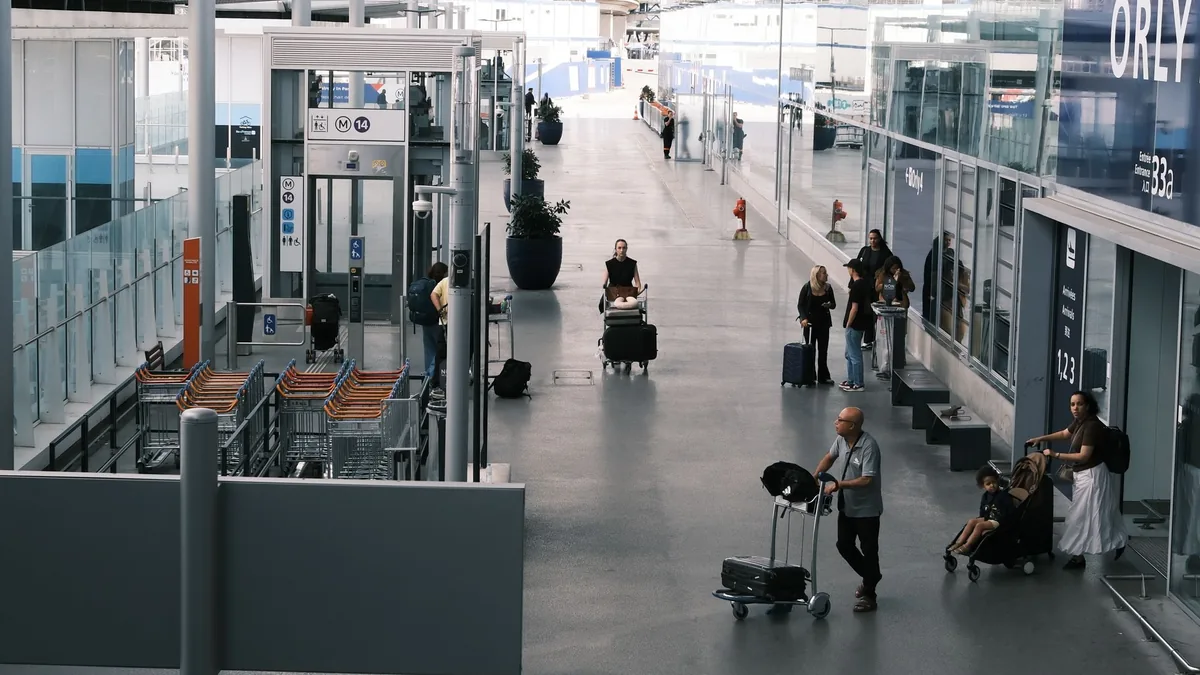
Receiving someone from airport in Pakistan used to mean one thing: a carload of cousins at the arrivals barrier with a garland. Plenty of families still do it that way. But when the person organising the trip lives in Manchester or Dubai, and the relative waiting at home is an aunt who does not drive, the job splits into two halves. A driver collects the passenger at the terminal. Someone at the house receives them at the gate. The part that usually goes wrong is the join between the two.
The short answer is this. Before the flight, swap numbers so the passenger, the host and the organiser can all reach each other. Give the driver the address plus a description of the actual gate. Agree three short updates: when the passenger has landed and is out, when the car leaves the airport, and when it is ten or fifteen minutes away. Decide who will stand at the gate, especially for a late-night arrival. Then treat the trip as finished only when the host confirms, to the organiser, that the passenger and every bag are inside.
This guide is about that home end: the receiving household, the handover at the door, and the message that closes the loop. If you need the airport side first, our guide to arranging an airport pickup for parents while you are abroad covers the terminal half.
Receiving someone from the airport in Pakistan: three people, one journey
Most failed handovers are not dramatic. The driver arrives at the right street, the host is at the wrong gate, the passenger's phone has no signal, and the organiser in London is refreshing a flight tracker at three in the morning with nobody answering. Each person assumed another one had it covered.
Give every role a name before the flight:
- The organiser is the person who arranged the journey, often abroad. They hold the plan, the numbers and the final confirmation.
- The passenger is the traveller arriving. They may be elderly, a first-time visitor, a student, or a relative with three suitcases and a wheelchair request.
- The host is the person receiving the passenger at the destination: an aunt, a grandmother, a family friend, a caretaker at a house that has been locked since last winter.
- The driver collects the passenger and brings them to the host's gate.
One person can hold two roles. The passenger is sometimes also the organiser. The host is sometimes also the person who made the travel request. What matters is that nobody holds a role by accident. For how the collection itself runs at the terminal, iDrive, the network behind Pakistan Taxi, explains how the arrivals pickup works at Islamabad and Sialkot.
The passenger and host number swap, done before anyone packs
The passenger and host number swap sounds obvious, and it is exactly the step families skip, because everyone is related and "of course they have each other's numbers". Often they have an old number, or a landline, or a WhatsApp contact saved under a nickname nobody else would recognise.
Do it properly, a day or two before departure:
- Organiser collects three numbers: the passenger's, the host's, and a backup at the house (a son, a neighbour, the chowkidar if there is one).
- Everyone saves everyone. The passenger saves the host and the backup. The host saves the passenger and the organiser. Use names a stranger could understand, such as "Shabnam Khala - Gulberg house", not "Khala 2".
- Test one message each way. A short WhatsApp that gets a reply is worth more than a number written on a boarding pass.
- Agree which app. Many overseas passengers will land with only their foreign SIM and rely on WhatsApp over Wi-Fi or roaming. Decide now whether updates will be WhatsApp messages, normal calls, or both.
- Share the driver's details once confirmed. When the operator gives a driver name and number, the organiser forwards it to both the passenger and the host.
A note on local SIMs. Foreign visitors sometimes plan to buy a Pakistani SIM on arrival and sort everything out then. The US State Department's Pakistan country information says tourists cannot buy a Pakistan SIM at Islamabad airport and need to visit an official mobile provider store, and it warns that international data roaming in Pakistan is generally very expensive. So assume the passenger may have no local number for the first evening, and build the plan around the numbers they already have.
What the host should know about the passenger
The host is going to open the gate to this person, possibly after midnight. They should know:
- The passenger's full name as written on the booking, and a recent photo if they have not met for years.
- The flight number and the airport, so they can check the status themselves.
- How many bags and whether anything bulky is coming: a wheelchair, a pram, boxes of gifts.
- Any health or mobility needs, so a ground-floor room or a hand up the stairs is ready.
An address and a gate description the driver can actually use
A Pakistani address that works for the post office does not always work for a driver at night. "House 14, Street 7, Sector F-10/2" is a good start in Islamabad. "Near the mosque, behind the school, Model Town" is a start of a conversation. The driver needs two layers: where the house is, and which gate on that street is yours.
Send the driver, through the organiser or the booking team:
- The written address in full, including block, phase, sector or mohalla, and the city. Housing societies often have repeated street numbers in different phases.
- A dropped map pin from the gate itself, not from the middle of the plot or a nearby market. The host can do this from their phone while standing outside.
- A landmark on the way in: a named petrol pump, a school, a mosque, a society entry barrier.
- The gate description: colour, material, whether there is a name plate, a light above it, a car porch, a guard hut. "Black iron gate, white wall, name plate says Malik, light on" is what a driver wants at 2am.
- Access instructions: which society gate to use, whether the guard needs a name or a phone call, and whether the car can go right up to the house or must stop at a barrier.
Our Lahore guide on getting the address right from Lahore Airport to a family home goes further on Lahore housing schemes. The principle holds in Rawalpindi, Karachi, Sialkot or a village off the Grand Trunk Road: the last two hundred metres are where time disappears.
Gated societies and the guard at the barrier
Many families now live in gated housing societies with an entry barrier and a security guard who logs visitors. That guard is part of your handover. Tell the host to let the guard know a car is expected with a named passenger, roughly when, and which house it is going to. If the society issues visitor passes or needs a resident's call, arrange that before the flight lands, not when the car is idling at the barrier with a tired passenger inside.
The arrival message to the receiving household: three updates, no more
The host does not need a running commentary. They need to know when to put the kettle on, when to wake the household, and when to walk to the gate. Three updates cover it. Each one should go to both the host and the organiser, ideally in the same family WhatsApp group so nobody has to forward anything.
| Moment | Who sends it | Example wording | What the host does |
|---|---|---|---|
| Passenger is out and with the driver | Passenger or driver | "Landed, through immigration, bags collected, with the driver now." | Starts getting the house ready |
| Car leaves the airport | Driver or passenger | "Leaving the airport now. Driver's number is the one we shared." | Checks the gate light, tells the guard |
| Ten to fifteen minutes away | Driver or passenger | "About 15 minutes away, coming via the main society gate." | Goes to the gate with a phone |
The wording above is only an example. Use whatever your family finds natural, in English, Urdu or Punjabi. The point is the timing, not the phrasing.
Why "landed" is not the right first message
Families love a "landed!" message, and it is fine to send one. But landing and being ready to leave the airport are different things. There is taxiing, the walk or bus to the terminal, immigration, baggage reclaim and customs, and at a big international airport that can take a good while on a busy night. If the host gets up and stands at the gate the moment the wheels touch down, they may be standing there a long time. Make the first update the one that says the passenger is actually with the driver.
How long the drive home might take
Travel time depends on the airport, the hour and where the house is. Islamabad International Airport sits about 25 km southwest of the city, roughly equidistant from Zero Point in Islamabad and Saddar in Rawalpindi, according to Wikipedia's Islamabad International Airport article. Allama Iqbal International Airport in Lahore is closer to the city, about 15 km from the centre. Sialkot's airport is about 14 km west of the city, and Karachi's Jinnah International is reached along Shahrah-e-Faisal. Treat these as orientation, not a promise: ask the booking team for a realistic estimate for your address and hour, and let the "leaving the airport" message start the host's clock.
Who waits at the gate
Decide who waits at the gate before the day, and name one person, not "someone from the house". A driver pulling into a dark lane needs to see a person, a torch or a phone screen, and a gate opening. Guessing between three similar houses is how passengers end up knocking on a neighbour's door at one in the morning.
A good gate person:
- Is awake and dressed when the "fifteen minutes away" message arrives, not woken by the horn.
- Has their phone on loud and knows the driver's number.
- Can open the gate and the front door without hunting for keys.
- Can lift or wheel a bag or has help lined up, because suitcases from the UK and the Gulf tend to be heavy and numerous.
- Knows the passenger by sight, or has the photo the organiser shared.
If the host is elderly or unwell, the gate person should be someone else: a grandson, a neighbour, the driver of the house. The host can then wait inside where it is warm, or cool, depending on the month.
Late-night arrivals and building access
A lot of flights from the UK and the Gulf land in Pakistan late at night or in the early hours. That changes the handover in three ways.
Security. The UK government's FCDO safety and security advice for Pakistan tells visitors to be cautious moving around urban areas at night, notes that local driving standards are erratic, especially at night, and says British nationals of Pakistani origin have been targeted by criminals, including kidnappers, because they are often perceived as wealthier than locals. It also advises avoiding street taxis, e-taxis and online taxi apps and using reputable, licensed companies you call. For the home end, that means the car should stop at the right gate, the gate should open quickly, and nobody should be standing in an unlit street for twenty minutes with luggage on display.
Where you are going. The FCDO advises against all travel, or all but essential travel, to some parts of Pakistan, including all of Balochistan, a number of districts in Khyber Pakhtunkhwa (Peshawar city among them), Dera Ghazi Khan in Punjab, northern Sindh from Nawabshah upwards, and Azad Jammu and Kashmir, which includes Mirpur. It also advises against travel within set distances of the Afghan and Indian borders and the Line of Control. Islamabad, Lahore, Karachi, Rawalpindi and Sialkot are not on those lists at the time of writing, but advice changes. Check the FCDO Pakistan travel advice for the host's area before the trip, and if the house is in an area the FCDO advises against, take that advice seriously rather than planning round it.
Getting in. At night, buildings behave differently:
- Apartment blocks may lock the main door, switch off lifts, or have a guard on a break. Tell the host to check with the building before the flight.
- Gated societies may close some entry gates overnight and route all traffic through one. The driver needs to know which gate is open.
- Load-shedding can leave the street, the gate light and the doorbell dead. Keep a torch or charged phone at the door and make sure the gate person's mobile has battery.
- Dogs and neighbours: if the house has a guard dog or the neighbours react to horns, ask the driver to call rather than hoot.
For the passenger's side of a night arrival, our guide to a contact plan for arriving in Pakistan late at night covers what to do between the aircraft and the car.
The handover to a relative at home: what "handed over" actually means
A handover to a relative at home is complete when four things are true, not when the car stops.
- The passenger is inside the gate with the host or the named gate person.
- Every bag is out of the car. Count them against the number the passenger gave before the flight. Check the boot, the back seat footwell and the front passenger door pocket, which is where passports and phones get left.
- Nothing of the host's is in the car either, such as a shawl or a phone charger passed through the window for the passenger to use.
- The driver has been thanked and released, and any waiting time or extras have been noted, so the organiser can check them against what the booking team set out.
Only then does the host send the closing message.
Confirming the handover back to the organiser
The organiser abroad should never have to ask "did she get there?". The host, or whoever was at the gate, sends one final message to the same group:
Example: "Ammi is home, all four bags inside, driver has left. Thank you."
That line does three jobs. It tells the organiser to stop watching the phone. It gives everyone a time stamp if anything turns up missing later. And it confirms the driver has left, so nobody wonders whether a car is still waiting outside.
If there is a problem, such as a missing bag, an unexpected charge or a late arrival that caused worry, the host should mention it in that message too, while it is fresh. The organiser can then take it up with the booking team the same day.
When the plan slips
Flights are delayed, phones die and hosts fall asleep. Having one agreed fallback for each common problem saves a lot of panicked calls.
| What goes wrong | Likely sign | What to do |
|---|---|---|
| Flight delayed or diverted | Tracker shows a new time | Organiser tells the host and booking team; host goes back to bed until the "with the driver" message |
| Passenger's phone is dead or has no signal | No reply after landing | Driver's number becomes the main line; organiser calls the driver or booking team |
| Host is not answering | Calls ring out near arrival | Driver calls the backup number; organiser calls the backup too |
| Driver cannot find the gate | Car circling, repeated calls | Gate person stands in the street with a phone torch; send a fresh pin from the gate |
| Society barrier will not let the car in | Guard asks for a resident | Host calls or walks to the barrier; next time, pre-register the visitor |
| Wrong house | Passenger at a neighbour's door | Gate description and name plate should prevent this; host keeps the gate light on |
The one-page checklist
Copy this into your family group before the flight.
Organiser
- [ ] Passenger, host and backup numbers collected and shared
- [ ] Test message sent and answered each way
- [ ] Flight number, airport and landing time shared with the host
- [ ] Driver name and number forwarded once confirmed
- [ ] Waiting time and any extras discussed with the booking team when they reply to your request
Host
- [ ] Full address, gate pin and gate description sent
- [ ] Society guard or building told a car is expected
- [ ] Named gate person awake, phone on loud, keys ready
- [ ] Gate light on, torch by the door in case of load-shedding
- [ ] Room ready for the passenger's needs
Passenger
- [ ] Host, backup and organiser saved under clear names
- [ ] Phone charged, power bank in hand luggage, roaming or Wi-Fi plan sorted
- [ ] Bag count noted and shared
- [ ] "With the driver" message sent before leaving the terminal
At the gate
- [ ] Passenger inside, all bags counted, car checked
- [ ] Driver released
- [ ] Closing message sent to the organiser
Plan the journey with us
If you are arranging for a relative to be collected and brought home, you can plan the journey on Pakistan Taxi (planned link) and give us the passenger, host and address details in one place. Our team reviews each request and comes back to you about vehicles and availability, so share the gate description and any late-night access notes at the start.