
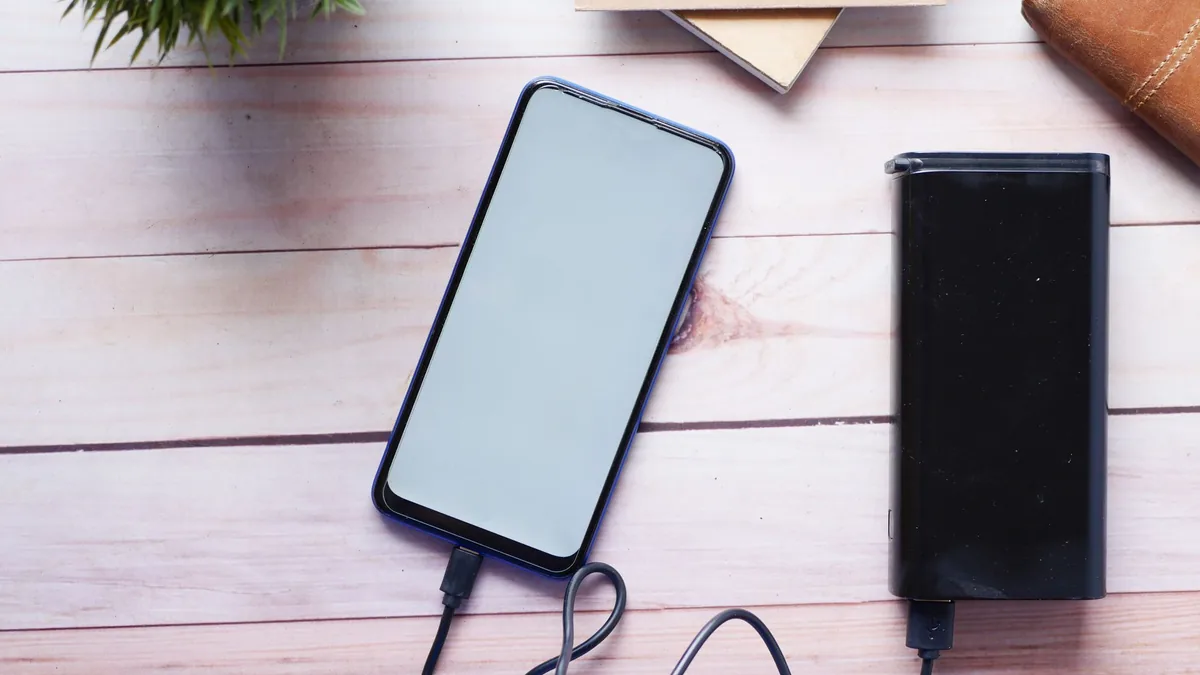
Here is the short version of the power bank rules on flights: a power bank goes in your hand luggage, never in the suitcase you check in. Most airlines cap each one at 100 watt-hours, and larger packs up to 160 Wh need the airline's approval, if they are allowed at all. Since 2025 many carriers have gone further. Qatar Airways, for example, now allows two power banks per passenger, each no bigger than 100 Wh, and bans charging the power bank itself at any stage of the flight. Other airlines have banned using them on board altogether or stopped passengers keeping them in overhead bins.
The practical result is simple. You can no longer count on topping up your phone from a power bank over the Arabian Sea. So you may land at Islamabad, Lahore or Karachi after a long day of flying and a transit with a phone on 4% and a driver waiting outside whose number is saved only in that phone.
This guide covers both halves of the problem. First, what the rules actually say and how to pack for them. Second, a family pickup plan that still works when the phone doesn't: pickup details written on paper, a second contact who can reach the driver, and a sensible order of steps if you walk out of arrivals and can't reach anyone.
What the power bank rules on flights actually say
There is no single worldwide rulebook you can read once and forget. There is a baseline that almost every regulator and airline shares, and then each airline adds its own restrictions on top. The airline you fly with sets the rule that applies to you, so the airline's own page is the one to trust.
The baseline most airlines start from
The US Federal Aviation Administration's PackSafe guidance on lithium batteries sets out the common baseline clearly:
- Spare lithium batteries and power banks travel in carry-on baggage only. If your cabin bag gets taken at the gate and put in the hold, take the power banks out first.
- Rechargeable lithium-ion batteries are limited to 100 Wh each without special permission.
- With airline approval, you may carry up to two larger batteries of 101-160 Wh. Anything above 160 Wh is prohibited.
- Protect the terminals from short circuits: keep a battery in its retail packaging, tape over the contacts, or use a pouch or case.
The FAA also says plainly that many airlines have stricter quantity and watt-hour limits than this baseline. That line is the whole story of the past two years.
Why the rules tightened
On 28 January 2025, a fire broke out in an overhead bin on Air Busan Flight 391 before departure from Busan to Hong Kong. All 176 people on board got out using the slides, but the aircraft was destroyed. Investigators pointed to a power bank battery stored in an overhead compartment as the likely cause.
Airlines and regulators responded quickly. South Korea banned its airlines from letting passengers store power banks in overhead compartments from 1 March 2025, and EVA Air stopped passengers using portable chargers on its flights. Other Asian carriers reviewed their guidelines too. The wider power bank article on Wikipedia records that the International Civil Aviation Organization published updated standards on 27 March 2026 limiting passengers to two power banks each, with onboard recharging prohibited.
None of these airlines fly every route to Pakistan, and airlines update their rules at different speeds. The point is the direction of travel: more airlines are restricting how you use a power bank in the cabin, not just whether you can bring one.
An example of a current airline rule: Qatar Airways
Qatar Airways, which connects passengers through Doha, is a useful example because it states its rule in plain terms. Its restricted items page says:
- Only two power banks are allowed per passenger, and each must not exceed 100 Wh.
- Charging power banks is prohibited at all phases of flight.
- During non-critical phases of flight, a power bank may charge a personal device only if it stays under your direct supervision and is not stowed in a bag or the overhead bin while charging.
- Power banks above 100 Wh are no longer allowed in passenger baggage at all, cabin or hold.
That last point catches people out. Watt-hours are roughly the milliamp-hour figure multiplied by the cell voltage and divided by 1,000, so a 20,000 mAh pack at 3.7 V works out at about 74 Wh, a 27,000 mAh pack sits right on the 100 Wh line, and a 30,000 mAh pack goes over it. Most packs print the Wh figure on the casing. If yours doesn't, treat that as a reason to leave it at home rather than argue at the gate.
PIA, Emirates and other airlines to Pakistan
If you are flying PIA, Emirates, Saudia, Etihad, flydubai or any other carrier, check that airline's own restricted or dangerous goods page before you pack, and check it again in the week you fly. We have not reproduced their rules here because airline pages change, and an out-of-date summary is worse than none. If the page is unclear, ask the airline directly. Your power bank in hand luggage on PIA is governed by what PIA says on the day, not by what another airline allowed last year.
At UK airports, the government's guidance on electronic devices in hand luggage says your devices should be charged before you travel, because if a device does not switch on when security ask, you will not be allowed to take it on the aircraft. And if your onward leg is on a different airline, the stricter of the two rules is the one to pack for.
Packing for the rules without losing your battery
A few habits make the flight rules almost painless.
- Pack one good power bank, not three mediocre ones. A single labelled pack of 100 Wh or less fits almost every airline's rule. Two is the most many airlines now accept.
- Keep it in the bag you carry, not the wheelie case. If your cabin case is gate-checked, the power bank has to come out. A small handbag or jacket pocket avoids the scramble.
- Charge everything at your last hotel or at home. Phone, power bank, and any child's tablet that buys you an hour of peace on the M4 or the GT Road.
- Use the seat power, where it exists, on the long leg. Many long-haul aircraft have USB or mains sockets at the seat, but not all, and some don't work. Treat seat power as a bonus.
- Switch the phone to low-power or aeroplane mode for the long leg. A phone searching for signal over the sea drains itself for nothing.
- Charge up in the transit airport. On a one-stop trip through Doha, Dubai, Abu Dhabi or Jeddah, the connection is your best charging window. Budget twenty minutes for it.
Even with all of that, plan as if the phone will be flat on landing. Then a dead phone is an inconvenience rather than a crisis.
The paper card: a written copy of pickup details
This is the single most useful thing in this guide, and it costs nothing. Before you leave home, write out a card, one per adult in the travelling group, with a written copy of pickup details on it. Keep it in the same place as your passport, not in the checked bag.
What to put on the card
| Line on the card | Example of what to write | Why it matters |
|---|---|---|
| Your booking or enquiry reference | Example: PT-12345 | Anyone helping you can quote it |
| Flight number and date | Example: flight XX 123, 14 March | The driver's side tracks this, not your name |
| Arrival airport and terminal | Example: Allama Iqbal International, Lahore | Removes guesswork if plans changed |
| Agreed meeting point | Written exactly as confirmed with the operator | Stops you waiting at the wrong door |
| Driver or operator phone number | Written in full with +92 | You can call from any borrowed phone |
| Second contact's name and number | A relative in Pakistan or at home | Someone who can reach the driver for you |
| Destination address | Full address plus a landmark | You can hand it to any driver |
| One line in Urdu | Example: "Mera driver bahar intezar kar raha hai" | Helps when you ask airport staff for help |
The examples in the table are labelled because they are only examples; use your own confirmed details. A printed booking email folded inside your passport cover does the same job, as long as the numbers are legible. If you need help working out which details to confirm before you fly, our UK departure checklist for your airport pickup walks through them in order.
Why paper beats a screenshot
A screenshot lives on the phone that has just died. A note in a cloud app needs a signal and a charged battery. Paper needs neither. It also works for the elderly parent or teenager in your group who may not have the booking details on their own phone at all.
A second contact who can reach the driver
The paper card tells you what to do. The second contact is the person who can do it for you when you can't.
Choose one person, not a family WhatsApp group of thirty, and brief them before you fly. Good choices are:
- A relative in Pakistan who is awake at your arrival time and has the driver's number.
- The person who made the booking, if someone in the UK, the Gulf or North America arranged the ride on your behalf. Our guide to arranging an airport pickup for parents while you are abroad covers that set-up in detail.
- A travelling companion on the same flight, if their phone is in better shape than yours.
What the second contact should have
- The driver's or operator's number, and the booking reference.
- Your flight number, so they can check a live flight tracker for the actual landing time.
- A description of who is travelling: "Two adults, one child, a wheelchair and four cases."
- Permission to make decisions: if the driver asks whether to wait or move to a different door, your contact can answer.
A simple agreement to make in advance
Agree a time window. For example: "If I haven't messaged you within 60 minutes of landing, call the driver and tell him I'm still inside." Immigration and baggage reclaim at a large Pakistani airport can take a while after a wide-body arrival, so a silent hour is not unusual. What matters is that someone outside knows the plan and doesn't panic, and the driver hears from somebody.
For late arrivals in particular, our contact plan for arriving in Pakistan late at night goes further on who stays awake and when.
Phone died, can't find driver: what to do, in order
You have cleared immigration, collected the bags and walked out. The phone is dead, or it's alive but can't get a signal on your UK SIM. You can't see anyone holding your name. Take a breath. This is fixable, and the order you do things in matters.
- Stay at or near the agreed meeting point. Don't start walking the kerb or car park looking for the driver. Two people searching for each other rarely meet. One person staying put almost always gets found.
- Check the paper card. Confirm you are at the right terminal and the door or exit you agreed. A large arrivals hall can have more than one exit and waiting area, and after a long flight it is easy to come out of the wrong one.
- Look for a name board. Drivers often wait behind a barrier with the passenger's name or the booking reference. Scan once, slowly.
- Borrow a phone. Ask a travelling companion, a fellow passenger or airport information staff if you can make one short call to the number on your card. Keep the call short: "I'm at [meeting point], wearing [colour], with [number] bags."
- Call your second contact rather than the driver if you can only make one call. They can then call the driver, and they may already know where he is.
- Charge the phone if you can. A few minutes of charge is enough to send one message. See the next section on where power is likely to be.
- Wait a sensible length of time. Agree a limit in advance. If you've waited well beyond it and nobody has made contact, move to the fallback below.
Charging points at arrivals and in the car
Where you can charge a phone after landing varies by airport and changes as terminals are refurbished, so we're not going to promise you a charging point at any particular spot. Plan around what you can control.
Before you leave the terminal
- Carry a short cable and a plug. A mains plug that fits Pakistani sockets, or a universal adaptor, means any working socket is usable. Many airport sockets are simply wall sockets near seating.
- Use the power bank now. Once you are off the aircraft, the in-flight restrictions no longer apply. Five minutes on the power bank while you queue for immigration can bring a phone back to life.
- Ask a café or information desk. If you see a socket behind a counter, a polite request often works. Don't rely on it.
Charging cable in the car
Ask about a charging cable in the car when you arrange the journey, not when you get in. Many cars have a USB socket or a 12-volt socket, but the cable, the connector type and whether the socket actually works vary from one vehicle to the next. The safest arrangement is:
- Bring your own cable with the right connector for your phone, whether USB-C or Lightning.
- Pack a small car adaptor if you want to be certain. They weigh almost nothing.
- Mention it in your journey request. If you are travelling on to Mirpur, Sialkot, Peshawar or Faisalabad after landing, a working charger for a two- or three-hour drive is a reasonable thing to ask about. The operator can tell you what the vehicle has, but treat it as a request, not a guarantee.
Once the phone has charge, send one message to your second contact: "Picked up, on the way." It saves a lot of worried calls.
What to do if you can't contact anyone
Suppose the phone is dead, no one can lend one, your second contact isn't answering and the driver isn't where you expected. Think it through now so you don't improvise at 3am:
- Stay inside the terminal building or at the well-lit arrivals area. Don't leave with anyone who approaches you offering a ride and claiming to be "your driver" unless they can tell you the name and reference on your card. A genuine driver will know the booking details.
- Go to the airport information desk. Explain in plain words that your pickup hasn't arrived and your phone is dead. Show the paper card. Staff can often help you make a call.
- Keep your bags together and in sight. A family with several cases is easier to manage in one corner than spread around a seating area.
- Wait for the time you agreed with your second contact to pass. If they hear nothing from you by then, they will already be calling the driver and, if needed, looking at alternatives.
- If you decide to make other arrangements, tell someone. Once you can make a call or send a message, let your second contact and the original operator know, so no one is searching for you after you've left.
Our airport transfer planning pages (planned link) have more on individual airports, including the ones most families land at.
When the trip continues to Saudi Arabia
Some families combine a Pakistan visit with Umrah, flying on from Lahore, Islamabad or Karachi to Jeddah or Madinah. The same rules apply on every leg: power banks in the cabin, within the airline's limits, and a paper card for the pickup at the other end. For the Saudi side, our sister company Hajj Umrah Taxi has a practical guide to charging phones and staying connected during long pilgrim transfers, including the long road journeys between Jeddah, Makkah and Madinah.
Putting it together before you fly
Here is the short checklist to run through in the last 48 hours:
- [ ] Checked the power bank rules on your airline's own website for every leg
- [ ] One or two power banks of 100 Wh or less, with the Wh figure printed on them, in hand luggage
- [ ] Phone, power bank and devices fully charged at home or in the hotel
- [ ] Paper card written for every adult, kept with the passports
- [ ] Second contact chosen, briefed and given the driver's number and flight number
- [ ] Waiting-time limit agreed with the second contact
- [ ] Charging cable and plug adaptor in your hand luggage
- [ ] Charging cable in the car mentioned in your journey request
If you are also arranging a pickup for relatives arriving at Islamabad or Sialkot, iDrive, the network behind Pakistan Taxi, explains how the arrivals pickup at Islamabad or Sialkot airport actually works.
When you're ready, you can plan your airport journey with Pakistan Taxi (planned link). Tell us your flight, the airport, how many people and cases, and anything else we should know, such as a phone charger or a late arrival. We'll come back to you with options to review; nothing is booked until you have confirmed the details with the operator.