
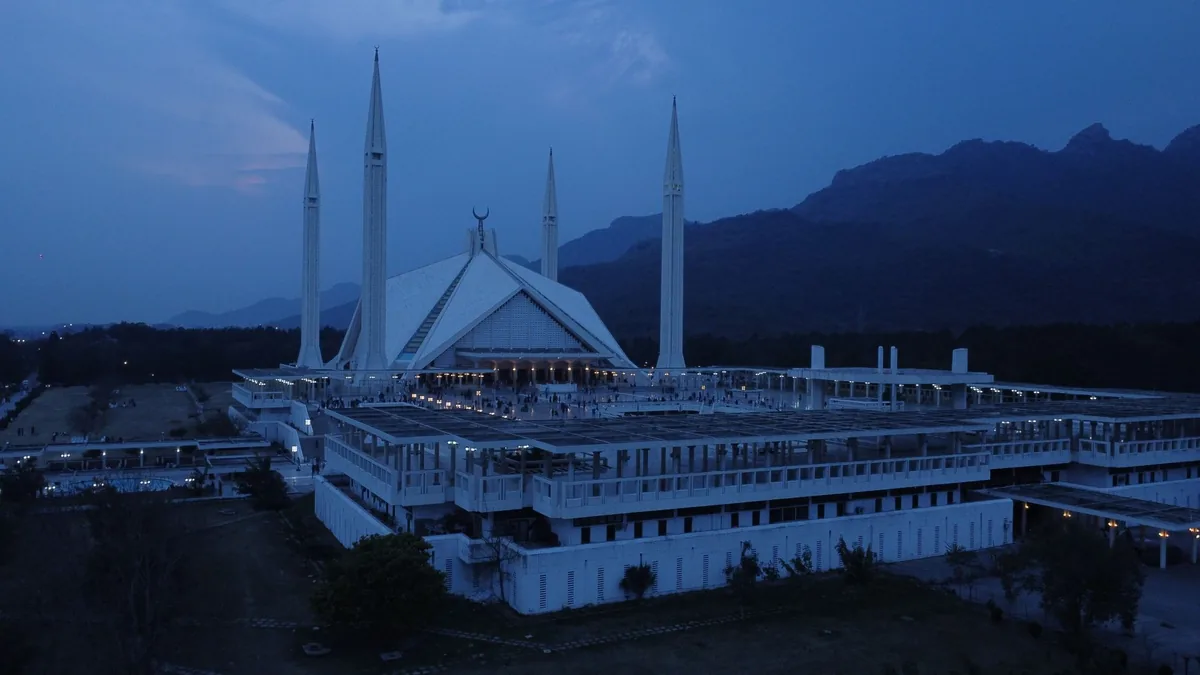
If you have a US embassy Islamabad visa interview, the car does not take you to the embassy door. The Consular Section sits inside the Diplomatic Enclave, and every applicant rides an official shuttle from a building on Avenue 3, Quaid-i-Azam University Road in sector G-5. The embassy asks you to reach that shuttle building 30 minutes before your appointment. Phones and other electronics, handbags and backpacks, food and liquids cannot go in, and the embassy has no storage for them. Anyone not named on the appointment letter is turned away at the door. So a family coming from Lahore needs three things sorted: a departure time that gets you to G-5 with room to spare, a plan for what stays in the car, and a return that can wait for an uncertain finish. The rest of this guide works through each one, with the official pages linked so you can check anything that changes.
What the official pages say about the US embassy Islamabad visa interview
Start with the embassy's own words, because they decide the rest of your day. The US Embassy's visa section gives its hours as 8:00 am to 1:00 pm, Monday to Friday, except Pakistani and American public holidays and administrative closures. Its important visa information page explains the rest: the Consular Section is in the Diplomatic Enclave, applicants take the diplomatic shuttle from the Diplomatic Shuttle Service building on Avenue 3, Quaid-i-Azam University road, G-5, and should arrive there half an hour before the appointment. The shuttle drops you at the Consular Section's reception area, where guards screen you before bringing you inside.
The immigrant visa instructions on the State Department's Islamabad post page say the same about the shuttle and add some detail: all bags are searched, anyone not listed on the appointment letter is refused entry, and any National Visa Center fees still unpaid must be paid at the embassy on the day, before the interview.
A few points people miss:
- The shuttle is part of the journey. You are not being dropped at a gate. Your arrival target is the G-5 shuttle building, and the ride into the enclave comes after that.
- The shuttle has a cost. The State Department page gives roughly Rs 1,500 for a round trip, while Dawn reported in January 2025 that the Capital Development Authority had taken over the service at Rs 1,000 per trip. The figures do not agree and may have changed again, so carry enough cash and confirm on the day.
- Public holidays count twice. A US holiday can close the embassy on a normal Pakistani working day. If your date sits near one, re-read your appointment confirmation before you leave Lahore.
Check which city your letter actually names
The embassy also runs a Consulate General in Karachi, on Mai Kolachi Road. Your appointment confirmation is the only document that tells you where you are going. Read it before you plan a single kilometre; a Lahore family planning for Islamabad when the letter says Karachi has a very different problem.
US embassy Islamabad: what to bring, and what stays behind
The "what not to bring" list on the embassy's information page is specific. You cannot take in battery-operated or electronic devices or any photographic equipment; luggage, shoulder bags or purses (travel bags, backpacks, briefcases, suitcases, leather or cloth bags and zip folders are all out, and application papers go in a plastic bag); food and liquids; sealed envelopes or packages; cigarettes, matches and lighters; sharp objects such as scissors, pen knives or nail files; and cosmetics, including spray perfume and talcum or baby powder. The embassy adds that the list is not complete and security staff can refuse other items. There is no storage at the embassy, applicants are told to leave these things at the shuttle service before they arrive, and anything prohibited that reaches the embassy has to be disposed of before entry.
The document side depends on your visa type. For a visitor visa, the State Department's visitor visa page lists a passport valid for at least six months beyond your intended stay, the DS-160 confirmation page, the fee payment receipt if you paid before the interview, and one printed photo if the photo upload failed while you were completing the DS-160. Supporting papers showing the purpose of your trip, your ties at home and how you will pay are yours to judge. Immigrant visa applicants follow a different list on the Islamabad post page (including two recent 5 cm x 5 cm photographs of each applicant, and the medical results if the panel physician hands them to you in a sealed envelope, which you bring unopened). If your category's own instructions conflict with a general list, follow your category.
A practical way to split everything before you leave home:
| Item | Goes inside with you | Stays with the driver or family | Stays at home or the hotel |
|---|---|---|---|
| Passport, appointment letter, DS-160 page, receipts | Yes, in a plain plastic bag (zip folders are on the banned list) | No | No |
| Cigarettes, lighter, nail file, small scissors | No | Yes, or leave them out of your pockets entirely | — |
| Mobile phone | No | Leave with a family member in the car, or with the shuttle service | If nobody is waiting with the car, consider this |
| Handbag, backpack, laptop bag | No | Yes | Or leave it behind entirely |
| Water bottle, snacks, tiffin | No | Yes, for after the interview | — |
| Perfume, powder, cosmetics | No | Better not brought at all | Yes |
| Spare copies of documents | Only if your instructions ask | A second set in the car | A third set at home |
Two small habits help. Write the embassy phone number and your driver's number on paper and keep it in your document bag, because your phone will not be in your pocket. And settle before you leave who holds which phone, so a family member in the car is not holding three handsets and answering none.
Travel to Islamabad for visa interview: work back from the shuttle time
The M-2 motorway runs about 375 km from Thokar Niaz Baig in Lahore to its junction with the M-1 just west of Rawalpindi, according to its Wikipedia entry, with service areas at Sukheki, Sial, Bhera, Kallar Kahar and Chakri. Add the cross-town run to that junction from wherever you live in Lahore, then the final stretch from the motorway into Islamabad and across to G-5, and you have a long morning in a car even when everything goes right.
To travel to Islamabad for a visa interview on the same day, work backwards:
- Take your appointment time and subtract 30 minutes. That is when you must be at the G-5 shuttle building.
- Subtract a buffer for finding the building and unloading. A first-timer does not know the drop point, and Islamabad traffic police may direct cars away from a spot you expected to use.
- Subtract the drive itself, including a stop. Families rarely manage Lahore to Islamabad without a fuel, washroom or prayer break. Build that in rather than pretending it will not happen.
- Subtract a disruption margin. Motorway works, weather, a slow truck on the Salt Range climb near Kallar Kahar, or protests in the capital can all cost time. The UK FCDO travel advice for Pakistan warns that protests and marches in Islamabad and Rawalpindi can bring road closures and transport disruption.
- The result is your leaving-home time. If it lands in the middle of the night, that is your answer: go the day before.
A hypothetical example, not a promise: an 8:30 am appointment means reaching G-5 by 8:00 am. Allow even a modest margin for traffic, a single stop and the unfamiliar final kilometres, and the car is leaving central Lahore well before dawn. Most families look at that number once and book a room in Islamabad instead.
Before the drive, check the National Highways and Motorway Police travel advisory and its FM 95 radio service. They will not tell you when the embassy will finish with you, but they can tell you whether the road you are counting on is open.
Staying overnight if the interview is early
An early appointment is the strongest case for arriving the evening before. The visa section opens at 8:00 am, so the first slots of the day are the ones most exposed to a pre-dawn drive.
The overnight plan also changes how the interview goes. You arrive rested, you can do a dry run to the G-5 shuttle area in the evening so the morning is not your first sight of it, and you can check your documents at a hotel desk rather than on your knees in a moving car.
Some things to settle if you stay over:
- Choose where you sleep by the morning run, not the price alone. A room that needs a long cross-city drive at 7:00 am gives back some of the time you bought.
- Keep the same driver if you can. A driver who brought you up the day before already knows your family, your luggage and the drop point.
- Tell the driver the real appointment time, not a rounded one. "Morning" is not a time.
- Decide the return now, in principle. Same day after the interview, or the next morning. You can adjust later, but the driver needs to know which way you are leaning.
If you are coming from further than Lahore, the same logic applies with a longer drive. Our Lahore to Islamabad appointment checklist covers the general appointment-day routine; this guide is specifically about the embassy's shuttle, its rules and the uncertain finish.
Where your driver can and cannot wait near the Diplomatic Enclave
The Diplomatic Enclave in G-5 is a secure zone. Private vehicles have been barred from entering it since the federal government's security ban after the 9/11 attacks, according to Dawn's report on the shuttle service, and the enclave is not open to the general public without a pass. In practical terms, your car goes as far as the shuttle area and no further.
What that means for the waiting plan:
- The driver cannot follow you inside or wait at the embassy. Do not plan on it and do not ask a driver to try.
- Waiting outside the drop point depends on what police allow on the day. Security around the enclave can tighten without notice, especially when protests are expected. If officers ask a car to move on, it moves on.
- Agree a fallback waiting place before you get out. Somewhere the car can park legally, with a washroom and shade for any family members waiting with it. The driver can then return to the shuttle area when you call.
- Agree how you will call. You will not have your phone inside. Once you are back at the shuttle building and have collected your things, you make the call. Until then, the car waits on a plan, not on a signal.
This is why it helps to tell us your appointment details when you plan the journey. A driver who knows he is dropping at the G-5 shuttle point, rather than "the American embassy", starts the day in the right place.
Waiting after a visa interview: why the finish time is uncertain
Nobody, including the embassy, can promise when you will walk out. The appointment time is when you are expected, not when you are seen. There is security screening, the shuttle in and the shuttle back, any fee payment for immigrant cases, and the interview itself. On some days the queue moves quickly; on others it does not.
Waiting after a visa interview can also stretch into days or weeks for reasons that have nothing to do with your transport:
- Administrative processing. The State Department's administrative processing page explains that when a case needs further processing, the officer tells the applicant at the end of the interview, and the time it takes "will vary based on the individual circumstances of each case."
- Extra documents. If the officer refuses a visa under section 221(g) but asks for more information, you have one year from the refusal date to provide it.
- Passport return. The same page notes that published wait times do not include the time taken to return passports by mail or courier.
None of this should change your journey home that day. It does mean you should not book an onward flight or a long Pakistan trip that needs the passport in hand the next morning.
Return trip after embassy appointment: open return or fixed time
This is the decision that most shapes the day. The visa section's published hours end at 1:00 pm, but your finish time could be mid-morning or well into the afternoon, and a fixed pick-up time guesses at something nobody knows.
| Return plan | How it works | Suits | Watch out for |
|---|---|---|---|
| Open return, same day | The driver waits at an agreed place and leaves when you call from the shuttle building | Families who want to be home in Lahore that night | Waiting time needs to be agreed in advance; ask what happens if the day runs long |
| Fixed return time, same day | Pick-up is set for a particular hour | Applicants with a firm evening commitment | If you finish late, the car may have to rearrange; if you finish early, you sit and wait |
| Return next morning | You stay a second night and drive back rested | Early starts, elderly parents, small children, winter evenings | Extra room night; the driver's overnight arrangements must be agreed |
| Separate return on another day | You are dropped and a new journey is planned later | Applicants staying on with relatives in Islamabad or Rawalpindi | Treat it as two journeys, and plan both |
For most Lahore families, an open return on the same day is the natural choice if the interview is mid-morning and nobody in the car will be exhausted. If the appointment is at the start of the window and the family came up that morning, a same-day return means a very long day in the car on both ends. That is the case for sleeping over.
A return trip after an embassy appointment is easier to plan when the enquiry says plainly: "open return, waiting at a fallback location, pick-up once the applicant calls from the shuttle building." If you want to come back on a different day instead, our guide to booking an intercity return on another day explains how to set that up, and one-way or return: choosing an intercity journey helps if you are still deciding.
For a straight comparison of the road against the coach and the train on this corridor, our sister service iDrive, the network behind Pakistan Taxi, has a guide to Islamabad to Lahore by car, coach or train.
Family members who travel but cannot enter
Many applicants do not travel alone. A parent comes for moral support, a spouse handles the conversation with the driver, or the whole family makes a day of it. The State Department's Islamabad instructions for immigrant visa interviews allow only narrow exceptions: one interpreter for an applicant who cannot manage the interview in English or Urdu, and one helper for an applicant who is elderly, disabled or a minor child. Anyone not on the appointment letter will be refused entry.
So the family who comes along needs its own plan for the hours ahead:
- Where do they wait? Not at the shuttle building, where space and patience both run short. A café, a relative's home in Islamabad or Rawalpindi, or somewhere near the fallback parking spot is better.
- Who holds the phones? Put one reliable person in charge of the applicant's phone and the driver's number.
- What about children? A small child who is not an applicant will not enjoy several hours in a parked car. Pack for that honestly, or ask whether they need to come at all.
- Is it a day out? If the family wants to visit relatives or shop while the applicant is inside, the driver needs to know. A car cannot be in two places, and an open return only works if the car is free when the call comes.
Safety and disruption on the day
Islamabad, Rawalpindi, Lahore and the M-2 are not among the areas the UK FCDO advises against travelling to, though its advice (linked above) tells visitors to stay away from all demonstrations and warns that protest routes can change at short notice. British passport holders should read the current page before the trip.
In practice: leave with a margin, let the driver choose the approach to G-5 if a road is shut, and if the embassy announces a closure, believe it and replan.
A planning checklist to send with your enquiry
When you plan the journey with us, the more of this you share, the less guessing there is on the day:
- The applicant's name, and the names of anyone travelling with them.
- The appointment date and time exactly as they appear on the confirmation.
- Pick-up address in Lahore, or your Islamabad hotel if you are staying over.
- Whether you want an open return, a fixed return time, or a return on another day.
- Luggage for an overnight stay, and anything that must stay in the car during the interview.
- Any passenger who needs extra help: elderly parents, a wheelchair, young children.
- A second contact number for someone who is not going into the embassy.
Our city to city service covers the Lahore to Islamabad run and the return, and you can plan your journey here (planned link). We will come back to you to confirm what can be arranged; nothing is final until then, and waiting time and any overnight stay are discussed before the day rather than after it.