
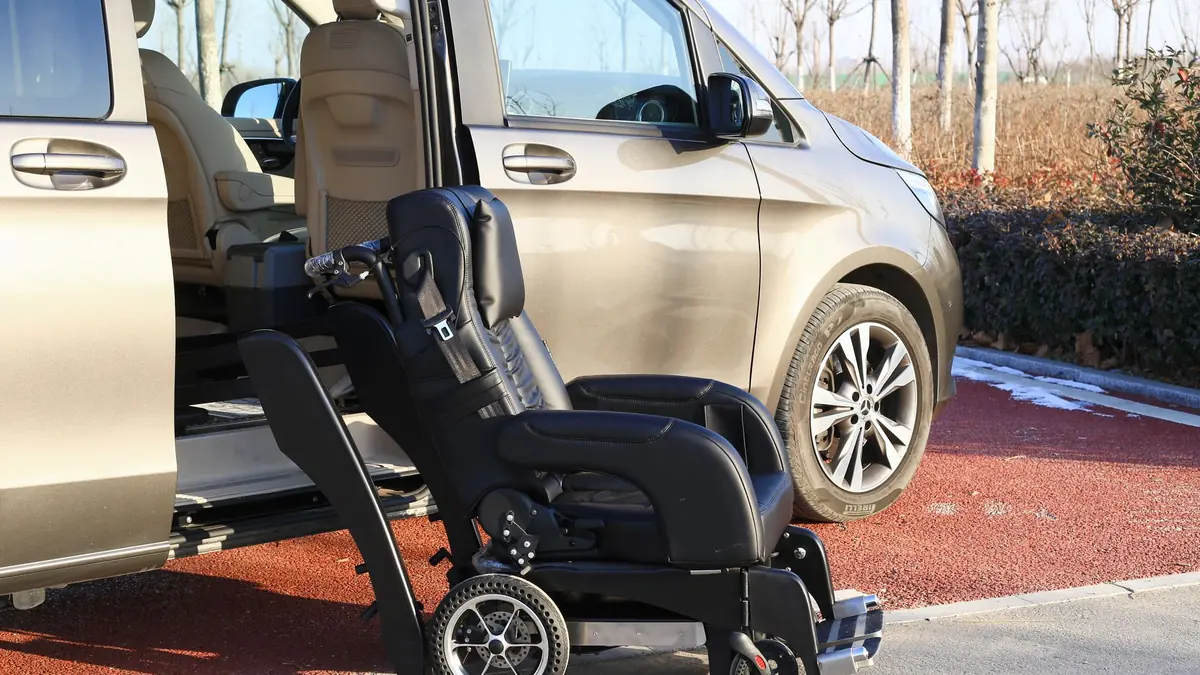
If you need a wheelchair accessible taxi in Lahore for a family outing, a wedding or a day of visits, the thing that decides everything is the chair itself. A folding manual chair that the passenger can leave for a car seat opens up almost any family vehicle. A power chair, or a passenger who has to stay seated in their chair, needs a ramp vehicle with proper floor restraints, and those are far fewer, so they need asking for early. After that, the plan is about three things: measuring before you ask, checking the venue before the day, and timing the accessible vehicle so it arrives with the rest of the family rather than half an hour behind them.
This guide is written for the relative who is doing the organising, often from Birmingham, Dubai or Toronto, for a parent, grandparent or guest who uses a wheelchair. The goal is simple: your guest should arrive with everyone else, sit with the people they came to see, and get home without anyone lifting them up a flight of stairs in their best clothes.
First, a quick word on safety and official advice
Lahore is not in any of the areas where the UK Foreign, Commonwealth & Development Office (FCDO) advises against travel, but the FCDO Pakistan travel advice does note that attacks have taken place in major cities including Lahore, and it advises against street taxis and app-hailed rides, recommending reputable companies where an operator arranges the driver. Read the current page before you travel; it is updated often.
The FCDO also publishes a general guide to disability and travel abroad. Its taxi advice fits Lahore well: book in advance, state your needs, and be aware that in many places accessible vehicles may not be available. That last line is not a reason to give up. It is a reason to start the conversation a few weeks out, not the night before the mehndi.
Wheelchair accessible taxi Lahore options: ramp van or transfer seat
There are really only two ways a wheelchair user travels in a car, and the right one depends on the person, not the vehicle.
Option 1: transfer into a car seat, chair in the boot
The passenger moves from the wheelchair into an ordinary seat, with or without help, and the chair is folded and stowed. This works well when:
- the passenger can stand and pivot, or slide across with a transfer board;
- the chair folds, or its wheels come off quickly;
- the journey is short and the passenger is comfortable in a normal seat.
The advantage is choice. Almost any family vehicle (planned link) with a decent boot can carry a folded manual chair, and your guest can ride in the same car as their daughter or grandson. The catch is that every stop means another transfer. Four venues in one day means eight transfers, and that tires people more than families expect.
Option 2: stay seated in the chair, in a ramp vehicle
The passenger is wheeled up a ramp and the chair is secured to the vehicle floor. This is the right answer when:
- the passenger cannot transfer safely, or transfers are painful;
- the chair is a heavy power chair that cannot be lifted into a boot;
- there are several stops and repeated transfers would wear the passenger out.
Accessible vans generally use either a side-entry or rear-entry ramp, with a lowered floor or dropped tub for headroom. Side-entry designs need extra room beside the vehicle to lower the ramp; rear-entry designs manage without it, unless another car is parked tight behind. That detail matters more in Lahore than you might think, because a narrow lane in an older neighbourhood can leave room for one and not the other.
A quick decision table
| Your guest's situation | Usually works | Ask the booking team about |
|---|---|---|
| Walks a few steps, folding manual chair | Standard family car or MPV, chair in the boot | Boot space with luggage, seat height |
| Cannot stand, manual chair, can use a transfer board | Standard car with a helper, or ramp vehicle for long days | Whether the driver may help with transfers |
| Must stay in the chair | Ramp vehicle with floor restraints | Ramp type, door height, restraint system |
| Power chair or scooter | Ramp vehicle | Total weight, chair length, securing points |
| Several stops in one day | Ramp vehicle, even if transfers are possible | Waiting time between stops |
Treat the table as a starting point for the conversation. The person who knows best is the passenger, and it is worth asking them directly which they prefer rather than deciding for them.
Measure the chair before you ask for a vehicle
"We need a wheelchair taxi" is not enough information for anyone to match a vehicle. Chairs vary enormously. Wheelchair references commonly describe self-propelled rear wheels of roughly 20 to 24 inches (510 to 610 mm), ultra-light manual chairs under 10 kg, and the largest outdoor power chairs at 200 kg or more (Wikipedia: Wheelchair). A vehicle that suits one of those will not suit the other.
Take five minutes with a tape measure and write these down:
- Width at the widest point, usually across the push rims or armrests.
- Length from the front of the footplates to the back of the rear wheels or anti-tip bars.
- Height with the passenger seated, measured to the top of their head. This decides whether they clear the door of a ramp vehicle without ducking.
- Weight of the chair on its own, and whether it folds, or has quick-release wheels.
- Type: manual folding, manual rigid, power chair or mobility scooter.
- Batteries, if powered: the type, and whether they can be removed.
Folding manual chairs versus power chairs
Folding chairs fold by bringing the two sides together, which is why they fit into ordinary boots so easily. Rigid-frame manual chairs often break down differently, with the wheels popping off and the backrest folding flat. Either can usually travel in a normal car if the passenger transfers.
Power chairs and scooters are another matter. They are heavy, they rarely fold, and some are too long for a small ramp vehicle. If your guest is flying in with a power chair, remember that airlines have their own battery rules. IATA's passenger guidance on batteries and mobility aids says passengers should make advance arrangements with the airline and have the battery type documented. Sort that out first, because there is no point booking a ramp van at Lahore airport for a chair that was not accepted at Heathrow or Dubai.
Securing the chair and keeping the family together
In a ramp vehicle, the wheelchair should be fastened to the floor with tie-down straps attached to fixed points, and the passenger should wear an ordinary seat belt as well; overviews of wheelchair accessible van design are firm that wheelchair users are belted in while the vehicle moves. Some chairs are built to recognised transit standards, such as ISO 7176-19 or the American WC19, and have marked securing points, but not every chair is built that way. If yours has those markings, mention it. If it does not, ask how the driver will secure it.
A few practical points to raise:
- Facing forward. Transit standards such as WC19 are written for chairs travelling forward-facing, so ask for that position, not sideways.
- Loose items. Oxygen, bags and walking frames should be stowed, not balanced on laps.
- Cushions and trays. Remove trays and anything that could come loose under braking.
- Headroom. With the passenger seated, check they are not pressed against the roof over the speed humps you will meet on almost every residential street.
The companion seat matters as much as the ramp
Here is the part that accessible-vehicle listings rarely mention. A wheelchair user at a family event usually wants to travel with someone, not be sent ahead on their own like a parcel. Ask how many seated passengers the vehicle takes once the wheelchair is in position. Some layouts remove rear seats to make room for the chair, which may leave space for only one or two companions.
If your guest's spouse, carer or a favourite grandchild should ride with them, say so at the start. It changes which vehicle is suitable. For the rest of the group, a second family car travelling in convoy keeps everyone arriving together; our events and group transport page explains how multi-vehicle plans are put together.
Check the venue before you worry about the vehicle
Families spend a lot of energy on the car and very little on the fifty metres between the car and the chair at the table. That fifty metres is where most outings go wrong. The FCDO's disability guide makes the same point for hotels: check step-free access, lifts and toilets before you go, not on arrival.
For a Lahore marquee, banquet hall, restaurant or relative's house, ask someone local to check these, ideally with photographs on WhatsApp:
- The drop-off point. Can a vehicle stop on level ground right by the entrance, or is the only kerb beside a drain, a raised footpath or a line of parked cars? A side-entry ramp needs clear space beside the vehicle; a rear-entry one needs the space behind kept free.
- Steps at the entrance. Even two steps matter. Is there a ramp, a side gate at ground level, or a service entrance used by caterers?
- Surfaces. Gravel, grass and thick marquee matting can stop a manual chair and bog down a power chair. Ask whether there is a firm path.
- Lifts. If the hall is upstairs, is there a working lift, and is it large enough for the chair plus one helper? Power cuts happen; ask whether the lift runs on the generator.
- Toilets. Is there one the guest can actually use, with a door wide enough?
- Seating. Can the guest sit at a family table, not in the aisle or by the exit?
- Shade and heat. Summer afternoons in Lahore are fierce. A long wait outside a venue in June is a medical question, not a comfort one.
For a wedding, the best person to ask is often the hall manager or the event decorator. They know which gate the dhol players use and where the generator cables run.
Old city lanes and family homes
Visits to relatives in older parts of Lahore bring their own problems: narrow lanes, parked motorbikes and front doors raised above street level. A large ramp van may not get close. In that case, a smaller family car that can reach the door, plus a transfer, may be kinder than a ramp vehicle that stops two lanes away. This is exactly why the passenger's own abilities should drive the plan.
Timing: arriving with the group, not after it
Here is an example of how it goes wrong: the family cars leave at 7 pm, the accessible vehicle is booked separately for 7 pm, and it arrives at the hall forty minutes after the baraat, with the guest missing the very entrance they flew in from abroad to see.
Avoid that with a bit of choreography:
- Plan the wheelchair user's pickup first, and set the family departure around it, not the other way round.
- Allow extra loading time. Deploying a ramp, wheeling the chair up and fitting restraints takes longer than stepping into a car. Build that into the schedule rather than guessing on the doorstep.
- Travel in convoy if the group is small enough, so the accessible vehicle and family cars leave and arrive together.
- Arrive slightly early at the venue, so the guest is settled before the crowd and the parking chaos build.
- Plan the return journey at the same time. The end of a wedding is when drivers get held up, and your guest may tire long before the last dish is served.
If the outing spans more than one city, the same rules apply, with rest stops added. Our guide to intercity travel with older relatives goes through stop planning on the motorway in detail.
A ramp vehicle for a wedding guest arriving from abroad
Many of these outings start at Allama Iqbal International Airport, which sits about 15 km from the city centre (Wikipedia: Allama Iqbal International Airport). Passenger assistance there is available on request, and the usual route to it is your airline: the car only takes over at the kerb. Ask the airline for assistance when you book the flight, confirm it in writing as the FCDO guide suggests, and tell whoever is meeting the guest roughly how long assistance and baggage usually take so nobody panics at the arrivals barrier.
For the ride itself:
- Send the flight number, not only the landing time, so delays can be followed.
- Ask where the chair comes back. Check with the airline whether the guest's own chair is returned at the aircraft door or with the baggage. Until it is, they may be in an airport wheelchair, and the meeting plan should allow for that.
- Allow for luggage. A ramp vehicle with the chair secured has less boot space. Wedding suitcases, gifts and a folded spare chair may need a second car.
- Plan the first stop. After a long flight, going straight to a hotel or home to rest is usually wiser than heading straight to a function.
If the guest's first stop is a family house, our guide on getting from Lahore Airport to a family home explains how to send an address a driver can actually find.
What to tell the booking team in advance
This is the short version of everything above. Copy it into your enquiry and fill in the gaps. The more precise it is, the easier it is to tell you honestly what is possible.
- Passenger: how many wheelchair users, and whether each can transfer to a car seat.
- Chair: type (manual folding, manual rigid, power, scooter), width, length, seated height and weight.
- Restraints: whether the chair has marked transit securing points.
- Companions: who must ride with the wheelchair user, and how many others need seats.
- Luggage and equipment: suitcases, walking frames, oxygen, medication bags.
- Pickup and drop-off: exact addresses, with a pin, and notes on steps, gates and narrow lanes.
- Venue access: where a vehicle can stop, and whether there is space to lower a ramp.
- Timings: when the group leaves, when the guest must be seated, and when they are likely to want to go home.
- Help needed: whether the passenger needs a hand with transfers, or only with the chair.
- Contacts: a local family member's number who can talk the driver in.
Send this through our journey planning form (planned link) and say plainly that it is an accessibility request. It is an enquiry, not a confirmed booking: the team will come back to you on what vehicles are available on your date and what the arrangements would look like, and nothing is fixed until you have that reply in writing. Accessible vehicles are limited, so the earlier you ask, the more options you are likely to have.
Our sister platform iDrive, the network behind Pakistan Taxi, also lists an accessible vehicle category if you want to see how those vehicles are described before you enquire.
Travelling in Pakistan with a wheelchair user: the wider picture
Lahore is one outing. Many families plan a longer trip, with a few days in Islamabad or a drive to relatives in Faisalabad or Sialkot, and the same measure-check-time approach applies to any wheelchair taxi Pakistan journey. A few honest points help set expectations.
Accessibility is uneven. Pakistan has national and provincial disability legislation and an accessibility code, but day-to-day access in older buildings, markets and homes often lags behind what UK or Gulf visitors are used to. Plan for steps and ask, rather than assume.
Local support exists for residents. If the wheelchair user lives in Punjab, the Punjab Social Welfare Department runs assessment and registration for persons with disabilities and a helpline on 1312. That is useful context for families arranging care around a visit, though it is not a transport booking service.
Long days add up. A wedding week can mean three functions in four days, plus airport runs. Pace the schedule. Build in a rest day, and let the guest skip an event without anyone making a fuss.
Insurance and medication. The FCDO disability guide recommends comprehensive travel insurance and suggests carrying a letter from your doctor explaining the need for any medication. Those matter more on a trip with several moving parts.
If the family trip continues to Saudi Arabia
Plenty of families combine a Lahore wedding with Umrah on the way home. The planning questions are the same, although the vehicles, airports and distances are different. Our sister company Saudi Cab Co has a guide on travelling with older passengers in Saudi Arabia that covers vehicle choice and rest stops there.
Accessible transport for family events: a final checklist
Use this the week before the outing:
- [ ] Chair measured and weighed, with the figures sent to the booking team
- [ ] Decision made: transfer into a car seat, or stay seated in a ramp vehicle
- [ ] Companion seats confirmed alongside the wheelchair position
- [ ] Venue drop-off point, steps, lift and toilet checked, with photos
- [ ] Pickup times set so the accessible vehicle leaves with the family cars
- [ ] Return time agreed, with a plan if the guest wants to leave early
- [ ] Airline assistance and battery approval confirmed in writing, if flying
- [ ] Local contact number shared with the driver
- [ ] Charger, medication and any small spares the passenger relies on packed
When you are ready, plan the journey with us (planned link) and include the checklist details. A clear enquiry gets a clear, honest answer about what can be arranged for your date.