
Do you need a car seat in Pakistan? Legally, on the official record, no. For safety, on most journeys, yes. The World Health Organization's road-safety legislation data records that Pakistan has a national seat-belt law but no national child-restraint law (the latest Pakistan entry is for 2017). That means there is no Pakistani equivalent of the UK rule that children ride in a car seat until they turn 12 or reach 135 cm. A toddler on an aunt's lap is, as far as the national picture shows, not a legal problem in itself.
What the law does not require, physics still does. A child held in arms in a crash is not protected by the adult holding them, and motorway speed on the M-2 does the same damage as it would on the M6. So the useful question is not "is it legal?" but "which of our journeys actually need a seat, which vehicle can take one, and who is responsible for each child when the family splits across three cars?" This guide answers all three, with a counting routine you can use from the airport kerb to the last car home from the walima.
Car seat law in Pakistan: what we could and could not confirm
Here is the position, stated as carefully as the sources allow.
- Child restraints. WHO's indicator "Existence of a national child-restraint law" shows "No" for Pakistan. WHO defines a child restraint as a seat designed for a child's age and weight that protects them in a crash. You can check the live entry on the WHO Global Health Observatory indicator page.
- Seat belts. The same dataset records that Pakistan does have a national seat-belt law. For whether that law covers every occupant (rear passengers included), WHO's own entry reads "No data".
- Who enforces what. The National Highways & Motorway Police enforce traffic and safety law on the national highways and motorways, while city and provincial traffic police cover urban roads. Local rules, campaigns and enforcement can differ from place to place.
What this article does not do is quote you a fine or a section number for child passengers. We could not verify one from an official source, so we are not going to invent one. Laws change; if you need a definitive answer for a legal or insurance reason, ask the provincial traffic police or the motorway police helpline in advance.
Why UK and EU car-seat rules do not follow you to Pakistan
A lot of families flying from Manchester or Birmingham assume the rules at home travel with them. They do not. Traffic law is territorial. The GOV.UK rule that children "must normally use a child car seat until they're 12 years old or 135 centimetres tall, whichever comes first" applies on UK roads only, as set out on the government's child car seat rules page.
That cuts both ways:
- There is no national Pakistani rule to comply with on child seats, so you are not required to bring one.
- You also lose the safety net that UK law quietly provides. At home, the rule makes the decision for you. In Pakistan you are the safety system, so the decisions sit with you.
- Your UK seat is still a good seat. A seat carrying the circled capital E and "R129" or "ECE R44" label was approved to a UN standard. That approval is about how the seat is built, not about which country you drive in, so it protects a child in Lahore exactly as it does in Leeds.
A workable middle ground is to insist on a seat for the long, fast, or night-time legs, and relax the rule for a five-minute hop to the sweet shop. That is a reasonable, deliberate choice. Drifting into "no seat anywhere" because everyone around you does it is not.
Child seat rules for Pakistan trips: which journeys deserve a seat
Since the law leaves it to you, set your own family rule before you land and tell every driver and relative the same thing. Here is a practical split.
| Journey | Seat for babies and toddlers? | Why |
|---|---|---|
| Airport to home after a long-haul flight | Yes | Tired adults, a night arrival, motorway or ring-road speeds |
| Intercity drive, e.g. Islamabad to Lahore on the M-2 | Yes | Hours at sustained speed; the FCDO describes local driving standards as erratic, especially at night |
| Wedding convoy (baraat or rukhsati procession) | Yes, and fixed before the convoy forms | Stop-start traffic, sudden braking, lots of distraction |
| Short, slow hop within a housing society | Your call | Low speed, but a belt or seat still beats a lap |
| Northern mountain roads | Yes, and think twice about the trip | FCDO advises experienced local drivers and clear weather only |
The road-condition notes come from the UK government's Pakistan safety and security advice, which says that outside the major motorways road quality is variable and conditions can be poor. The FCDO also advises against all travel, or all but essential travel, to some parts of Pakistan. Check the regional list on that page before any long drive or family day out beyond the big cities, and do not plan leisure trips into areas it flags.
Older children and the booster question
For children past the toddler stage, the realistic target in Pakistan is simpler: a working seat belt, worn properly, in the back. A folding high-back booster packs small and is designed to make an adult belt sit across the hips and shoulder rather than the stomach and neck. If you only carry one piece of kit for a 7-year-old, make it that.
Which vehicles have usable rear seat belts and ISOFIX
This is where plans quietly fall apart. A seat is only as good as the car it goes into, and the vehicles you will meet in Pakistan vary a great deal: the family's own car, an uncle's older saloon, a hired van, a booked car from a local operator.
ISOFIX: what it is and why you cannot assume it
ISOFIX is the international standard for fixing a child seat directly to the car's frame: two lower anchors at the base of the rear seat and a top tether or support leg. In the United States the same idea is called LATCH, and it became a requirement in new cars from September 2002; in the EU, new vehicles produced since February 2013 must have ISOFIX anchorages and top tethers, according to the ISOFIX article on Wikipedia and its cited sources.
Neither of those dates is a Pakistani rule. The cars on Pakistani roads include locally assembled models, imported used vehicles and older cars kept running for decades. Some will have ISOFIX; many will not, and a fair number of older rear benches have a lap-only middle belt or belts tucked away under the cushion. You have to check the actual car, not the model name.
A five-point check before you fit a seat
Do this at the car, not on WhatsApp the night before:
- Find the rear belts. Pull each one fully out. It should lock when you tug sharply and retract cleanly.
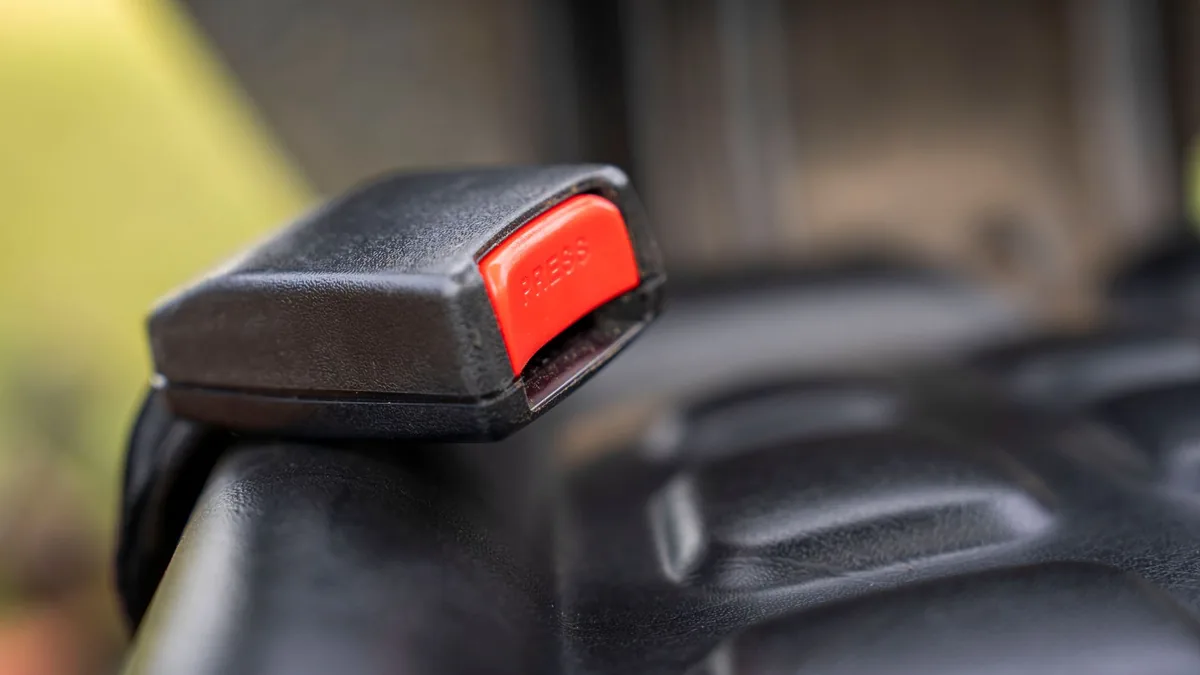
- Check buckles. Belts are useless if the buckle has been pushed down behind a seat cover or has gone missing.
- Look for ISOFIX. Feel in the gap between the seat back and cushion for two metal bars; there is often a small label or plastic guide.
- Check the seat's own instructions. Your seat's manual says whether it can be fitted with a lap-and-diagonal belt, ISOFIX, or both. A seat that needs ISOFIX cannot be forced into a car without it.
- Keep rear-facing seats out of the front unless the front airbag can be switched off. GOV.UK states the airbag must be deactivated before fitting a rear-facing baby seat in the front, and that advice is about the physics, not the UK.
If a car fails the belt check, it is not the car for the baby. Swap vehicles within the family rather than improvise.
Asking a booked car or hired van the right questions
When you plan a hired vehicle, put the question in writing. Ask the operator to confirm working rear three-point belts in the seats you intend to use, whether ISOFIX is fitted, and, if you are relying on it, for a photo of the rear seats. Treat any answer as information to check on the day, not a guarantee. Our guide to choosing a vehicle when your family has lots of luggage explains why the boot space question and the car-seat question usually collide on the same airport run, and the family vehicle page (planned link) shows the kind of seating layouts you can ask about.
Children split across several cars: one named adult per car
Car seats are the hardware. The bigger risk on a Pakistani family outing is the software: fourteen relatives, four cars, six children, and the shared belief that "someone" has the little one. That belief is how a five-year-old ends up waiting on a shaadi hall's steps while the last car pulls away.
The fix is one sentence long: every car carrying a child has one named adult who is responsible for the children in that car, and everyone knows who it is. Not "the Toyota has Khala and Phuppo". One name.
How to assign car captains
Before anyone gets in, the organiser (usually whoever holds the family WhatsApp group together) writes a short list:
- Car 1, white Corolla, driver Imran. Car captain: Sana. Children: Ayaan (seat fitted), Maryam (booster).
- Car 2, hired van. Car captain: Bilal. Children: Zara, Hamza, Ali.
- Car 3, Nana's car. No children.
Those names are an example, not a template to copy. The point is that the list is in writing, it is sent to the group, and each captain replies to confirm. If you are planning your arrival from abroad, add the list to the notes in our UK to Pakistan pickup checklist so it is ready when you land.
Rules for car captains
Keep them short enough to remember in a noisy car park:
- You count your own car, every time. Not the whole group; your car.
- Children do not swap cars without both captains agreeing. A child who hops into a cousin's car at a petrol station is one of the easiest ways for a headcount to break.
- You hold a phone number for every other captain, saved before you leave, not scrolled for later.
- If you have to get out, you hand over. A captain who goes to the washroom at a service area names a stand-in out loud.
- The driver is not the captain. The driver's job is the road.
Choosing between one van and several cars
Some of these problems disappear if everyone travels together. A single van means one headcount, one door and one set of seat checks, but it can leave you short of belts and ISOFIX points, and it only works if the whole group is going to the same place at the same time. Several cars are more flexible but multiply every risk above. Our guide on whether to book a group van or several cars walks through that trade-off for Pakistani family trips.
Headcount at every stop and at departure
Counting only when you set off is not enough. Children get out of cars at every stop, and not always back into the same one.
The three counts
- Departure count. Each captain counts heads and checks seat buckles, then sends one message to the group: "Car 2: 3 children, all belted, ready." The organiser does not wave the convoy off until every car has reported.
- Stop count. At a service area on the M-2 or a tea stop on the GT Road, each captain counts on the way out of the car and again before the engine starts. The second count is the one that matters.
- Arrival count. On arrival at the venue or house, captains count before children scatter, and tell the host adult who is now in charge of them.
A simple habit helps: children say their car number out loud when they get back in. It sounds fussy; it takes three seconds, and a small child who has just climbed into the wrong car will usually say the wrong number.
What to do if a count is short
Agree the plan before you need it:
- The captain who is short tells the group immediately, with the missing child's name and last-seen point.
- Every other captain counts their own car and replies within a minute.
- Nobody drives off from the stop until the child is found or a named adult has stayed behind with a phone.
- If the child is still missing, go straight to security or police at the venue or service area. Do not wait to be sure.
Kids in the car at a wedding convoy
A baraat kafila is the hardest version of all this. The cars are decorated, the music is loud, relatives change cars at the last minute to ride with the groom, and the convoy moves in the stop-go rhythm that makes sudden braking likely. Children want to be in the car with the flowers.
A few convoy-specific habits:
- Fit seats in the morning, not at the hall. Once the cars are lined up and the dhol has started, nobody is going to fit an ISOFIX base properly.
- Keep small children out of the groom's car unless a car captain is sitting with them and there is a proper belt or seat. The lead car tends to be the most crowded.
- No children standing up through sunroofs or leaning out of windows for photos or to throw petals, however festive the moment feels.
- Plan the return separately. The drive home after the reception is late, children are asleep and the seating is usually different from the outbound plan. Write a second list for it.
- Tell the drivers. Hired drivers should know which seats have children and that the convoy stops for a count if anyone signals.
If a family member is running transport for the day, our sister network iDrive, which runs the platform behind Pakistan Taxi, has a page on planning wedding and event cars with a driver that covers the convoy side in more detail.
Toddler seat for a family outing: bring, borrow or buy?
For a toddler seat on a family outing in Pakistan you have three options, and each has a catch.
| Option | Upside | Catch |
|---|---|---|
| Bring your UK seat | You know it, it is approved to R129 or R44, and it fits your child | It must travel as baggage; check your airline's rules |
| Borrow from relatives | Free, already in the country | Unknown history, missing manual, possibly expired or crash-damaged |
| Buy locally | No airline hassle | Check for an approval label and a manual you can read before you pay |
On the airline point, policies differ by carrier and change. As one example, Qatar Airways' baggage allowance page says infants have their own checked allowance plus one stroller or collapsible carrycot at no extra cost, and that infants travelling on a separate seat may also bring one car seat at no additional cost. Always read your own airline's current page before you pack.
Whichever route you take, practise fitting the seat once before the first proper journey. A seat fitted loosely under time pressure at arrivals gives much less protection than it should.
Arranging a seat with a hired car
If you would rather ask a booked car to supply a seat, treat it as a request, not a promise, and still bring a fallback such as a travel booster. Our sister company Saudi Cab Co has a clear walkthrough of what to check before booking a taxi with a child car seat; the questions it lists travel well to Pakistan, even though the local rules are different.
A one-page plan for the family organiser
Print it, or pin it to the top of the WhatsApp group.
Before the trip
- Decide your family seat rule (which journeys get a seat) and share it with the relatives who will drive.
- Pack the seat or booster, its manual, and any ISOFIX base; confirm your airline's rules for car seats.
- List every vehicle you expect to use and who owns or supplies it.
The day before an outing
- Check rear belts and buckles in each car that will carry a child.
- Fit seats in daylight and test them by pulling firmly at the belt path.
- Write the car list: car, driver, captain, children, seat or booster.
On the day
- Departure count from every captain before the first car moves.
- Stop count before each engine restarts.
- Arrival count and handover to a named adult at the venue.
- A separate list for the late drive home.
It looks like a lot written down. In practice it is two minutes of organising and about ten seconds per car at each stop, and it turns "I thought she was with you" into a message you never have to send.
Planning the cars with us
If you want help shaping the transport side of a family visit or wedding, you can plan your journey with Pakistan Taxi (planned link) and tell us the number of adults and children, the seats you are bringing, and which legs you want a seat fitted for. We will pass the details to local operators and come back to you; what vehicles are available and on what terms depends on the operator and the date, so nothing is confirmed until you have it in writing.