
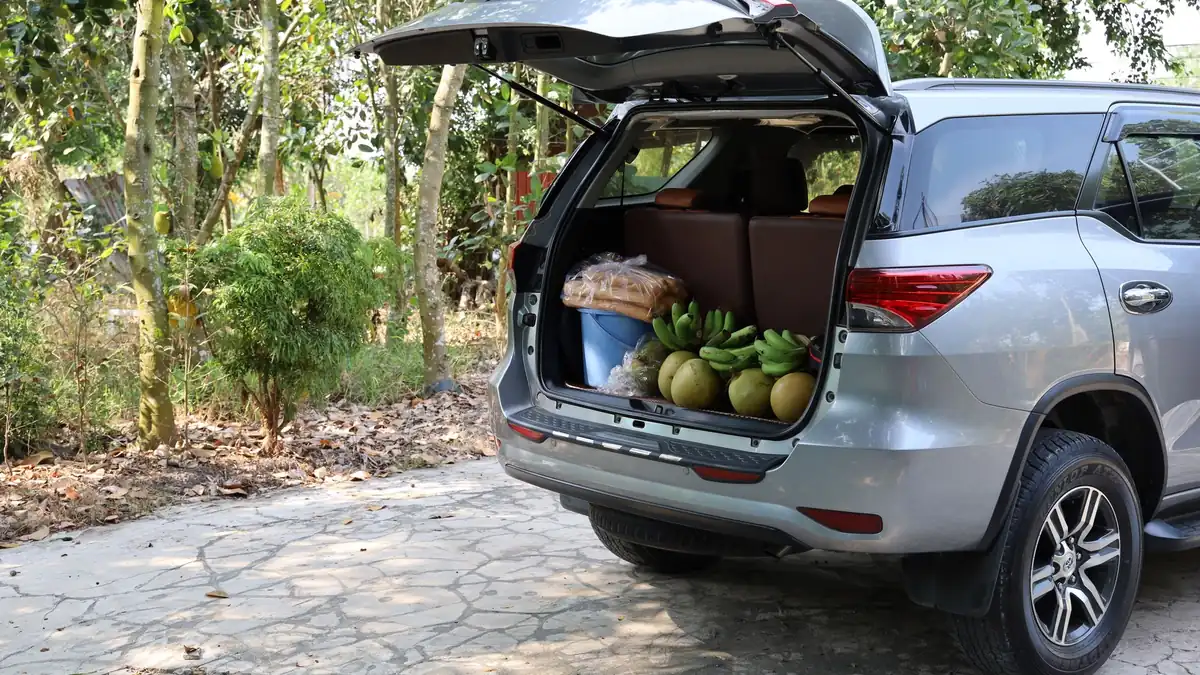
If you are looking at 7 seater car hire in Pakistan because six or seven of you are landing together, the seat count is the easy part. The hard part is the boot. On most seven-seat SUVs and MPVs, once the third row is up and every seat is filled, the space behind that last row takes a couple of cabin bags and perhaps one or two soft holdalls, not a family's worth of 23 kg checked cases. So the honest answer is this: a seven-seater carries seven people or five people and their luggage, but rarely both. If your group is six or seven adults flying in from the UK, the Gulf or North America with full allowances, plan for a van, or for a seven-seater plus a second car, or for the luggage to travel separately. If you are five or fewer, a seven-seater with the third row folded is a very comfortable choice.
The rest of this guide shows you how to work out which camp you are in before you land, what to ask a hire supplier, and how to handle the airport kerb when the trolleys come out.
Why "7 seats" and "7 people with luggage" are different promises
Most listings you find when searching "7 seater car hire Pakistan" sell seats, because seats are easy to count. Luggage space is harder to describe, and it changes completely depending on what the third row is doing.
In a typical seven-seat layout, the rear-most bench sits where a five-seat car would have its boot floor. With that bench upright, the load area shrinks to a shallow strip behind it. With it folded, you get a long, flat (or nearly flat) space that swallows several large cases. The same vehicle is really two different cars.
Some designs make the trade-off even sharper. On the Toyota Fortuner, which Toyota Indus assembles for the Pakistani market, the third-row seats split 50:50 and flip up against the sides of the body rather than folding into the floor. That means folded seats still eat some width at the sides of the load bay. It is a practical design for mixed loads, but it is worth knowing before you picture four hard-shell cases standing side by side.
Third row seats and boot space: the simple rule
Think of third row seats and boot space as one budget you spend two ways:
- Third row up, all seats used: passengers only, plus small bags and handbags. Expect to hold cabin bags on laps or at feet.
- Third row half folded (on a 50:50 split): six passengers, and roughly half the rear load area for luggage.
- Third row fully folded: five passengers and a genuinely useful boot.
If you remember nothing else, remember that each third-row passenger costs you luggage space you cannot get back.
How many large suitcases each class of vehicle takes
Nobody can give you an exact suitcase count without the exact model, the exact cases, and a willing pair of hands to play Tetris at the kerb. What you can do is plan with conservative working assumptions and then confirm with the supplier.
The table below is rough planning guidance only, based on typical full-size checked cases (the kind near an airline's size limit) plus a cabin bag per person. Soft bags squash; hard shells do not. Car seats, prams and wedding outfits in garment carriers all take extra room.
| Vehicle class | Comfortable passengers with luggage | Large checked cases (working assumption) | Best for |
|---|---|---|---|
| Standard saloon | 3 adults | 2, perhaps 3 | A couple or small family travelling light |
| Seven-seater, third row up | 6 to 7 | 0 to 1, plus small bags | Short local runs with no luggage |
| Seven-seater, third row folded | 4 to 5 | 3 to 4 | Most families of five arriving from abroad |
| Seven-seater, third row split 50:50 | 5 to 6 | 2 to 3 | A family of six with modest luggage |
| Passenger van (e.g. a Hiace-type van) | 8 or more, depending on layout | Many, depending on seat configuration | Large families, wedding arrivals, shared pickups |
| Two cars | Up to 8 across both | 4 to 6 across both | Groups who want flexibility after the airport |
For a side-by-side look at what specific Pakistani fleet vehicles tend to hold, the network behind Pakistan Taxi, iDrive, keeps a useful comparison: how many people and suitcases actually fit in Pakistani fleet vehicles. Use it alongside the table above, not instead of asking the supplier.
Start from your airline allowance, not your wish list
Your luggage volume is set before you leave home, by your fare. Airline rules are the best clue to how big and how many your cases will be:
- Emirates says no single checked bag may weigh more than 32 kg, and on weight-concept routes the total dimensions of each bag should not exceed 203 cm (length plus width plus height).
- Qatar Airways also caps a single checked piece at 32 kg, and on routes outside Africa and the Americas it uses a total-weight allowance with no limit on the number of pieces within that weight.
That last point matters more than it looks. A weight-based allowance often means families pack several medium bags rather than two giant ones, and more pieces are harder to fit than fewer, bigger ones. Allowances change and vary by fare, so check your own booking with your airline, then count the bags you will actually bring, including the extra one that always appears for gifts.
Seven-seater, van or two cars: choosing for your group
Here is a quick way to decide. Count adults and children who need a proper seat, then count checked cases (not cabin bags). Then find your row.
| Your group | Checked cases | Sensible choice |
|---|---|---|
| 4 to 5 people | Up to 4 | Seven-seater with the third row folded |
| 6 people | 2 to 3 | Seven-seater with one half of the third row folded, if the model allows it |
| 6 to 7 people | 4 or more | Van, or seven-seater plus a second car |
| 8 or more people | Any | Van, or two vehicles |
| Any size, with a wedding or long stay load | Lots | Van, or passengers in one vehicle and luggage in another |
When a seven-seater is the right answer
A seven-seater works beautifully for a family of five who want space to breathe on a long drive, for grandparents who find a low saloon hard to get in and out of, or for a group of six with light luggage and a short local trip. It is also a good self-drive option for someone confident behind the wheel who wants one vehicle for a family stay. If you are weighing up driving yourself at all, sort out eligibility, deposit and handover questions with the supplier first.
When a van makes more sense
A passenger van is less glamorous but far more forgiving. More seats, a taller load area and flexible seat layouts mean the question "will it all fit?" usually becomes "yes". Vans suit wedding arrivals, an extended family meeting several relatives at once, or anyone carrying boxes and bulky gifts. Our group van journeys page explains how van journeys are planned.
When two cars beat one big one
Two vehicles sound more complicated, but they solve three problems at once: seats, luggage and the fact that families often split up after the airport. One car can head to the family home with the elders and the cases; the other can go via a relative's house or a hotel. If you are coordinating people on different flights, build the plan around the last flight to land, not the first.
Roof carriers: why many suppliers say no
It is tempting to solve the luggage problem by strapping cases to the roof. Many hire suppliers will refuse, and it is worth understanding why before you ask.
- Insurance and liability. A load that shifts or falls on a motorway is a serious hazard. Suppliers may exclude roof loads from cover, or simply not allow them.
- Damage to the vehicle. Roof rails, paintwork and door seals suffer when loads are strapped on without proper bars.
- Weather and dust. Cases on a roof are exposed to rain, road dust and heat for the whole journey, and soft bags can arrive soaked or stained.
- Handling. A heavy roof load raises the centre of gravity and changes how the vehicle behaves on bends, particularly on hill roads towards places like Murree.
You will sometimes see heavily loaded roofs on Pakistani roads. That does not mean a hire supplier will accept one, and it does not mean it is a good idea for your family's cases. If the luggage does not fit inside, the answer is a bigger vehicle or a second one, not the roof.
On the motorways, the National Highways and Motorway Police are responsible for road safety and publish travel advisories and run FM 95 radio for road users. If you are driving yourself on the motorway network, tune in or check the advisory before a long run.
Airport arrival with a full family load
The airport is where luggage planning succeeds or fails. You are tired, the trolleys are piled high, and the vehicle is waiting at a pickup point that is not always where you expect.
Before you fly
- Count the bags, not the people. Send your supplier or planner the number of checked cases, cabin bags, car seats and prams, not just "seven passengers".
- Mention anything awkward. Long garment carriers, boxed gifts, wheelchairs or folded mobility aids all need to be planned.
- Share flight numbers for everyone. If the group is arriving on more than one flight, list each one.
- Agree who is the lead contact. One phone number that will actually be switched on after landing.
At the kerb
- Keep the group together until the vehicle is found. Do not send half the family out with trolleys while the others are still at baggage reclaim.
- Load heavy cases first, low and to the back. Soft bags fill the gaps afterwards.
- Keep one small bag per person out of the boot. Passports, phones, medicines and a snack should not be under three suitcases.
- Check the child seats before loading luggage around them. It is much harder to fit a seat once the boot is packed.
- If it does not fit, stop. Do not squeeze passengers onto laps or wedge cases into footwells. Call your contact and ask about a second vehicle.
For airport-specific pickup details, see our Islamabad Airport journey guide, which covers the arrivals side in more detail.
Ask for the exact model, not "or similar"
"Toyota Fortuner or similar" can mean almost anything with three rows. Two vehicles in the same class can differ a great deal in how their third row folds, how deep the boot is with it up, and whether that last row is fit for adults or only for children.
Model ranges also change. The Honda BR-V, for example, went on sale in Pakistan as a locally assembled model in 2017, and it was discontinued in Pakistan in 2026. A car you remember from a previous visit may simply not be on the fleet any more, so older reviews and photos are not a reliable guide.
When you ask a supplier about seven-seat or SUV hire, ask these questions in writing:
- Which exact make and model is proposed, and roughly what year?
- Is it a true seven-seater, or an eight-seater with a bench? Seat belts for every passenger matter more than the brochure number.
- How does the third row fold? Into the floor, or up against the sides?
- Can the third row be split, so that six travel and half the rear holds luggage?
- Is a roof rack or roof load allowed at all?
- If the proposed vehicle is unavailable, what is the substitute, and will you tell me before the day?
A good supplier will not mind these questions. A vague answer to them is useful information too.
SUV rent in Pakistan: the self-drive checklist
If you are planning SUV rent in Pakistan and driving yourself, the luggage question sits alongside a few others that matter just as much.
- Driving documents. The UK Foreign, Commonwealth and Development Office says visitors should carry both a 1968 International Driving Permit and their UK driving licence, and warns that not having the correct documents can lead to detention and police reports. Check the equivalent rules for your own licence if it was issued elsewhere.
- Where you will drive. FCDO notes that road quality varies a lot away from the main motorways, that landslides often block mountain roads in the north, and that experienced local drivers are advisable in remote areas. It also describes local driving standards as erratic, especially at night, and advises care on long journeys.
- Where you should not go. FCDO advises against all travel to some parts of Pakistan, including the whole of Balochistan and several districts of Khyber Pakhtunkhwa, and against all but essential travel to others. Check the current list before any road trip beyond the big cities. A seven-seater full of family is not the vehicle for testing a route the advice warns against.
- Deposit and handover. Ask what the deposit covers, how damage is recorded at handover, and what happens if the car is returned with more mileage than planned.
Our self-drive hire page explains what to share when you are planning a self-drive vehicle, and what the booking team will need to check with you.
7 seater car hire in Islamabad and the other big airports
If you are arranging 7 seater car hire in Islamabad, you are probably landing at Islamabad International Airport and heading to Rawalpindi, Islamabad or further north. The same planning applies at Lahore, Karachi and Sialkot, but a few points are worth adding for longer onward journeys:
- Allow for a comfortable onward drive. If the family home is two or three hours away, a folded third row and more legroom for elders is usually worth more than squeezing everyone into one vehicle.
- Think about the return. The load can change by the end of a stay, with gifts and shopping going one way and wedding clothes the other. Plan the departure vehicle around the return luggage, not the arrival luggage.
- Hill trips are different. If the plan includes a day out towards Murree or the Galyat, a fully loaded seven-seater on steep roads is harder work than the same vehicle half empty. Leave the heavy cases at home for day trips.
Whichever airport you use, send the full home address with a landmark and a local contact number, so the driver is not guessing with a loaded vehicle.
6 passenger car hire: the awkward middle
Six is the number that catches families out. Six people fit in a seven-seater, but six people with six checked cases do not. If you searched for 6 passenger car hire, you are probably in this group, and you have three realistic options:
- Seven-seater with half the third row folded, if the model has a split third row and your cases are modest.
- A van, which gives each passenger a proper seat and leaves real room for luggage.
- A seven-seater for people and a saloon for bags and one or two passengers, which also gives you a second vehicle for errands after the airport.
A hypothetical example: a family of six flying from Manchester, each with one large case and a cabin bag. That is six large cases. On the rough table above, a seven-seater with the third row up takes almost none of them, and even with half of it folded you would struggle. This family is a van or two-car booking, however roomy the SUV looks online.
Plan the vehicle around the load
The easiest way to get this right is to tell the planner everything at once: passengers, ages, flights, bags and where you are going afterwards. Our family journeys page explains the vehicle types used for family trips, and our guide to choosing an airport vehicle when your family has lots of luggage goes further into kerbside loading.
When you are ready, start planning your journey with your passenger and luggage details. The booking team will come back to you about suitable vehicles and availability; nothing is confirmed until they do.