
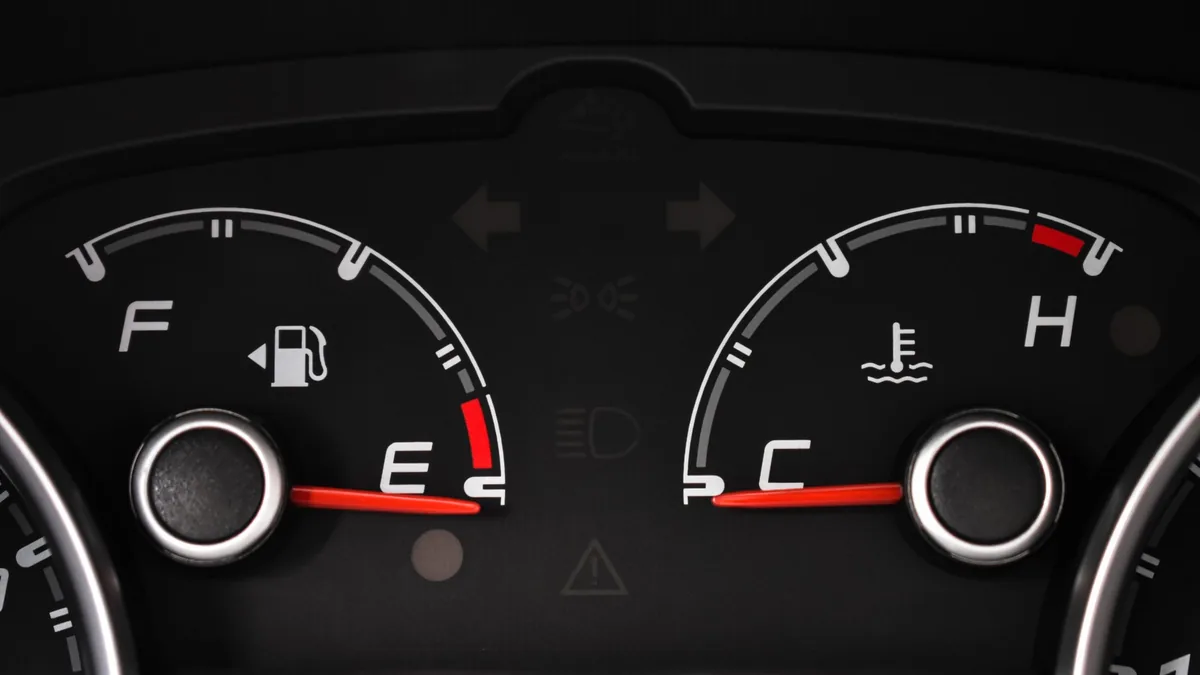
A full to full fuel policy means you collect the car with a full tank and hand it back with a full tank. You pay only for the fuel you actually burn, bought at an ordinary pump. If the car comes back short, the supplier refuels it and bills you for the litres plus, usually, a service charge. On a Pakistan rental, three extra details decide whether that goes smoothly: whether "full" was written down at handover, whether the car also runs on CNG, and whether you filled up close enough to the drop-off that the needle is still on the top line when the supplier checks it.
If you are still deciding between driving yourself and having a driver, our guide to self-drive questions for overseas bookers covers eligibility, deposits and handover first.
What a full to full fuel policy means on a Pakistan rental
The idea is simple, and so is the way it goes wrong. The supplier fills the tank before you arrive. You drive, refuel wherever suits you, and before the return you top the tank back up. Nobody pays anyone for fuel at the counter.
The problems come from three places:
- "Full" was never recorded. A verbal "tank is full, sir" at a busy handover carries no weight later. If the handover sheet has no fuel box ticked, or the box says "3/4" while the needle sat on F, you have nothing to point to.
- The needle lies a little. Most fuel gauges read "full" for the first stretch of driving after a fill. As an example, a car filled a few kilometres before the drop-off will usually still show F; one filled on the far side of the city may not. Suppliers know this, and some check by topping up themselves.
- The car has two fuel systems. Many cars in Pakistan are fitted to run on compressed natural gas as well as petrol. A full to full clause may cover the petrol tank only, the CNG cylinder only, or both. If the paperwork does not say, ask.
None of this is unique to Pakistan, but the handover culture is often less formal than at a large international rental desk. That is why the written record matters more, not less.
Full to full, same to same and prepaid: the three policies side by side
Before you compare daily rates, compare fuel terms. A cheaper car with a punitive fuel clause can cost more than a slightly dearer one with a fair clause.
| Policy | How it works | Suits you if | Watch for |
|---|---|---|---|
| Full to full | Collect full, return full | You will drive a fair distance and can refuel before return | Refuelling charge and service fee if short; what "full" means for a CNG cylinder |
| Same to same (also called like for like) | Return at the level you received it | Short hires where you will not use much fuel | Starting level must be written precisely, e.g. "half", not "some" |
| Prepaid fuel | Pay for a full tank up front, return at any level | Early-morning returns with no time to refuel | Usually no refund for unused fuel; check the per-litre rate against pump prices |
Same to same fuel policy: precision is everything
A same to same fuel policy sounds relaxed, and on a short hire it can be. The catch is that "same" only works if both sides agree what the starting level was. "Quarter tank" and "just under half" are very different amounts of fuel on a sedan, and a gauge with no markings between E, ½ and F leaves a lot of room for argument.
If you are offered same to same, ask for the starting level to be written as a fraction on the handover sheet, and photograph the gauge with the odometer in the same frame. At return, aim to be slightly above the starting level rather than slightly below. A little extra fuel is cheaper than a dispute.
Prepaid fuel vs full to full
The prepaid fuel vs full to full question comes down to timing and distance. Prepaid makes sense if your return is at an hour when you would rather not stop, or if you expect to bring the car back nearly empty anyway. It rarely makes sense on a short city hire, because you pay for a full tank and typically get nothing back for what is left.
If a supplier offers prepaid, ask three things: the per-litre rate they charge, whether that rate follows the current official pump price, and whether any unused fuel is refunded. Then compare the answer with what you would pay at a pump. Official petrol and diesel prices are notified by the regulator and change often, so a rate that was fair last month may not be fair this week.
At pickup: photograph the gauge before you move
The first two minutes at pickup protect you for the whole hire. Do this before you adjust the mirrors or load the bags.
- Switch the ignition on, engine off. Many gauges only read correctly with the ignition on. Wait a few seconds for the needle to settle.
- Take one photo that shows the fuel gauge and the odometer together. On most cars they sit in the same cluster. The odometer reading ties the fuel level to a moment in time.
- If the car is CNG-fitted, photograph the CNG gauge too. It is often a separate small dial or a row of lights near the switch that changes fuel. Take a second photo showing which fuel the switch is set to.
- Check the handover sheet says the same thing. If the sheet says "full" and the needle is a hair below, ask for it to be corrected or noted. It is a small conversation now and a long one later.
- Send the photos to yourself or the booking contact. A WhatsApp message to the supplier's handover contact with "Fuel full, odometer 48,210, 10:15" (an example) gives both sides a timestamped record.
- Ask where the supplier normally refuels. Staff usually know the nearest reliable pump to their own yard. That is useful information for your return.
Keep the photos until any deposit has been returned in full. Deleting them the day you hand back the keys is a common mistake.
Petrol grade and CNG-fitted cars
Which petrol to put in
At a Pakistani pump you will generally see a standard petrol, a higher-octane premium petrol and diesel. Pakistan State Oil, which runs the country's largest network of retail fuel stations, lists its current forecourt grades as Premier Euro 5 (standard petrol), Octane+ Euro 5 (premium petrol) and Hi-Cetane Diesel Euro 5 on its official website. Other retailers use their own brand names for similar grades.
For a full to full return, the rule is: put in what the supplier puts in. Ask at pickup, and if the answer is "any petrol," confirm whether they mean standard or premium. Most everyday rental sedans and hatchbacks run on standard petrol. Some turbocharged or higher-performance cars need premium, and a few SUVs and vans run on diesel. Putting petrol into a diesel vehicle, or diesel into a petrol one, is a far bigger problem than a short tank, so check the label inside the fuel flap before the attendant starts.
A practical point: at many Pakistani stations an attendant fills the tank for you. Say the grade clearly, and say "full" rather than a rupee amount if you want the tank brimmed. Watch that the pump display resets to zero before filling begins.
CNG-fitted cars: two tanks, two questions
Pakistan built one of the world's largest fleets of natural-gas vehicles; it had the second largest, about 2.85 million, by the end of 2011, according to the natural gas vehicle entry on Wikipedia, which also notes that almost every converted car in Pakistan keeps the ability to run on petrol. So a rental you pick up may have a CNG cylinder in the boot as well as a normal fuel tank.
That raises two questions a full to full clause should answer:
- Does "full" apply to the petrol tank, the CNG cylinder, or both? Some suppliers only care about petrol. Others expect the cylinder back full too.
- Are you allowed to use CNG at all? Some suppliers prefer the car to run on petrol only. Others are happy for you to use gas.
The same entry records repeated CNG shortages in Pakistan and a 2012 government decision to ban new CNG conversions as the start of a phase-out. In practice, a CNG station near your drop-off may have a queue, restricted hours or no gas on the day. If the contract expects a full cylinder, plan a fallback: fill the gas earlier on the route and top up the petrol near the end.
Also be aware that the cylinder often takes up boot space. If you are carrying airport luggage, check the boot before agreeing to a CNG-fitted car.
Finding a pump near the drop-off point
The single most useful habit on a full to full hire is choosing your last pump the day before you return, not in the final twenty minutes.
Pick a pump on the approach, not beyond it
Look at the route into the drop-off point and pick a station on your side of the road, on the way in. Doubling back across a divided carriageway to reach a pump on the other side can cost you far more time than it looks on the map, especially at peak hours in the big cities. On a motorway approach, the service areas are the obvious choice, but work out how far the last one is from your exit. If it is a long way out, top up again after you leave the motorway.
Airport drop-offs need extra margin
If you are returning the car at or near an airport before a flight, fuel is the step most likely to be squeezed. Build it into the plan the way you would build in check-in time. Work backwards from departure time, and add your refuelling stop and the handover inspection to that timeline.
Use the supplier's local knowledge
When you ask at pickup where staff normally refuel, you are also finding out which pump the supplier trusts. Filling there makes the reading on return less likely to be questioned.
Check official prices before you fill
Retail petrol and diesel prices in Pakistan are regulated. The Oil and Gas Regulatory Authority publishes its notified petroleum prices, and in 2026 new notifications have been appearing several times a month, sometimes on consecutive days, so do not assume last week's price still holds. It also publishes district and pump-wise oil prices. If your hire spans a price change, the refuelling rate a supplier charges should reflect the price on the day, and it helps to know what that was.
Keeping the last fuel receipt
The final fuel receipt is your proof that you did what a full to full fuel policy asks. It shows the station, the date, the time, the grade and the litres. On its own it does not prove the tank was full, but together with a gauge photo at return it makes a strong record.
- Ask for a printed receipt every time. Ask at the counter or the pump. If the pump only gives a handwritten slip, ask for the station name and date on it.
- Photograph the receipt immediately. Thermal paper fades, and receipts get lost in glove boxes.
- Keep the receipt with the car keys until handover. Then show it at inspection rather than hunting for it afterwards.
- If you paid by card or wallet, keep that record too. A card statement or app record with the station name and time backs up a lost paper slip.
The receipt matters most when the drop-off is some distance from the pump. If the needle has moved off full by the time you arrive, a receipt showing you filled 15 minutes earlier (an example) is a reasonable answer to "the tank isn't full."
If you return the rental car with less fuel
Sometimes it happens. A flight gets moved, a pump has a queue, or the last station on the route has run dry. If you return the rental car with less fuel than the policy requires, this is what to expect and how to keep it fair.
How refuelling charges are usually worked out
Suppliers generally charge for the missing fuel in one of three ways:
- Per litre at the pump price, with the supplier filling the car and passing on the actual cost.
- Per litre at a higher refuelling rate, which covers the staff time to drive the car to a pump.
- A flat refuelling fee plus the fuel, or a fixed charge per quarter tank.
The first is the fairest. Ask at booking which method applies and write the answer down. Our booking terms (planned link) set out how Pakistan Taxi handles enquiries and what is agreed with the supplier before a journey; the fuel method is part of what you should see confirmed by the supplier, not assumed.
What to do if you know you will be short
- Tell the supplier before you arrive. A short message saying "I will be about a quarter short, happy to pay the refuelling charge" turns a surprise into an agreed cost.
- Ask them to note the level at return in front of you. Then photograph the gauge and odometer yourself, as you did at pickup.
- Ask for the charge to be itemised. Litres, rate per litre and any fee should appear as separate lines, not as one deduction from the deposit.
- Compare the rate with the official price for that day. If the per-litre figure is far above the notified price and there was no service fee in the terms, raise it politely and in writing.
When the supplier says it is short and you think it is full
This is where your photos earn their keep. Show the pickup photo, the receipt and the return photo together. If the car was filled a long way from the drop-off, accept that the needle may have dropped and offer to pay the actual top-up amount. Most disagreements end quickly once both sides are looking at the same timestamped pictures.
A fuel checklist for the rental handover
Print this or save it on your phone. It covers both ends of the hire.
At booking
- [ ] Which fuel policy applies: full to full, same to same or prepaid?
- [ ] Is the car petrol, diesel or CNG-fitted? Which grade of petrol?
- [ ] If CNG-fitted, does "full" include the cylinder? Can you use CNG?
- [ ] How are refuelling charges calculated if you return short?
At pickup
- [ ] Photo of fuel gauge and odometer together, ignition on
- [ ] Photo of CNG gauge and fuel switch, if fitted
- [ ] Fuel level written on the handover sheet as a fraction or "full"
- [ ] Nearest trusted pump to the return point, from the supplier
Before return
- [ ] Final pump chosen on the approach side of the drop-off
- [ ] Printed receipt kept and photographed
- [ ] Extra time allowed for queues, especially before a flight
At return
- [ ] Photo of fuel gauge and odometer together, in front of staff
- [ ] Receipt shown at inspection
- [ ] Any refuelling charge itemised before you sign
Rules of the road worth knowing before you fill up
A few things sit alongside the fuel question and are worth settling before your hire starts.
Pakistan drives on the left. The US State Department's Pakistan country information page describes crowded roads, aggressive driving, poorly maintained surfaces and many vehicles without working headlights at night, and recommends travelling with experienced local drivers. The UK government's Pakistan safety and security advice says UK visitors need both a UK driving licence and a 1968 International Driving Permit, which must be obtained in the UK before you travel. The same advice warns against all or all but essential travel to parts of the country, including areas of Khyber Pakhtunkhwa, Balochistan and some districts of Azad Kashmir, so check the current map before planning any self-drive route.
Night driving and long cross-country runs also change the fuel picture. If you plan to cover a long distance, refuel before the tank drops low rather than hoping for a station further on, particularly on smaller roads where stations are further apart.
If the conditions above make self-drive feel like more than you want to take on, a car with a driver removes the fuel question entirely: fuel, parking and route choices become the operator's job. It is worth pricing both before you decide.
Planning a self-drive hire with Pakistan Taxi
Pakistan Taxi helps you plan and enquire about journeys across the country, including self-drive hire. When you send an enquiry, include the dates, the pickup and return points, and any fuel questions from the checklist above. The supplier's answer on fuel policy should come back in writing before you commit; we cannot promise a particular car, rate or fuel arrangement until a supplier has confirmed it.
For a wider look at rental options, including deposits and eligibility on the network side, our sister service iDrive, the network behind Pakistan Taxi, has a guide to self-drive car rental in Pakistan. If you have a question that this page does not answer, the help and journey planning page (planned link) is the place to start, or you can plan your journey (planned link) and add the fuel questions to your notes.