
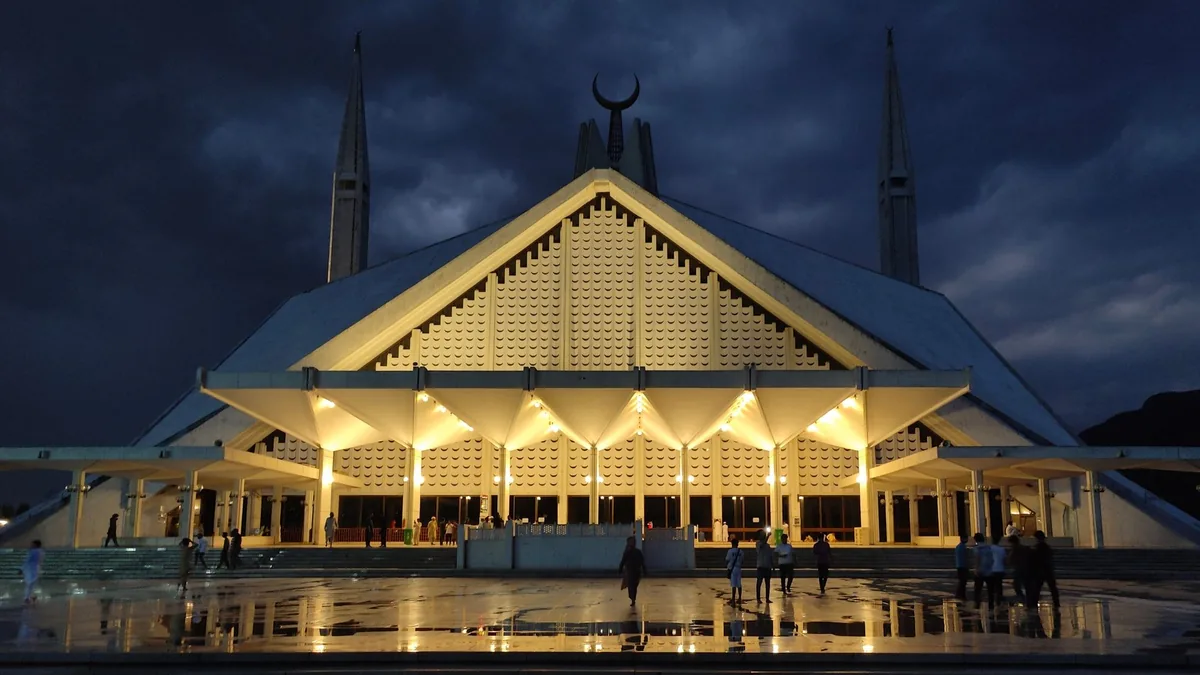
If your relatives have one free day in the capital, here is the Islamabad city tour that fits: Faisal Mosque in the morning, the Pakistan Monument and Lok Virsa in Shakarparian around midday, then Daman-e-Koh in the Margalla Hills for the late-afternoon view, finishing at dinner or back at the hotel. Four stops is enough. Try to squeeze in six and the elders spend the day in the back seat while the children fight over the window.
Two calendar checks shape the day more than anything else. Friday midday belongs to congregational prayer, so it's the worst time to arrive at the country's flagship mosque as a tourist. And the Pakistan Monument Museum is listed as open Tuesday to Sunday, so on a Monday you'd see the monument but not the galleries beneath it. Get those two right and the rest is mostly about shoes, water and one agreed meeting point.
The one-day Islamabad city tour at a glance
The order looks like a zig-zag on the map: north to the mosque, south-east to Shakarparian, then back north into the hills. That's deliberate. The mosque courtyard is at its calmest and coolest early; the museums give you shade and seats in the middle of the day; the Margalla viewpoint is at its best as the light softens.
| Stop | Best slot | What your group gets | Time to allow | Watch for |
|---|---|---|---|---|
| Faisal Mosque | Morning | The landmark everyone photographs, plus a quiet walk across the courtyard | 60-90 minutes | Prayer times, Friday midday, head coverings, shoes off |
| Pakistan Monument | Late morning | The petal-shaped national monument on the Shakarparian hills and its museum | 60 minutes | Museum listed as closed Mondays |
| Lok Virsa (Heritage Museum) | Midday to early afternoon | Indoor galleries of costumes, crafts and music from across Pakistan; food court and craft bazaar | 90-120 minutes | Allow a proper lunch stop here |
| Daman-e-Koh | Late afternoon | A panoramic view over the city from the Margalla Hills | 45-60 minutes | Winding road, weekend traffic, monkeys |
| Dinner or hotel | Evening | A sit-down meal before the drive home | Open | Book ahead for larger groups |
Times in the table are planning suggestions, not official figures. With a large family, add a buffer of half an hour between each stop for loading, unloading and the inevitable toilet queue.
Three checks before the day starts
1. Read the current travel advice
The UK Foreign, Commonwealth & Development Office (FCDO) does not place Islamabad or Rawalpindi in the areas it advises against travelling to, but its Pakistan travel advice does warn that attacks have taken place in Islamabad and other major cities, and that protests and marches can cause road closures at short notice. Its general guidance includes keeping a low profile, being ready to change plans and limiting movements on Friday afternoons. Read the latest version the evening before, and again in the morning if there's news of a march.
2. Pick the right day of the week
- Monday: Lok Virsa's own website lists the Pakistan Monument Museum as open Tuesday to Sunday, so Monday is the weakest day for this route.
- Friday: the midday congregational prayer draws large crowds to Faisal Mosque. If Friday is the only day, move the mosque to late afternoon, or visit only the grounds.
- Weekends: everything is busier, and the road up to Daman-e-Koh can clog in the evening.
A Tuesday, Wednesday or Thursday is the easiest fit.
3. Check Ramadan and public holidays
During Ramadan the FCDO advises visitors not to eat, drink or smoke in public in daytime, including in your car, and to check shop and restaurant opening hours. A sightseeing day still works, but plan the meal around iftar and expect heavier traffic as people head home at dusk.
Stop 1: a Faisal Mosque visit in the morning
Faisal Mosque sits at the northern end of Faisal Avenue, right against the Margalla foothills. Designed by the Turkish architect Vedat Dalokay after an international competition and completed in 1986, it has no dome at all: the prayer hall is a tall, tent-like form framed by four minarets. According to its Wikipedia entry, the main areas hold about 74,000 worshippers and the grounds far more. For your relatives, the practical point is that it's big. The walk from the car to the courtyard and across it is the longest stretch of walking on this route, and the marble can be hot underfoot by late morning in summer.
Dress: sort it before you leave home
The FCDO's guidance for Pakistan is simple: dress modestly, with shoulders and legs covered in public, and women should cover their heads when entering mosques and holy places. For a family day that means:
- a dupatta or scarf in every woman's and girl's bag, not just one spare in the boot
- long trousers for men and teenage boys rather than shorts
- slip-on shoes, because they'll come off before the prayer areas and go back on several times during the day
- a small cloth bag to carry shoes in, so nobody has to hunt for a pair afterwards
Prayer times and the tourist rhythm
The five daily prayers move through the year with the sun, so check the times for Islamabad on the day. As a rule of thumb for sightseeing:
- Arrive well clear of a prayer time, not ten minutes before it.
- If the call to prayer begins while you're inside, members of the family who wish to pray can join; everyone else should step to the side, keep voices down and put phones away rather than photographing worshippers.
- Avoid Friday midday entirely unless your group is going specifically to pray.
The morning slot suggested in the table usually sits comfortably between the dawn and midday prayers, which is exactly why the mosque goes first.
Stop 2: the Pakistan Monument on the Shakarparian hills
From the mosque, head south-east across the city to Shakarparian, the wooded hill park near Zero Point. The Pakistan Monument, opened on 23 March 2007, is the national monument: seven petals that, according to its Wikipedia page, stand for the Punjabi, Sindhi, Baloch and Pakhtun cultures (the four large petals) and for minorities, Azad Kashmir and Gilgit-Baltistan (the three small ones). The inner walls carry murals of other landmarks, such as Lahore Fort and the Badshahi Mosque, which makes it a surprisingly good stop for children who have just been told the country's history on the drive over.
Pakistan Monument timings
The monument grounds and the museum are worth thinking about separately. Lok Virsa, which lists the Pakistan Monument Museum among its facilities, gives the museum's hours on its official website as Tuesday to Sunday, 10am to 8pm. That tells you two things: Monday is out for the galleries, and there's no need to rush here first thing. Hours can change around national days and events, so check the site or ring the number listed there before you go.
The museum includes a wax museum and a small auditorium. If your group includes grandparents who have strong memories of the Independence era, allow a little longer than you think. That's often the part of the day they talk about at dinner.
Walking and parking
The monument stands on the Shakarparian hills, so expect a walk from wherever the car is parked. It's open to the sky with little shade at midday in summer, so this is the moment for water bottles and caps. Let a driver drop the older members of the group as close as permitted and collect them from the same spot. It saves knees and saves arguments.
Stop 3: Lok Virsa for lunch and the heat of the day
Lok Virsa, on Garden Avenue in Shakarparian, is the home of the national ethnology collection. Its Heritage Museum shows the costumes, jewellery, musical instruments, woodwork and everyday objects of communities from every part of Pakistan. For a mixed family it has a rare quality: the Pakistani-born members recognise things, and the UK-born or Gulf-raised children get the story behind them.
On its website, Lok Virsa lists the Heritage Museum (National Museum of Ethnology) as open all week, 10am to 8pm, with the craft and artisan bazaars and the food court open Monday to Sunday, 10am to 8pm. Third-party listings don't always match, so treat the official site as the reference and check it the week you travel.
Why put it at midday? Three reasons:
- It's indoors. In May, June or a humid monsoon afternoon, a gallery beats a hilltop.
- There's food and seating on site. A food court means you can feed everyone without getting back in the car.
- The craft bazaar solves the gift question. Relatives flying home always need something to take back. Buying it here saves a separate stop at a market.
Stop 4: Daman-e-Koh for the late-afternoon view
Daman-e-Koh is a viewpoint in the Margalla Hills, on the Pir Sohawa road, run by the Capital Development Authority. At around 2,400 feet it sits roughly 500 feet above the city, and from the terrace your group can pick out Faisal Mosque, Seventh Avenue and Rawal Lake, which neatly ties the morning's first stop to the day's last. The whole hill range belongs to Margalla Hills National Park, established in 1980.
The road and the parking
The approach road is narrow and winding, and it backs up on weekend evenings and public holidays. Practical consequences:
- Go on a weekday if you can, and aim to arrive well before sunset rather than at it.
- Expect the car park to be the busiest point of the day. Agree before you get out exactly where the car will wait, because turning round to re-collect a straggler here is slow.
- Anyone prone to car sickness should sit in the front for the climb.
Monkeys and wildlife
Rhesus macaques live throughout the Margalla Hills and are well used to visitors with snacks. Keep food in bags, don't feed them, and keep small children's ice creams in the car. It's a national park; the animals are wild, however tame they look.
What's no longer up there
Many overseas relatives remember a dinner at Monal on the Pir Sohawa ridge. The Monal and La Montana restaurants inside the national park were demolished in 2024 on the order of the Supreme Court of Pakistan, so don't plan the evening around them. Build the meal into the city instead, as below.
Ending near a restaurant or hotel
The simplest way to end an Islamabad city tour is to come down from the hills and eat in the city sectors on the way back to wherever your group is staying. Rather than recommending specific restaurants, which open, close and change quickly, here's how to choose:
- Decide before lunch, not at 7pm. A family of twelve arriving unannounced at a popular place on a Thursday night will wait.
- Choose by direction. If your relatives are staying in Rawalpindi or heading to the airport the next morning, eat on that side of the city so the last drive is short.
- Ask for parking and a ground-floor table. Grandparents and pushchairs don't do stairs gracefully after a long day.
- If the group is staying at a hotel, consider its restaurant. It removes the final drive for anyone who's exhausted, and the driver can drop everyone at the door.
- Tell the driver the final address in advance. A drop-off plan agreed at breakfast avoids a debate in a dark car park.
When one guest is late or goes missing
Every family day out has one. A cousin whose flight got in late, an uncle who "just popped out" for tea, a teenager who wandered off at the monument. The fix isn't a clever app; it's one rule agreed at breakfast.
The 15-minute rule
Before the first stop, tell everyone: "If you're not at the car within 15 minutes of the agreed time, we go to the next stop and you meet us there." Then make it workable:
- Share the day's plan in the family WhatsApp group with each stop, its rough time slot and the address. Anyone who falls behind knows where to catch up.
- Name one coordinator who holds the plan and the driver's number. Not the driver, who needs to concentrate on the road, and not the most talkative uncle.
- Save the driver's number in every adult's phone, including the overseas relatives who may be on a local SIM or roaming.
- Pick a fixed meeting point at each stop, such as the main gate or a named car park entrance, not "near the car".
- Check phones are charged. A power bank in the coordinator's bag is cheaper than a search party.
If someone is late to start
When a guest is still asleep, stuck in traffic from Rawalpindi or waiting on a late flight, don't hold the whole group at the first stop. Go ahead with the mosque; they can join at Shakarparian, which is central and easy to reach. If they're arriving from the airport the same day, see our Islamabad Airport journey guide (planned link) for how the arrivals side works, then point them straight to the midday stop.
If someone can't be found
Stay calm, and work through it in order:
- Call and message them first. Most "missing" relatives are in the toilet queue or the gift shop.
- Send one person to the agreed meeting point and keep everyone else together at the car. Splitting the group into three search parties just creates three new missing people.
- Ask staff or security at the site to keep an eye out, and give them a description.
- Give it the full 15 minutes, then follow the rule: the group moves on, one adult stays behind or the driver comes back.
- If a child or a vulnerable adult is missing, don't wait at all. Alert site security and call the police on 15 immediately (1122 is the ambulance and fire number, both listed in the FCDO advice).
A worked example
*Example only:* a family of nine is at Lok Virsa. One cousin hasn't come back from the craft bazaar at the agreed 2pm. The coordinator calls her, sends her brother to the main entrance and waits at the car with everyone else. At 2:15 she still hasn't surfaced but has messaged that she's paying for something. The group leaves for Daman-e-Koh as agreed; her brother waits with her, and the driver returns for both of them after dropping the main group. Nobody sits in a hot car for 40 minutes, and nobody misses the view.
Islamabad sightseeing with family: pacing everyone
Visiting relatives come in all ages. A few adjustments keep the day kind to everyone.
- Grandparents: the long walk at the mosque and the walk up at the monument are the hard parts. Drop them close to entrances, bring a folding stick or walker if they use one, and plan a seated rest at Lok Virsa.
- Young children: snacks in bags (away from the monkeys), a change of clothes, and one screen-free promise per stop so they look up at the minarets rather than down at a tablet.
- Anyone fasting: in Ramadan, cut the route to two stops and schedule the viewpoint close to iftar with food waiting at the end.
- Heat: June is the hottest month, with average highs that routinely pass 38°C. If the forecast is harsh, keep the open-air monument stop short and spend the hottest hours indoors at Lok Virsa.
Places to visit in Islamabad in one day, if you have spare time
If the family moves faster than planned, add one of these on the way rather than bolting on another cross-city drive:
- Saidpur village, which has a preserved Hindu temple and a history reaching back to the Mughal period
- The Islamabad Museum, known for its Gandhara-period relics
- A short stroll in Shakarparian before leaving the park
Keep additions short. The point of a one-day route is that everyone finishes it still speaking to each other.
Planning the car and driver for the day
A sightseeing day with four stops and a group that gets in and out repeatedly suits a car with a driver who stays with you, rather than separate rides between each stop. The driver learns the group, keeps bags and shoes safe in the vehicle, and can come back for a straggler without anyone having to arrange a new pickup. Our car and driver service explains how a day with one driver is set out, and if you're still weighing it up, this comparison of chauffeur duty and separate transfers walks through who is responsible for what.
For a bigger family, the real question is one vehicle or two. A single van keeps everyone together, which helps with the 15-minute rule; two cars let the grandparents leave early without ending the day for the teenagers. Our guide on a group van or several cars sets out the trade-offs.
When you share your plan with us, include:
- the date and whether it's a Friday, Monday or a day in Ramadan
- the pickup address and the final drop-off (home, hotel or restaurant)
- the number of adults, children and anyone with limited mobility
- the four stops in order, and any extras you'd like if time allows
- the name and phone number of the family coordinator
You can plan your Islamabad day out with Pakistan Taxi (planned link) and our team will come back to you about what's possible on your date. It's a planning enquiry, not a booking: sending it doesn't fix a fare or reserve a vehicle. Pakistan Taxi is part of the iDrive network, and if you'd rather arrange it through our sister service directly, iDrive's Islamabad and Rawalpindi car hire page covers the same cities.