Yes, you can usually order a Yango at Islamabad Airport, because Islamabad and Rawalpindi are both on the company's list of Pakistani cities. The harder question is whether you should, with parents, children and a trolley stacked with suitcases. Three things decide it. First, the app needs a working number and mobile data the moment you clear customs, and a phone brought from abroad has its own rules in Pakistan. Second, the standard cars are small hatchbacks and saloons, fine for two people with cabin bags and a squeeze for anything more. Third, and most important, the UK government currently tells British travellers to avoid online taxi apps in Pakistan altogether and to use licensed companies you call instead. If you are travelling alone or as a couple, light, with local data sorted and a daytime landing, an app ride may suit you. If you are a family of four or more, landing after midnight, or collecting elderly relatives, a car arranged before you fly takes most of the guesswork away.
Below is what we would want to know standing in the arrivals hall at ISB: how the app works here, what to set up before you board, what the kerbside pickup is really like, and a fallback plan for when things do not line up.
Can you get a Yango at Islamabad Airport, and how does it work here?
Yango is a ride-hailing service run by Yango Group, a Dubai-headquartered business that grew out of Yandex. According to the company's Wikipedia entry, its ride-hailing arrived in Pakistan in 2023. Its own Pakistan site currently lists six cities: Lahore, Karachi, Islamabad, Rawalpindi, Faisalabad and Multan.
The mechanics will feel familiar if you have used any app in London, Dubai or Toronto:
- You install the app (iOS or Android) or use the browser version.
- You sign up with a mobile number, so that number has to be reachable when you land.
- You set a pickup point and a destination.
- The app shows the fare before you confirm, and you choose a class.
- A nearby driver accepts, and you can watch the car approach on the map.
Yango says it accepts cash and cards, including Visa and Mastercard, and offers in-app route sharing, an SOS button and round-the-clock support. Those are the company's own descriptions of its service; how well any single trip goes depends on the driver who accepts, the traffic and the hour.
One point worth stating plainly: the fare the app shows is the app's price for that request at that moment. It can differ from one request to the next, and nothing about it is agreed with you in advance of landing. That is the core difference between hailing on arrival and arranging a car ahead.
Read the official safety advice before you open any app
Most people skip this part. Families should not.
The UK Foreign, Commonwealth & Development Office's Pakistan safety and security advice says, in so many words, to avoid street taxis, e-taxis and online apps for taxi services, and to use only taxis from reputable, licensed companies where you call for the car. That guidance covers the whole country, Islamabad included. It is advice rather than law, and plenty of residents use apps daily, but if you are a British traveller it is the position your government takes, and it is worth knowing before you choose.
The United States takes a similar line. Its Pakistan country information page currently rates the country at Level 3, "Reconsider Travel", and states that, for security reasons, US government employees are prohibited from using all forms of taxis or rideshare. It also warns that many vehicles lack working headlights and that roads are often poorly lit, which is relevant if you land at 2am.
To keep this in proportion: Islamabad, Rawalpindi and Lahore are not among the areas where the FCDO advises against all or all-but-essential travel, according to the main FCDO Pakistan page as last updated on 22 September 2026. The same advice does record attacks in major cities, including a suicide bombing at a mosque in Islamabad on 6 February 2026, and flags planned protests in Islamabad and Rawalpindi. Check the page again the week you fly; it changes.
What has to be on your phone before you can request a ride
An app ride starts working the moment your phone does. At ISB, that is not always the moment the plane doors open.
Data: roaming or a local SIM
You have two realistic options for data on arrival:
- Keep your home SIM on roaming. Check with your network before you fly that Pakistan is covered and what a day costs. The advantage is that your sign-up number stays the same and data should work as soon as your phone finds a partner network.
- Buy a Pakistani SIM. Usually better value for a long stay, but it is issued in your name against your CNIC or passport, which takes time you may not want to spend with tired children. Our Islamabad Airport journey guide (planned link) covers the rest of the arrival sequence.
Do not count on public wi-fi to carry you through. A ride request that drops out as you walk to the kerb is exactly the failure you want to avoid.
The PTA rules on phones brought from abroad
Pakistan runs a device registration system called DIRBS. According to the PTA's DIRBS frequently asked questions, international travellers have 60 days from arrival to register a device without paying duties. There is also a temporary registration for one device, valid for 120 days from arrival, which pairs the handset with a Pakistani SIM issued in your own name. A phone used purely as a roamer on its foreign SIM is allowed service under that roaming SIM. For a two-week wedding trip on roaming, none of this should get in your way; for a long stay or a local SIM, read the FAQ before you land.
Payment
Yango says it takes cash as well as Visa and Mastercard. Two practical notes for arrivals:
- If you intend to pay in cash, you need rupees before you reach the kerb. The airport's official site lists banks, ATMs and currency exchange among its facilities; use them before you head outside.
- If you pay by card, tell your bank you are travelling. A card blocked for a foreign transaction at 1am is a long conversation to have from a pavement.
A two-minute check before you board
If you are setting up the Yango app for Pakistan for the first time, do it at home on your own wi-fi, not in the queue for immigration.
- Is the app installed and signed in, with your number verified at home?
- Will your data work in Pakistan from the moment you switch on?
- Have you saved the exact address of where you are going, with a landmark your driver will recognise?
- Does someone at home, or at the house you are heading to, know your flight number and landing time?
Where drivers meet you at Islamabad Airport
Islamabad International Airport sits near Fateh Jang in Attock District, about 25 km south-west of the city, and it is roughly as far from Zero Point in Islamabad as from Saddar in Rawalpindi. It opened on 6 May 2018, and its official site describes it as managed by the Pakistan Airports Authority. Road access runs along the Srinagar Highway towards Islamabad, via the GT Road (N-5) towards Rawalpindi, and onto the M-1 and M-2 motorways at their interchange. The airport's Wikipedia entry summarises the layout and the road links.
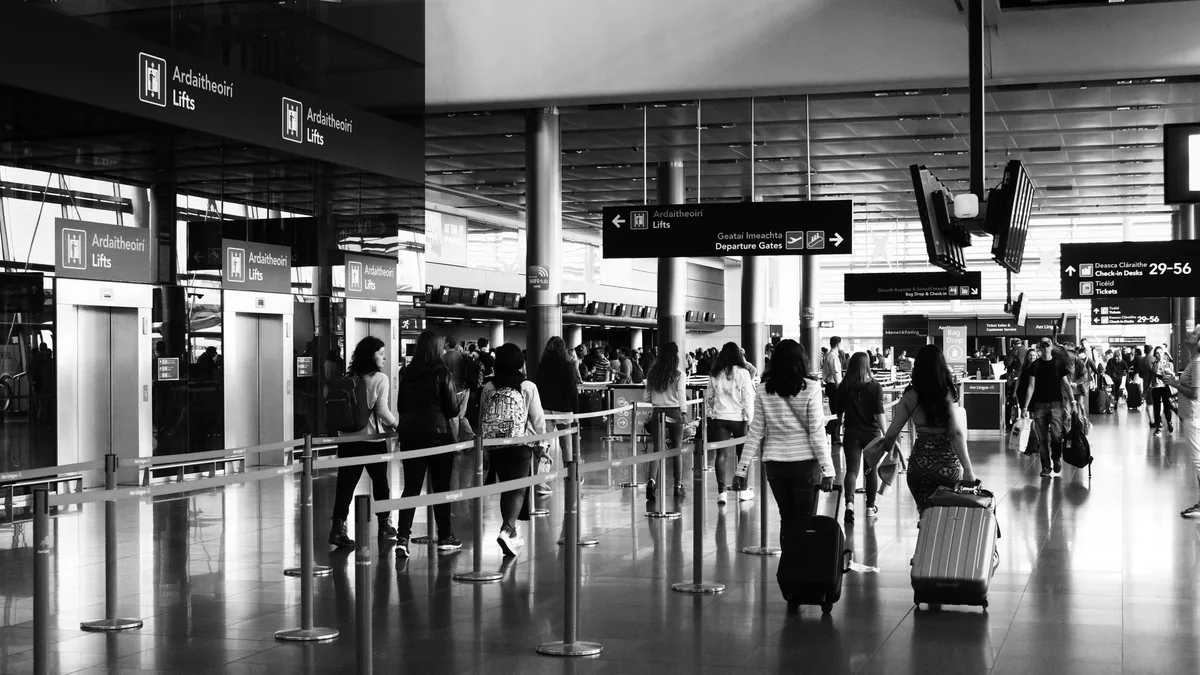
For app rides, the key fact is this: the airport's official site does not publish a designated ride-hailing pickup zone, so there is no signposted Yango Islamabad Airport bay we can point you to. You set a pickup point in the app, the driver heads for it, and between you, you work out where on the forecourt you actually are. In practice that means:
- Request only once you have your bags and are through customs. Requesting from the baggage belt means a driver circling or waiting, and potentially a cancellation.
- Walk out and fix your position first. Pick a spot you can describe: an exit, a pillar, a sign. Then drop the pin there, not inside the terminal building.
- Contact the driver as soon as the ride is accepted. A short message (for example, "two adults, one child, three large suitcases, standing outside the exit by the coffee counter") saves both of you a phone call.
- Check the car before loading. Match the plate, model and driver name to the app. If they do not match, do not get in.
- Keep one adult with the bags and children while another finds the car. Forecourts at night are busy and noisy, and a family split across two kerbs is how things get lost.
Forecourt arrangements are not published, so treat any photo or pin you have seen online as a rough guide rather than a map.
Car classes and whether your luggage will fit
This is where families most often come unstuck. Yango's Pakistan site describes four options. Two of them, Bike and Rickshaw, are irrelevant for an airport run with luggage. The other two are ordinary small cars.
| Yango option | Example models the company gives | Realistic airport fit |
|---|---|---|
| Economy | Kia Rio, Volkswagen Polo, Hyundai Solaris | One or two passengers with cabin bags or one medium case each |
| Comfort | Kia Rio, Mitsubishi Mirage, Suzuki Dzire; described as newer with more legroom | Much the same boot space as Economy; better for a tall passenger than for extra bags |
| Bike | Bajaj Boxer, Haojue HJ125 motorcycles | Not suitable with luggage |
| Rickshaw | Piaggio Ape, TVS King three-wheelers | Not suitable for the airport run |
The model names are Yango's own examples; the "realistic fit" column is our editorial judgement, not a published limit. None of these is an estate car, a people carrier or a minivan, and nothing in the class descriptions promises boot space. A typical diaspora arrival, say two adults, two children and four large checked cases plus hand luggage, will not fit in one small hatchback, even with a roof rack you cannot count on. The honest options are two cars or one larger vehicle arranged in advance.
If you do split into two app rides, agree before you leave the terminal who goes in which car, make sure each car has at least one adult with a charged phone, and share both trips with whoever is waiting at the house. Our guide to matching the vehicle to your family's luggage goes through case counts and vehicle types in more detail.
Late-night arrivals and waiting at ISB
If your flight lands in the small hours, the calculation changes in four ways.
- Fewer cars nearby. The airport is 25 km out of the city. At 3am, the nearest available driver may be some distance away, and the wait is whatever the app says it is.
- Tired decisions. After an overnight flight, checking plates, confirming names and managing children is harder than it sounds.
- Darker roads. The US advisory specifically warns about unlit roads and vehicles without working headlights after dark.
- Everyone at home is asleep. If a ride fails, the person you would normally ring for help may not pick up.
None of that means an app ride cannot work at night. It means you want a written plan before you land: who knows your flight, who you call if the phone does not connect, where you will wait. Our late-night arrival contact plan is a template you can fill in and send to the family group before you board.
Waiting is the other half. An app driver is responding to a request made on the spot; they are not tracking your flight. If immigration is slow or a bag is late, you simply request later. A pre-arranged driver, by contrast, is working to a flight number, which is the main thing you are paying attention to when you compare the two.
Yango in Islamabad, Rawalpindi and Lahore once you are settled
Once you have landed and your number and data are working, the picture changes. For short hops inside Islamabad, between sectors, to a restaurant, to a relative's house in Rawalpindi, a small car is usually all you need, and the app's upfront fare lets you see the price before you commit. The same applies to Yango in Lahore, where the company also operates. The official advice quoted above still stands, so weigh it for yourself, and keep using the in-app checks every time.
A few habits help for city trips:
- Share the trip with someone every time, not just from the airport.
- Sit in the back, and keep bags where you can see them.
- Save addresses with a nearby landmark; house numbers alone can be hard to find in some sectors and colonies.
- If a driver asks to cancel the ride in the app and take cash off the books, decline. You lose the tracking and the record.
If you are landing in Lahore rather than Islamabad, the phone, luggage and fallback advice here applies just the same.
When a prebooked car makes more sense than an app
A ride from Islamabad airport to the city covers roughly 25 km to either centre, and more if the family home is on the far side of either city or out towards Taxila. Use this as a quick sorting test. If two or more of these apply, arrange the car before you fly.
- More than three passengers, or more than three large cases. You will outgrow an Economy or Comfort car.
- You are landing between late evening and dawn. Fewer cars, darker roads, sleepier family.
- Someone in your party needs help. Elderly parents, a wheelchair, a baby seat, someone recovering from illness. The airport runs a disability assistance helpdesk on 051-59050252; a driver who knows in advance can wait where that assistance brings you out.
- You do not yet have working data. No data, no app.
- Your onward journey leaves the twin cities. A first run to somewhere like Jhelum, Taxila or Murree is a different job from a city hop, and the app classes above are built for city trips rather than long runs with luggage.
- You are British or American and want to follow your government's advice. The UK advises against app taxis, and the US bars its own staff from all taxis and rideshare.
- Someone else is paying or organising. For example, a relative in Birmingham booking a car for parents landing from Jeddah needs a named driver and a phone number, not an app login.
If only one or none applies, and you are comfortable with the official advice, an app ride may be perfectly reasonable. That is your call to make with the facts in front of you.
For longer onward trips, our Islamabad onward journey planning guide walks through the decisions on timing, stops and vehicle size.
A fallback plan that fits on one screen
Even the best-laid plan needs a second option. Put this in a note on your phone, and send a copy to whoever is expecting you.
Plan A: the car or app ride you intended.
Plan B, if the app will not connect or no car accepts:
- Move back inside the terminal to a well-lit, staffed area rather than waiting on the kerb.
- Use the airport's banks and exchange counters if you need rupees for another option.
- Call the family contact who knows your flight, and let them arrange a car by phone.
Plan C, for a light traveller in daylight: the Rawalpindi-Islamabad Metrobus Orange Line runs from the airport to Peshawar Morr, a 25.6 km route that opened in April 2022, according to the Metrobus article on Wikipedia. Hours and fares are not published there, so check locally before relying on it, and it is not a sensible choice with a family and a trolley of cases.
Always:
- Screenshot your destination address, in English and Urdu if you can.
- Keep your passport and phone on your person, not in a bag in the boot.
- Know your flight number and landing time so anyone helping you can check it.
Where Pakistan Taxi fits in
Pakistan Taxi is a planning service, not an app you hail from the kerb. You tell us your flight, who is travelling, how many bags you have and where you are going, and we work with you on a vehicle that fits, a meeting arrangement and timings. We will not pretend to quote a fixed price or promise a particular car before the journey details are confirmed, because at that stage nobody honestly can.
If you prefer a more direct airport-transfer page, our sister service iDrive, the network behind Pakistan Taxi, has a dedicated page for an Islamabad airport taxi.
When you are ready, start planning your journey from Islamabad airport (planned link) with your flight number, passenger count and luggage, and we will take it from there.