The short answer to rickshaw vs taxi in Pakistan: a rickshaw is fine for a short, daytime hop across a neighbourhood with one or two adults and a handbag. The moment you add suitcases, small children, an older relative, a long road, the midday heat or a monsoon downpour, a car with doors, seatbelts and a boot is the better choice. Most visiting families end up using both: a rickshaw for the five-minute run to the bazaar, a car for the airport, the wedding hall and anything that leaves the city.
One safety point before anything else. The UK government's Pakistan safety and security advice tells visitors to avoid street taxis, e-taxis and online taxi apps, and to use reputable, licensed companies where you call and the operator contacts the driver. It does not mention rickshaws by name, but one flagged down on the street is the same kind of unbooked ride. The same advice warns that street crime is a risk in crowded areas and asks you to be cautious moving around urban areas at night, especially on foot. The FCDO also advises against all travel to Balochistan and to several districts of Khyber Pakhtunkhwa, including Peshawar, and against all but essential travel to other areas such as northern Sindh and Azad Jammu and Kashmir; check the current FCDO Pakistan travel advice for the full list before you plan any journey, whatever the vehicle.
The quick decision: rickshaw or car?
If you only read one section, read this table. It compares a typical three-wheeler with a pre-arranged car and driver for the situations families actually face.
| Situation | Rickshaw | Pre-arranged car |
|---|---|---|
| Two adults, no bags, 10 minutes across town in daylight | Works well | Works, may be more than you need |
| Airport arrival with suitcases | Poor fit: little or no luggage space | Right choice |
| Baby or toddler who needs a car seat | No way to fit a child seat safely | Ask in advance; confirm before you travel |
| Older relative with limited mobility | Low entry, but no door or handle to hold, and a bumpy ride | Easier to get in and out, air conditioning |
| Summer afternoon in the plains | Open sides, hot air, exhaust fumes | Closed cabin with AC |
| Monsoon downpour | You and your bags get wet | Dry |
| Trip that leaves the city or uses a motorway | Not suitable | Right choice |
| Crowded old-city lanes and bazaars | Often the most practical way in | May have to drop you at the edge |
| Late at night | Not recommended | Better, especially if booked through an operator |
The pattern is simple. Rickshaws win on nimbleness and short distances. Cars win on everything that involves luggage, children, weather, distance or darkness.
What kind of rickshaw are you looking at?
"Rickshaw" covers more than one vehicle in Pakistan, and the difference matters for families.
The auto rickshaw (often CNG)
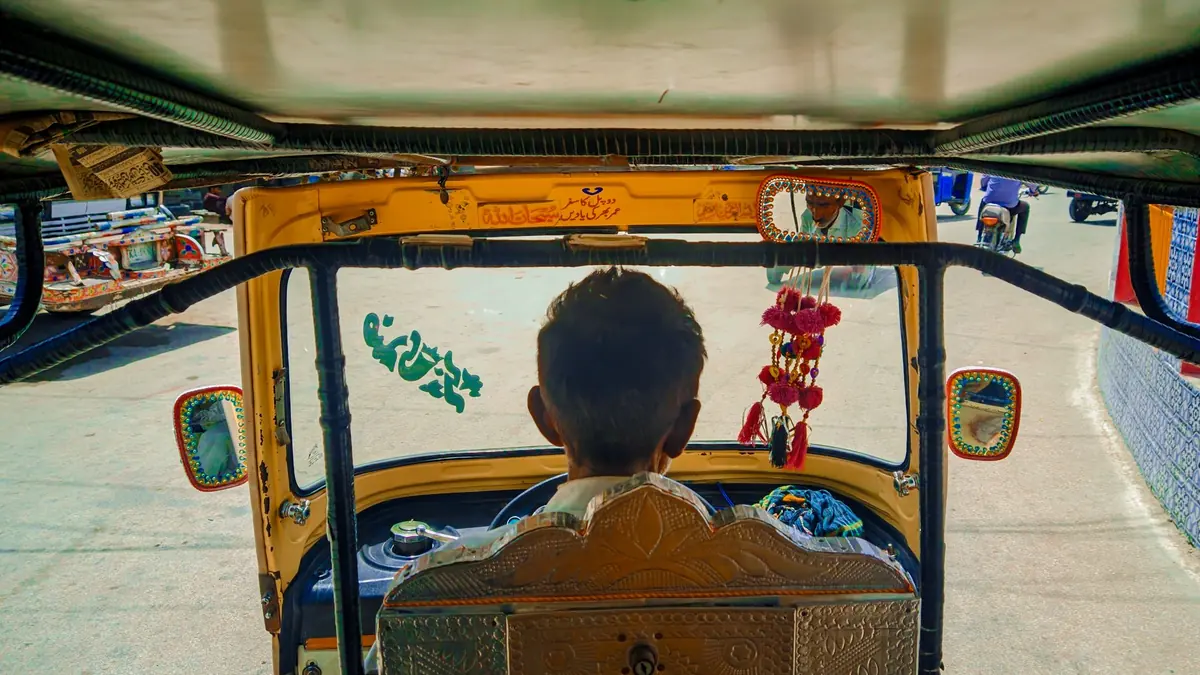
This is the familiar three-wheeler with a covered cabin, a driver in front and a bench for two or three passengers behind. Pakistan pushed these vehicles away from polluting two-stroke petrol engines towards compressed natural gas, and in Lahore all auto rickshaws have been required to run on CNG since 2002, according to Wikipedia's overview of transport in Lahore. As CNG rickshaws became costlier and less popular, the government began promoting electric rickshaws through easy loans from commercial banks in the major cities, as the auto rickshaw article summarises.
For a family, the auto rickshaw is the more comfortable of the two types: a roof, partial sides and a front-facing bench. It is still small. Two adults and a child on a lap is roughly the practical limit, and there is no proper luggage space.
The qingqi (chingchi) motorcycle rickshaw
The second type is built on a motorcycle, with a passenger platform bolted behind the rider. Locally it is called a *chingchi* or *chand gari*, a name borrowed from Jinan Qingqi, the Chinese motorcycle maker that first brought these vehicles to the market. In Karachi, Wikipedia's page on transport in Karachi lists rickshaws and qingqis alongside taxis, notes the city's large fleet of six-seater rickshaws, and describes the two-passenger three-wheeler as a short-distance vehicle.
Qingqi rickshaw safety is the question families ask most, and the honest answer is that it depends on what is in front of you. Before you climb in, look at the vehicle:
- Sides: is there anything between the passenger and the road apart from a rail? If not, a child on a lap is exposed.
- Seating: are passengers facing forwards, sideways or backwards? Rear-facing benches are unsettling for small children and hard for anyone holding bags.
- Load: a vehicle already packed with other passengers is a shared ride, not a private one.
- Condition: tyres, lights and brakes are worth a glance, particularly if you will be travelling close to dusk.
None of this means a qingqi is off-limits. For a short run down a familiar road with an adult who knows the area, many locals use them every day. It does mean that for a family with young children, older relatives or luggage, the covered auto rickshaw or a car is the better starting point.
Short city hops vs longer trips
Where a rickshaw earns its place
Rickshaws are at their best over short urban distances. They squeeze through lanes a car cannot enter, pull up at the gate of a relative's house in an old *mohalla*, and wait while you pick up sweets for the evening. For a visitor, a few situations suit them particularly well:
- A quick trip from the family home to the local market or the mosque.
- Getting from a main road into a crowded bazaar, where a car would crawl or be refused entry.
- A short hop between two houses in the same neighbourhood, in daylight, without bags.
If you are staying with family, the best rickshaw ride is usually one a cousin or uncle has arranged with a driver they already know. That familiarity does more for your comfort than any rule in this guide.
Why a rickshaw for long distance is a poor idea
A rickshaw for long distance runs into four problems at once.
- Speed and road type. A three-wheeler is a slow, light vehicle. It is not built for sustained speed or for fast national highways. Any trip between cities belongs in a car, a van or a coach.
- Exposure. Open or half-open sides mean an hour of hot wind in summer or rain in the monsoon. Neither is fun with children.
- Road conditions. The US State Department's Pakistan country information notes that roads outside major cities depend on the weather and are poorly maintained, that some drivers will come head-on in your lane to save time, and that many vehicles at night lack working headlights. A light three-wheeler is the last thing you want to be in on that kind of road.
- No real contingency. If a rickshaw breaks down halfway across a city, you can find another. If it breaks down on an open highway, you are standing by the road with your family and luggage.
Luggage and child safety: where the choice becomes obvious
A rickshaw ride with luggage
A rickshaw ride with luggage is possible in the loosest sense. Drivers will wedge a suitcase at your feet, tie one to the back, or balance a bag beside the driver's seat. What you lose is control. A bag strapped to the outside can shift or fall on a bump. A case at your feet leaves no room for your legs or a child. And if the bags are your only luggage for a month-long family trip, with gifts for half the *biradari* packed inside, that is a lot to trust to a length of rope.
A reasonable rule: if your luggage is more than one small bag per adult, it is time for a car. For airport runs in particular, you will almost always have more than that. Our guide to choosing an airport vehicle when your family has lots of luggage walks through how to count bags and passengers so the vehicle actually fits.
Children, car seats and older relatives
Here the gap between a rickshaw and a car is widest.
- Car seats. There is no way to fit a proper child restraint in a rickshaw. If your child uses a car seat at home, you will want a car with seatbelts, and you will need to say so when you plan the journey.
- Holding on. In a rickshaw, a toddler on your lap is held by your arms alone. Over speed bumps and potholes that is tiring, and the open sides do not help.
- Older relatives. Getting down into a low rickshaw bench and back out can be hard on knees and hips. A car with a door to lean on and a seat at a sensible height is kinder, and air conditioning matters more for older people in the heat.
- Prams and wheelchairs. A folding pram can go on a lap for a very short hop. A wheelchair is a car job, with the boot space confirmed in advance.
If you are travelling as a larger family group, our family vehicle (planned link) page describes the kind of car we would suggest for passengers, children and bags together.
Heat, dust and monsoon rain
Pakistan's weather changes the answer more than most visitors expect.
Summer heat
In the plains, June is fierce. Pakistan's climate profile gives a mean June temperature of about 38°C across the plains, with hot winds known as *loo* blowing during the day. The highest temperatures can exceed 53°C, and summers are at their most extreme in central Balochistan, southern Punjab and upper Sindh. In a rickshaw, you are sitting in that wind, plus the heat from the engine and the exhaust of the traffic around you.
For a short early-morning trip, it is bearable. For a midday run with children, it is not a comfortable choice. Carry water whichever vehicle you use, and plan longer journeys for the cooler parts of the day.
Smog and dust
The FCDO's Pakistan health advice warns that air pollution is a health hazard, especially from October to February, and that Punjab, particularly Lahore, suffers severe pollution in winter. An open-sided rickshaw offers no protection from smog or road dust. If anyone in your family is sensitive to poor air, a closed car with the windows up is the gentler option on bad days.
Monsoon rain
The FCDO notes that the monsoon season usually runs from late June to early October, bringing flooding and landslides that can damage infrastructure and disrupt travel across the country. City streets can flood quickly in a heavy shower. A rickshaw offers a roof at best; water sprays in from the sides, and low vehicles struggle through standing water. In monsoon weeks, keep rickshaw trips very short and have a car plan for anything important, such as a flight, a wedding or a hospital visit.
Agreeing a rickshaw fare without the awkwardness
Unless the rickshaw has a meter you can see working, treat the fare as something to agree before you set off. Fares change with fuel and gas prices, the time of day and how far you are going, so there is no single figure worth quoting here. What you can control is how you agree it.
- Ask a local first. Before you leave the house, ask your host roughly what the ride should cost. That one number is your best protection.
- Name the destination clearly. Give a landmark the driver will know: a well-known mosque, a market, a hospital or a chowk, not just a street number.
- Agree the fare before you sit down. Once you are seated with bags on board, you have lost your bargaining position.
- Confirm what the fare covers. Is it per rickshaw or per person? Does it include waiting while you shop? Does it include the return trip?
- Carry small notes. Drivers often struggle to change large notes, and "no change" can quietly become a tip.
- Stay polite and firm. If the price sounds far off what your host suggested, thank the driver and wait for the next one. There usually is a next one.
If a relative is with you, let them do the talking. A visitor with a foreign accent and a suitcase can hear a higher first price, in Pakistan as anywhere else.
When to switch to a car
You do not need to overthink this. Switch from a rickshaw to a car when any one of these is true:
- You have more than one small bag per adult.
- Anyone in the group needs a child seat, a wheelchair or help getting in and out.
- The trip is to or from an airport or railway station with a fixed time.
- The journey leaves the city, or uses a motorway or a busy national highway.
- It is the middle of a summer afternoon, a smog day or a monsoon storm.
- It is after dark, especially on unfamiliar roads.
- You are heading to something that cannot be missed: a flight, a *nikah*, a medical appointment.
- You are travelling in a group that would need two or three rickshaws. Keeping a family together in one vehicle is worth a great deal.
How to plan the car side of your trip
Once you know which legs need a car, the planning is straightforward.
Give the full picture
List each journey you expect to make and mark it "rickshaw is fine" or "needs a car". For each car leg, gather the details that decide the right vehicle:
- Number of passengers, and the ages of any children.
- Number and rough size of bags, plus anything awkward such as a pram or a wheelchair.
- Pickup and drop-off addresses with a landmark and a contact number.
- Date, time and any flexibility.
- Whether you need the driver to wait, or to make stops along the way.
You can put this into a journey request on our plan your journey page (planned link). A request through Pakistan Taxi is a planning enquiry: the booking team will come back to you about vehicle options and the price, and nothing is confirmed until you have agreed the details. Fares are not fixed in advance and vehicle availability is not guaranteed until your journey is confirmed.
Combine rickshaws and cars sensibly
A good family trip often uses both. Here is an example of how one day might look for a family staying in Lahore:
- Morning: a covered auto rickshaw from the family home to the local market, two adults, no bags, 10 minutes.
- Midday: back home for lunch and the worst of the heat.
- Afternoon: a pre-arranged car to relatives on the other side of the city, with grandparents and two children, gifts in the boot.
- Evening: the same car and driver waiting to bring everyone home after dinner.
The rickshaw handled the short errand; the car handled the part with children, older relatives, distance and darkness.
If you are organising work travel or a group trip alongside the family visit, iDrive, the network behind Pakistan Taxi, handles journey requests for business and managed travel on the same platform.
If something goes wrong
Keep these numbers saved in your phone before your first ride, whichever vehicle you choose:
- Police: 15, as listed in the US State Department's Pakistan emergency information.
- Ambulance and rescue: 1122. Rescue 1122 handles road traffic accidents, fires and other emergencies in almost all regions, including Punjab, Sindh, Khyber Pakhtunkhwa, Balochistan, Gilgit-Baltistan and Azad Kashmir; in Islamabad the equivalent is CARES 1122.
The FCDO notes that ambulance response times vary, especially between urban and rural areas. Two small habits help: share your live location with a relative for any ride you did not arrange in advance, and note the rickshaw's registration number before you get in. If you have booked a car and something changes on the day, our help and journey planning page (planned link) explains who to contact.
Travelling on to Saudi Arabia after Pakistan?
Many families combine a Pakistan visit with Umrah or a trip to Saudi Arabia. The transport questions there are different. If AlUla is on your list, our sister company Saudi Cab Co has a guide to getting around AlUla without a car that covers the options on the ground.
Questions people ask
Is a rickshaw cheaper than a taxi in Pakistan?
For a short hop, usually yes. For longer trips, the gap narrows once you count extra time, a second rickshaw for a larger family and the discomfort of heat or rain. Compare the whole journey, not just the headline price.
Can I take a rickshaw from the airport?
It is not a good fit. Airport arrivals usually mean suitcases, tired passengers and a fixed time, all of which point to a pre-arranged car. The FCDO also advises using licensed taxis you call through an operator rather than street taxis or online apps.
Are qingqi rickshaws safe for children?
Look at the vehicle first. If it has open sides, rear-facing seats or is already full of other passengers, it is not a good choice for a small child. A covered auto rickshaw is more comfortable, and a car with seatbelts is safer still.
Should I use a rickshaw at night?
It is better avoided. Both the FCDO and the US State Department advise caution when moving around at night, and many vehicles on Pakistani roads do not have working headlights after dark. A pre-arranged car is the calmer choice.