
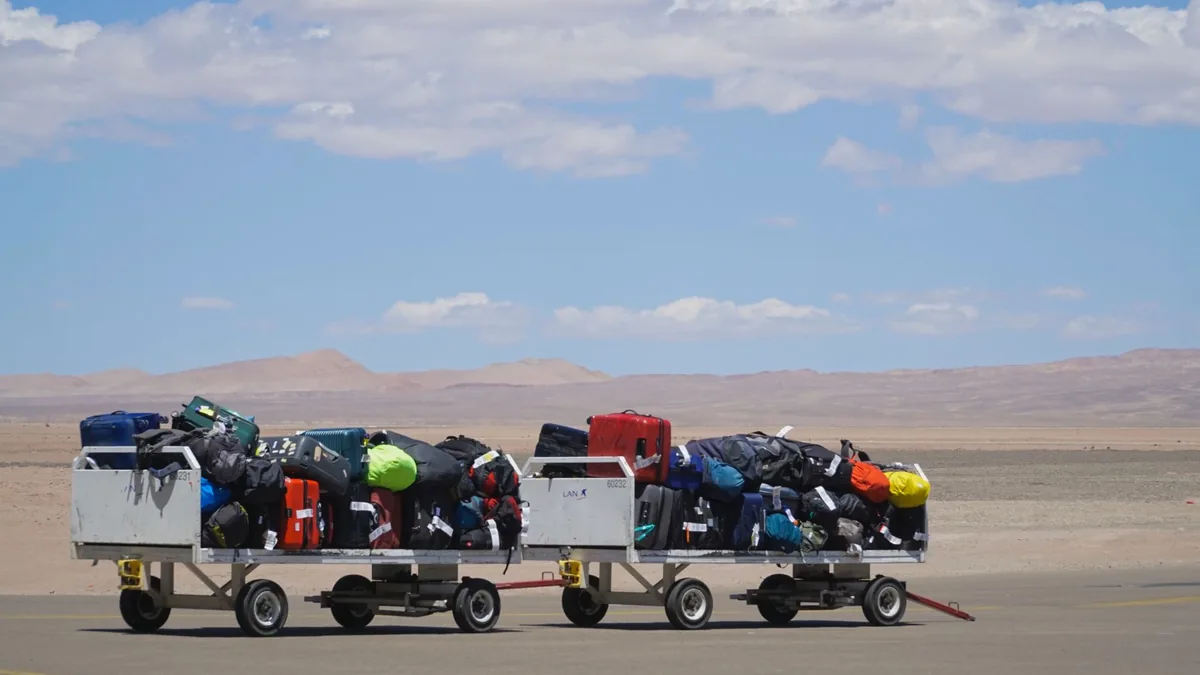
For an airport pickup for 6 passengers, one larger vehicle with a single driver is usually the calmer choice: a van or a genuine seven-seater with the rear row folded or a roof carrier, so all six people and their bags leave the terminal together. Two ordinary cars can work, but only when you plan for the parts a price comparison never shows you: two drivers waiting at possibly different spots, two phones that need signal, luggage split across two boots, and two cars reaching the house twenty minutes apart. If the six include small children, an older relative or a lot of checked baggage, the case for one vehicle gets stronger. If the group is four adults travelling light plus two who are heading somewhere else, two cars may be the right answer.
A quick decision table for six people landing together
Start here. Find the row that sounds most like your family, then read the section that explains why.
| Your situation | Usually better | Why |
|---|---|---|
| Six people, two or more large cases each | One van | Seven-seat cars rarely take six people and twelve big cases at once |
| Six people, one case each plus hand luggage | A seven-seater may be enough, a van is the safe margin | Depends on the third row and boot size of the actual model |
| Children who need car seats, or a pushchair | One van | Space for seats, a folded pushchair and an adult beside each child |
| An older relative who needs help, or a wheelchair | One vehicle, chosen for step height and space | One driver can help, and the wheelchair travels with the person |
| Two households going to two different addresses | Two cars | Each car goes straight to its own door |
| Passengers on two different flights | Often two pickups | Nobody sits in the car park for hours waiting |
| Everyone going to one home, same flight | One vehicle | One meeting point, one arrival, one set of instructions |
If two rows apply at once, the one about people (children, older relatives, mobility) should outweigh the one about bags.
What happens when a family splits across two cars
On paper, two cars look like one car doubled. At the airport they behave more like two small projects that have to finish at the same moment.
The arrival hall becomes a sorting exercise
Six people come off one flight, but they rarely come out of the terminal in one neat line. One adult is still at the belt waiting for the last case, another has taken a child to the washroom, a third is changing money. With one driver, the family simply regroups at one spot and walks out together. With two, somebody has to decide which people and which bags go to which car, usually standing on the kerb with a trolley in each hand.
Two drivers means two phone calls
Each driver will want to confirm where you are. That means two numbers saved before you fly, two WhatsApp chats, and an adult with a working connection in each half of the family. At Islamabad International Airport the official arrivals guidance asks passengers to refrain from mobile phone use at immigration, so the first real chance to call either driver usually comes after the baggage hall. By then both drivers may be circling, parked or asking which door you mean.
The luggage never splits evenly
Families pack by person, not by car. The baby's bag, the medicines and the gifts for Nani are rarely in the case that belongs to whoever rides in that vehicle. Split across two boots, something important ends up in the other car, and if one car stops for fuel it stays there for a while.
The family arrives in two halves
Even on the same motorway, two cars rarely arrive together. One gets through the toll plaza first, the other waits behind a lorry. At the house, relatives who have been waiting since dawn greet half the family, then wait again. It sounds minor until you picture an elderly parent standing at the gate asking where the grandchildren are.
Taxi for 6 people with luggage: count bags before seats
Most people ask "how many seats?" first. For a taxi for 6 people with luggage, the better first question is "how many bags, and how big?" A car can have seven seat belts and still be unable to carry six adults and their suitcases at the same time, because the third row often sits exactly where the boot would be.
Use this simple count before you enquire:
- Large checked cases. The big ones that go on the belt. Count each one.
- Medium cases and duffels. Anything a person cannot lift onto their lap.
- Cabin bags and backpacks. These can often go at people's feet, but not all of them.
- Awkward items. Pushchairs, car seats, boxed gifts, a wheelchair or walking frame, anything long or oddly shaped.
- Anything you are collecting on the way. A relative's parcel from the airport shop, or shopping bought on arrival.
Then write it as one line: "6 passengers (4 adults, 2 children aged 3 and 7), 8 large cases, 5 cabin bags, 1 folded pushchair." That single line tells a booking team far more than "family of six".
A useful rule of thumb: if the number of large cases is more than the number of adults, assume you need a van, or at least a vehicle with a roof carrier, until someone confirms otherwise with the actual model in front of them. Our guide to choosing a vehicle when your family has lots of luggage goes further into bag sizes and roof carriers.
Vehicles that fit a family of 6 airport taxi journey
When people search for a family of 6 airport taxi, they are usually choosing between three types of vehicle. Each has a place.
Seven-seat MPVs and crossovers
The Honda BR-V is the familiar example: a small crossover offered in three-row, seven-seat versions and assembled in Lahore by Honda Atlas since 2017. Cars like it are comfortable for six people on a short city run with light bags. The catch is the rear row: with all seats up, the luggage space behind it is small, and folding one side of the third row to fit cases means someone moves. For six adults with full allowances, a seven-seater is often too tight without a roof carrier.
Passenger vans
Vans such as the Toyota HiAce, which Toyota Indus Motors sells in Pakistan and whose high-roof Commuter body can seat up to 15 passengers, change the maths completely. Six people sit in comfort, the rear seats can stay in place, and there is usually room behind or between rows for cases. For many families the van is the one vehicle that makes an airport pickup for 6 passengers feel ordinary rather than crammed. See the group van (planned link) page for how van journeys are arranged.
The trade-off is height: a high van has a tall step. For an older relative, ask about a grab handle or a step, and let the driver know in advance.
Two ordinary saloons
Two ordinary cars seat six with a spare seat each, but a typical saloon boot takes perhaps two large cases. For a family with more than four large cases, two saloons often means cases on laps or a third car. They make sense mainly when the group is splitting anyway.
What to ask about the specific vehicle
Vehicle categories are broad, and models differ. When you get a reply to your enquiry, ask:
- How many seats will be usable with our luggage loaded?
- Is there a roof carrier, and is it waterproof or covered?
- Is the third row a real seat for an adult, or best for children?
- Can the vehicle take a car seat on an outer rear seat?
If you want to see how individual models compare on seats and space, our sister service iDrive, the network behind Pakistan Taxi, keeps a family MPV model overview with examples of the vehicles in that class.
Children, older relatives and who rides with whom
Six is a number, but a family is a set of relationships. The seating plan matters more than people think, especially after a long overnight flight.
Small children
Children want to be near a parent, and parents want to reach them. In one van, both parents can sit with the children and nobody has to decide which parent goes in which car. If you are bringing your own car seat, tell the booking team, because fitting it takes a few minutes at the kerb and needs a suitable seat position. A folded pushchair also takes boot space that people forget to count.
In a two-car plan, each car needs at least one adult who is responsible for the children in it, and those adults need to be happy with the split before landing, not negotiating it at the exit.
Older relatives
An older parent or grandparent often benefits most from one vehicle. The driver can bring the vehicle to one point, help with the door and the bags, and the person does not have to walk between two cars or wait while the second one is found. Mention mobility needs clearly when you enquire: a walking stick, a wheelchair, difficulty with a high step, or a need to stop for the washroom on a longer drive.
A simple seating sketch
For a van carrying six (example only): driver and one adult in front who knows the address; two parents with two children in the middle rows; the older relative in the most accessible seat nearest the door, beside the adult who is looking after them. Adjust to your family, but decide it before landing.
The arrivals meeting point with one driver
A single meeting point is the quiet advantage of one vehicle. Everyone knows where to go, and the driver has only one family to find.
How the exit works at Islamabad
The official arrival procedure at Islamabad International Airport runs in a set order: immigration, with lanes marked for Overseas Pakistanis, Foreigners, Taxpayers and Special Persons; then the baggage hall, where screens show which belt carries your flight; then customs, through the Green Channel if you have nothing taxable or the Red Channel if you do. Only after that are you out where a driver can meet you. The airport is about 25 km south-west of Islamabad, linked to the city by the Srinagar Highway and to Rawalpindi by the GT Road (N-5), so the drive home starts well outside town (background on the airport).
With six people and a lot of luggage, the baggage hall is where time goes. Several belts, several trolleys, and one person always waiting for the last case. That is why the driver should be told the flight number rather than a fixed time: the landing time is not the time you walk out.
Agree one spot, one message
With one driver, agree:
- The meeting point in words: for example, "outside the arrivals exit, by the pillar with the car park sign" (example only; the driver will tell you what works on the day).
- Who will send the first message once you clear customs, and from which phone.
- What the driver should do if you are delayed at the belt: wait, or ask the person with the phone to call.
With two drivers, you need all of that twice, and you also need the two drivers to agree between themselves which car goes first.
One car or two cars for family: the cost question
The honest answer to one car or two cars for family is that the cheaper option depends on the day, the distance and the vehicles available, so there is no fixed figure to quote here. What you can do is compare the whole cost, not just the headline price.
What changes when you add a second car
- Two waiting times. If the flight is late or the baggage hall is slow, both drivers wait. Ask how waiting time is handled for each vehicle.
- Two parking charges. At Islamabad International Airport, the published car park charges effective 1 July 2026 are Rs. 130 for the first three hours for private and commercial vehicles, then Rs. 80 an hour, and vehicles lifted from no-parking zones face a Rs. 1,000 fine. Two cars in the car park means two tickets. Charges change, so check the official page close to your date.
- Two sets of tolls. On a motorway journey, each vehicle pays its own toll.
- Two drivers' time. Two people are giving you their morning or night, and that is reflected in any quote.
- The hidden third car. If two saloons cannot take all the luggage, you may end up needing a third vehicle or a second trip, which is the most expensive outcome of all.
What changes with one larger vehicle
- A van or large MPV may cost more than a single saloon, but you are comparing it against two cars, not one.
- One parking ticket, one set of tolls, one waiting time.
- Less risk of the "third car" problem.
How to compare quotes fairly
Ask for both options in the same enquiry, with the same flight, passengers and luggage line, so the comparison is like for like. Then add the parking, tolls and waiting time to each one. Our guide on comparing a group van with several cars covers the wider comparison for larger groups; this page is about the specific six-passenger airport case.
Pakistan Taxi's journey form is a planning and enquiry tool, not a fixed-price checkout. You share the details, the team comes back with what may be available and an idea of cost, and nothing is confirmed until you agree it.
When two cars genuinely make sense
One vehicle is not always right. Two cars are the better plan when:
- The group splits after the airport. Three people are going to Rawalpindi, three to Jhelum. Two cars save a long detour.
- Arrivals are on different flights. If three people land at 03:00 and three at 11:00, one vehicle means eight hours of waiting. Separate pickups are kinder to everyone.
- One person must leave quickly. A passenger with a connecting domestic flight or an urgent appointment may need their own car.
- No suitable larger vehicle is available. On a busy date there may simply be no van free. Two cars that are available beat a van that is not.
If you do choose two cars, make the split deliberate:
- Decide who rides in which car before you fly, and share it in the family group.
- Split the luggage by car, not by person, and label cases with the car they go in.
- Put one adult with a working phone in each car.
- Give both drivers the same meeting point and the same flight number.
- Agree whether the cars travel together or separately, and whether they stop at the same place.
Getting there safely
The UK government's safety advice for Pakistan says local driving standards are erratic, especially at night. It also tells visitors to avoid street taxis and online taxi apps, and to use reputable, licensed companies where you call and the operator contacts the driver. That is one more reason to have your pickup arranged before you land rather than sorting two cars at the kerb.
Check where the drive ends, too. The FCDO Pakistan travel advice does not list Islamabad or Rawalpindi among the areas it advises against, but it does advise against all but essential travel to Azad Jammu and Kashmir, and against all travel to Peshawar, Balochistan and several other districts. If your family is driving on from Islamabad to Mirpur or elsewhere in AJK, read the advice and check your insurance before you plan the road leg. The same page warns that planned protests in Islamabad and Rawalpindi can bring short-notice road closures and temporary mobile and internet disruption. With two cars relying on two phones, that is worth knowing; allow extra time and check routes on the day.
What to send when you enquire about a car for 6 people in Pakistan
A clear enquiry gets a clear reply. When you ask about a car for 6 people in Pakistan, copy this list into your message and fill it in:
- Airport and flight number, plus the scheduled landing date and time in Pakistan time.
- Passengers: how many adults and children, with the children's ages.
- Luggage line: large cases, medium bags, cabin bags and awkward items, counted as above.
- Car seats or pushchair: whether you are bringing your own.
- Mobility needs: walking stick, wheelchair, difficulty with a high step.
- Destination address, with a landmark and the name and number of someone at the house.
- One or two vehicles: say which you prefer, or ask for both to be priced so you can compare.
- Lead contact: the name and phone number of the adult who will message the driver after customs.
If someone abroad is organising the pickup for parents or relatives, add who is paying and who is travelling, so the driver calls the right person.
Your next step
If your six are landing together and going to one home, start by asking for one larger vehicle and let the booking team tell you what fits your luggage line. Use the journey planning form (planned link) to send your flight, passengers and bags, or read more on our airport transfers page first. You will get a reply based on what is available for your date, and you can decide from there.