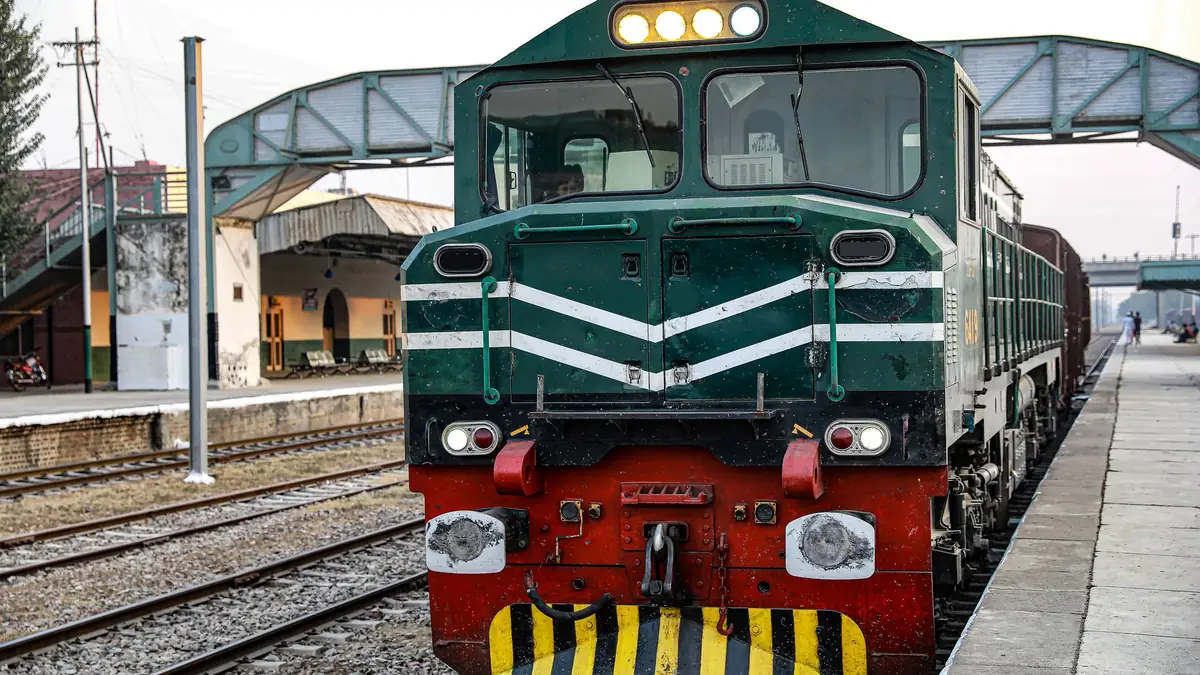
If you want to go by car and come back by train, the plan works best when you treat it as three separate pieces: a one-way road journey with its own clear quote, a rail ticket bought through Pakistan Railways' own channels, and a short station transfer at the far end so nobody is left on a platform with six suitcases and a sleepy toddler. The car gives you door-to-door travel on the outbound day, when you are usually carrying the most (gifts, wedding outfits, food for relatives). The train gives you a calmer, fixed-departure return once the visit is over.
The catch is that the two halves do not talk to each other. A car operator will not know your train is running late, and Pakistan Railways will not know your family is still at an aunt's house in Gulberg. You have to join the pieces yourself, and the rest of this guide shows how: when the split makes sense, how to book and check the rail leg, what to arrange at each station, how luggage rules differ, and what to do if the return date moves. One safety point up front: the UK government advises against all but essential travel to parts of northern Sindh that long-distance Karachi to Punjab trains pass through, so check the official advice before choosing that corridor (more in the safety section below).
When a one way family trip by car plus a train home makes sense
A split journey is not automatically better than a return by road. It earns its place in a few specific situations.
It usually suits you when:
- The outbound leg carries more than the return. Families heading to a wedding, a new baby or a long stay often travel out heavy and come back lighter. Gifts get handed over; food gets eaten.
- You need to arrive at a specific address, not a station. A car can take you straight to a family home, hotel or venue. For the arrival day, that matters more than anything.
- The return date is fixed and the route is well served by rail. Corridors such as Lahore to Rawalpindi, or Karachi to Lahore and Islamabad, have long-established intercity trains. If you know which day you are going home, a reserved seat is easy to plan around.
- Someone in the group prefers not to sit in a car for hours twice. Older relatives sometimes find a train easier because they can stand up, walk to the washroom and stretch.
It is often the wrong choice when:
- The return date is uncertain and trains on your route are busy around that time (for example, the days after Eid).
- Your group includes someone who cannot manage station steps, platform crowds or carrying bags between coach and exit.
- The return is short enough that a car door to door takes about as long as getting to and from two stations.
- You are heading somewhere the rail network does not serve directly, or where the station is a long way from where you are staying.
If you are still weighing single journeys against returns in general, our guide to choosing between one-way and return intercity journeys covers the wider trade-offs. This article assumes you have already settled on car out, train back.
A quick way to decide
| Question | If the answer is yes | If the answer is no |
|---|---|---|
| Is the return date fixed? | Rail return is easy to reserve early | Keep the return flexible; book the rail leg later or plan a road return |
| Is there a direct train between your two cities? | Split journey is practical | A road return is usually simpler |
| Is the station within a short drive of where you are staying? | Station transfer is quick | The transfer may eat most of the time you save |
| Can everyone manage stairs, platforms and bags? | Train works well | Consider a road return, or arrange help at both stations |
| Are you carrying far less on the way back? | Rail luggage allowance will likely be enough | Check the allowance carefully (see below) |
Booking the rail leg: Pakistan Railways online ticket booking and timetables
Buy the train ticket through Pakistan Railways itself. The railway's official website at pakrail.gov.pk links to its Rabta e-ticketing system, which also has mobile apps on the Google Play Store and Huawei AppGallery. Train timings sit on the same system at the Pakistan Railways train timings page, and that is where you should check departure and arrival times for your chosen date rather than relying on a screenshot a cousin sent last year. Timetables change, trains get added or suspended, and a schedule that was right in one season may not be right in the next.
According to the Pakistan Railways FAQ, reservations are available through railway reservation offices, PRACS reservation offices and online e-ticketing, and seats can be reserved up to 90 days in advance. For a family trip with a fixed return, that window is generous: you can often book the train home at the same time as you arrange the car out.
Choosing a class for a family
Classes vary by train. The flagship Green Line, for example, carries AC Parlour, AC Business, AC Standard and Economy coaches, while the railway's luggage rules also refer to AC Sleeper, First Class Sleeper and Second Class. Your booking screen shows what your particular train offers. For families the practical questions are simple:
- Do you want seats together? Reserve early and book all passengers in one transaction if the system lets you, so the seats are more likely to sit side by side.
- Is it a daytime or overnight train? Long routes such as Karachi to Lahore or Islamabad run for many hours; the Green Line Express between Karachi and Islamabad's Margalla station takes around 21 hours end to end, according to its Wikipedia entry, and its listed coaches are all seating classes. On a journey that long, check whether your chosen train offers berths at all; for children and older relatives, a sleeper changes the experience.
- How much luggage are you bringing? The free allowance is larger in AC Sleeper than in other classes (details below). That alone can decide the class.
Check the station name, not just the city
This is the detail that catches people out. Many cities have more than one station, and the ticket shows the station, not the neighbourhood.
- Islamabad and Rawalpindi: Many trains use Rawalpindi station on Station Road in Saddar; the Green Line Express runs to Margalla station in Islamabad. Check which one your train uses before telling anyone where to meet you.
- Karachi: Karachi Cantonment station in Saddar is one of the city's main long-distance stations, and Karachi City station is separate. Your ticket will tell you which one your train starts from or ends at.
- Lahore: Lahore Junction sits at the meeting of Circular Road and Allama Iqbal Road, on Empress Road. It is a large station, with 11 platforms across two levels.
Write the station name exactly as it appears on the ticket into your family group chat. "Pindi station" and "the Islamabad one" are not the same place.
Booking the return leg later: what to leave open and what to fix
Sometimes you cannot book the train home on day one. The wedding dates may still be moving, or you might want to see how an elderly parent copes before committing to a travel day. Booking the return leg later is fine, as long as you do three things:
- Check how full trains usually get on your route and dates. Around Eid, school holidays and long weekends, popular trains fill up. If your likely return falls in one of those windows, book the most probable date now and accept that you may need to change it.
- Keep the car quote strictly one-way. If your road operator quotes a "return" by default, ask for a one-way figure instead, so you are not paying for a leg you will take by train.
- Set a personal deadline. Put a reminder in your phone for the date by which you will book the rail leg. Without one, the return tends to slide until the only seats left are the ones nobody wanted.
If there is a real chance you will come back by road after all, read our guide on booking an intercity return on a different day, which explains how to keep that option open without committing to it.
Station pickup and drop-off at both ends
The train only covers the middle of your return. You still have to get from where you are staying to the departure station, and from the arrival station to your front door. Plan both transfers as separate, small journeys with their own times and meeting points.
Getting to the departure station
- Aim to arrive with time to spare. You need time to find the right platform, confirm your coach and get bags on board without rushing children. Large stations like Lahore Junction take longer to move through than you expect.
- Give the driver the station name, not "the railway station". In Karachi especially, say Karachi Cantonment or Karachi City; in the twin cities, say Rawalpindi station or Margalla.
- Allow for city traffic and road closures. The UK government's Pakistan travel advice notes that protests have previously led to road closures and transport disruption in cities including Islamabad and Rawalpindi, and advises allowing extra time and checking routes. A missed train is a far bigger problem than a missed car.
Being met at the arrival station
This is the transfer families most often leave to chance, and the one that goes wrong most often. After a long train ride, nobody wants to stand outside a station negotiating with strangers while the children sit on the suitcases.
A simple plan:
- Share the train name, number and scheduled arrival time with whoever is collecting you, whether that is a relative or a booked car.
- Agree a meeting point you can both find. "Main entrance" is vague at a station with several exits. Pick a landmark: the main booking hall, a named gate, or the car park.
- Send a message when the train leaves the last major stop before yours. On the Lahore to Rawalpindi line, for instance, trains call at stations such as Gujranwala, Jhelum and Gujar Khan, so your pickup has a rough idea how far away you are.
- Expect some delay and say so in advance. Trains can run late. If you have a booked car, ask how waiting time is handled before the day, not while you are still on the train.
For a booked station pickup, give the operator the same details you would for an airport arrival: the station, the train number, the arrival time, how many passengers and how many bags. Our city-to-city travel service page explains what information helps when you plan an intercity or station journey with us.
Return journey by train with luggage: what fits and what does not
This is where car and train differ most. In a car, the limit is the boot and the roof, and you can see it with your own eyes. On a train, there is a formal free allowance, and anything beyond it is handled differently.
The Pakistan Railways FAQ sets the free luggage allowance at 50 kilograms in AC Sleeper and 20 kilograms in the other classes it lists (including AC seating classes, First Class Sleeper, Economy and Second Class). It also says large items such as refrigerators, washing machines, generators and commercial goods do not count towards the free allowance. Pakistan Railways publishes separate parcel and luggage rates for goods sent outside the free allowance; check the current rate table on its fares and rates page before assuming anything.
What that means in practice:
| Item | Going out by car | Coming back by train |
|---|---|---|
| Large suitcases | Limited by boot space and vehicle size | Counted against each passenger's allowance |
| Wedding gifts, boxed sweets, crockery | Easy to pack flat or wedge in | Awkward in a crowded coach; fragile items at risk |
| Pushchair and car seat | Fits if you declare it when booking | Needs stowing; check space with the train staff on board |
| Bulk shopping or electrical goods | Possible if you ask for a suitable vehicle | May fall outside the free allowance entirely |
| Hand luggage and snacks | No real limit | Keep them light and close to your seat |
When you arrange the car for the outbound trip, tell the booking team about the heavy items on that leg. Our note on telling the booking team about family luggage on an intercity journey lists what to mention so the right size of vehicle turns up.
Keeping one-way car terms clear in the quote
A split journey falls apart if the car quote is vague. The outbound leg should be priced and described as a single journey, with nothing hidden that assumes a return.
When you plan the car leg, ask for these points in writing:
- Pickup address and time, including the exact gate or house number.
- Destination address, not just the city.
- Vehicle type and seats, matched to the number of passengers, children's seats and bags.
- Whether tolls and fuel are included in the figure you are given, or charged on top. Motorway tolls apply on routes such as the M-2 between Islamabad and Lahore.
- Stops you want on the way, such as a break at a motorway service area, and whether any stop affects the price.
- That the quote is one-way only, with no return leg, no waiting days and no driver's overnight stay built in.
- What happens if your plans change before you pay, and how cancellations are handled.
With Pakistan Taxi, the journey planner is where you set out these details as an enquiry. Nothing is fixed until the operator has reviewed your plan and you have agreed the terms, so use that stage to ask every question above.
The road leg itself
On the Islamabad to Lahore corridor, the M-2 motorway runs for about 375 kilometres from the Islamabad Interchange to Thokar Niaz Baig in Lahore, passing through the Salt Range, with service areas at places such as Bhera and Kalar Kahar. Those service areas are natural break points for a family car, and worth naming in your plan if you want a stop. The National Highways and Motorway Police provide a travel advisory service and FM 95 radio updates for motorists; check them on the morning you set off.
What happens if the return date changes
Plans shift. A wedding gets extended, a grandparent is unwell, a flight home moves. Because the car and the train are booked separately, a change to one does not automatically change the other, and that works in your favour: moving the train does not touch a car journey you have already completed.
If you have already bought the train ticket
Pakistan Railways publishes its refund policy for computerised paper tickets. The version on the site, in effect since 2011, allows a 90% refund up to 48 hours before departure, 80% between 24 and 48 hours before, and 70% within 24 hours of departure, with a reduced refund possible if requested within three hours after the train leaves. The page covers paper tickets specifically, so if you booked through Rabta, check the e-ticket terms in your account or with the railway before assuming the same figures apply. Refund rules can change; the official page is the one to trust.
The practical lesson: if your return date starts to look shaky, decide early. The refund is larger the further you are from departure.
If you decide to come back by road instead
That is a new one-way journey, not an extension of the first one. Plan it as a separate enquiry with its own pickup address, time and vehicle. Do not assume the operator who drove you out can simply turn round and collect you days later on the same terms.
Safety and route checks before you travel
Most family journeys that mix car and train run between the big Punjab cities, Islamabad and Karachi. The UK Foreign, Commonwealth & Development Office does not list Islamabad, Rawalpindi, Lahore or Karachi among the areas it advises against visiting. It does, however, advise against all but essential travel to all areas of Sindh north of and including the city of Nawabshah, and against all travel to Balochistan and much of Khyber Pakhtunkhwa, including Peshawar. Long-distance trains between Karachi and Punjab run through northern Sindh, so if you hold a UK passport, read the FCDO Pakistan travel advice before choosing that route, and check what it means for your travel insurance. Other governments publish their own advice, and the positions can change at short notice.
If you are still comparing car, coach and train
A split journey is one option among several. If you are travelling between the capital and Lahore and want a side-by-side look at road and rail on that single route, iDrive, the network behind Pakistan Taxi, has a straight comparison of car, coach and train between Islamabad and Lahore. It is a useful companion to this guide if you have not yet decided which way round to do things.
Your next step
When you are ready to plan the car leg, set out the pickup, destination, date, passengers and luggage in the Pakistan Taxi journey planner (planned link). Mention in the notes that this is a one-way journey and that you are returning by train, and add any station transfer you would like us to look at. We will review the details with you before anything is agreed.