
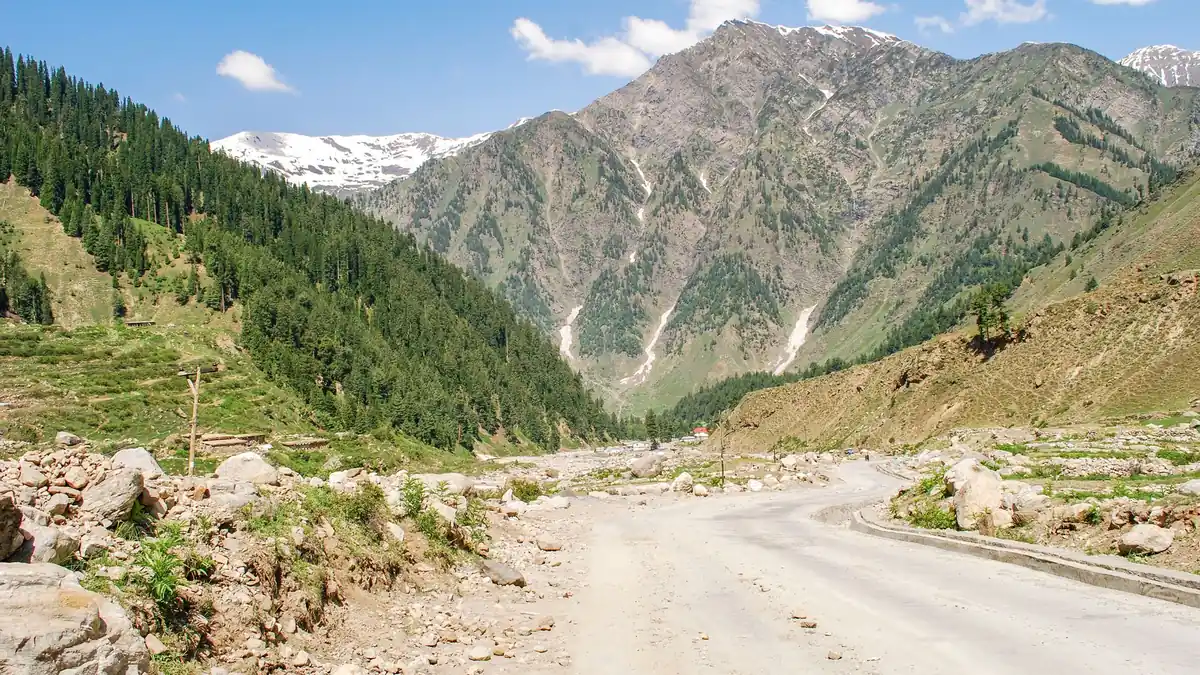
If you are looking at coaster rent for Naran, you are probably organising something bigger than a family car can hold: cousins flying in from the UK, a university reunion, two households who would rather travel together than in a four-car convoy. The short answer: a Coaster makes sense for a group too big for one or two vans, but only if you settle three things before anyone pays a deposit. Where the driver sleeps and eats each night. How each day's driving ends before dark on the valley road. And what happens if the plan changes halfway up the valley, because in the Kaghan valley it often does. Rain, a slip on the road or a late opening at Babusar Pass can turn "we finish in Naran" into "we finish in Balakot" overnight. This guide shows you how to build that flexibility into the hire from the start, so a change of plan is a decision you have already made, not an argument in a car park at dusk.
The road you are actually hiring for
Naran sits in the upper Kaghan valley, in Mansehra district of Khyber Pakhtunkhwa. The main road through the valley is the N-15, which the National Highway Authority maintains between Mansehra and Chilas over about 240 km, running through the Kaghan valley and over Babusar Pass. The valley itself stretches about 155 km and climbs from roughly 650 metres at its lower end to around 4,170 metres at the pass, following the Kunhar River the whole way, according to the Kaghan Valley overview on Wikipedia.
Balakot, on the Kunhar in Mansehra district, is the gateway town: the point where the temperate lower valley gives way to the colder, higher ground upstream. That matters for a group hire, because Balakot is the natural fallback. It sits well below Naran, it is the first stop on the way back down, and from there the run to Mansehra is short.
Getting to Mansehra became much easier once the Hazara Motorway (M-15) opened in stages. It runs about 180 km from an interchange west of Hasan Abdal to Thakot, and the Shah Maqsood to Mansehra section was inaugurated in November 2019. For a heavy vehicle full of people, the motorway is the easy part. The real work starts once you leave it and head up towards Balakot.
A safety point you must read before planning a loop
The UK Foreign, Commonwealth & Development Office (FCDO) advises against all travel on the Karakoram Highway between Mansehra and Chilas via Battagram, Besham City, Dasu and Sazin. Its lists do not name Naran, Balakot or the Kaghan valley, but that Karakoram Highway section is the obvious "other way round" if someone suggests crossing Babusar to Chilas and coming home by a different route. Do not plan it. If anyone in the group is travelling on a British passport, check what their travel insurance says about FCDO advice too. The page was last updated on 22 September 2026 when we checked; it changes, so read it again in the week you travel.
In practice, that means a Naran group trip should be treated as an in-and-out journey on the N-15. Up the Kaghan valley, and back down the same way.
Coaster or Hiace on the Kaghan valley road
The two vehicles people compare most are the Toyota Coaster and the Toyota Hiace. Both are common in Pakistan for group travel, and both can do the Naran run. They suit different groups.
| What matters | Coaster (minibus) | Hiace (van) |
|---|---|---|
| Group size | Suits one large group that wants to stay together | Suits a smaller group, or a large one split across two vans |
| Hills and hairpins | Longer and heavier; the driver needs to know the road | Shorter and nimbler on tight bends and narrow stretches |
| Parking in Naran | Harder to place near hotels in the busy centre | Easier to tuck in near your accommodation |
| If one vehicle has a fault | Whole group waits | With two vans, one can carry on or shuttle people |
| Luggage | More interior space; roof carrier on some vehicles | Less space; roof carrier often needed for a full group |
| Side trips | Plan for the main road only; ask before any track | Same rule; do not assume a van can reach high lakes |
Seat counts vary by model, layout and operator, so ask for the exact number of passenger seats in the vehicle being offered, not an "up to" figure from a brochure. A seat that is technically there but has a cool box on it for three days is not a seat.
A useful rule of thumb: if everyone in the group is happy to move as one unit, eat together and leave at the same time, a Coaster keeps things simple. If you have elderly relatives who may want to turn back early, or young children whose day will end sooner than everyone else's, Hiace rent for Naran split across two vehicles gives you options the big bus cannot. Our guide on choosing one group van or several cars walks through that trade-off in more detail.
Drivers matter more than the badge
On this road, the driver's experience of the valley is worth more than the model year. When you are comparing coaster for rent tours or a private hire, ask:
- Has the driver taken a vehicle this size up to Naran before, and recently?
- Will the same driver stay with the group for the whole trip, or is there a handover?
- Is the driver comfortable with the vehicle fully loaded, including roof luggage?
- What does the driver do if the road ahead is closed: wait, turn back, or call the office?
The quote: driver stay, meals and the small print
Most disagreements on group trips are not about the headline price. They are about what the price did or did not include. A multi-day Naran trip has more moving parts than a one-way city transfer, so get these answered in writing, even if "in writing" means a clear WhatsApp message you can scroll back to.
Checklist for a multi-day Naran quote
- Days and nights. How many days is the vehicle yours, and how many nights will the driver be away from home? A three-night trip is four driving days for the driver.
- Driver accommodation. Is the driver's room included, or are you expected to arrange it? If you are arranging it, will the driver sleep at your hotel, a nearby driver's lodge, or in the vehicle? Sleeping in the vehicle after a mountain drive is not a good plan for anyone.
- Driver meals. Included, a daily allowance, or paid by the group? Agree this up front. It is a small cost and a large source of awkwardness if left vague.
- Fuel. Included for a set route, or charged on actual use? If the plan changes, how is the difference worked out?
- Tolls and parking. Motorway tolls and any parking charges in Naran: who pays, and how?
- Standing days. If the group spends a day in Naran and the vehicle does not move, is that day charged the same as a driving day?
- Change of finish point. If you finish in Balakot instead of Naran, or come back a day early, what changes? This is the one people forget, and it is the one this guide is really about.
- Breakdown cover. If the vehicle fails in the valley, what does the operator do, and how quickly?
Our separate piece on what a city-to-city quote should include covers the general principles. For Naran, add the driver's overnight arrangements and the change-of-plan clause to that list.
Where the driver will stay in Naran
Naran town is compact and busy in season. A 2020 Dawn investigation into development along the Kunhar River described Naran's densely built town centre and reported that more than 60 percent of the Kaghan valley's 5,000 or so hotel rooms were crammed into less than a quarter of a square mile. For a large vehicle, that density is the practical problem: tight lanes, limited parking near the main strip, and a driver who needs a proper bed and a quiet night before the descent. Ask your hotel directly whether it has space for a minibus and a room or bed for the driver, before you confirm the booking.
Planning two possible finish points
This is the heart of a flexible Naran group trip. Instead of one fixed itinerary, you agree two versions of the final leg with your operator and your group before you leave home. The question is not "will something change?" but "which version are we running?"
How to set it up
- Finish point A: the full plan. Usually your last night in Naran, perhaps with a day trip further up the valley if the road is open, then back down.
- Finish point B: the fallback. Usually Balakot or another lower stop in the valley, or a straight run back towards Mansehra and home, if weather, the road or the group's energy says so.
- The decision time. Agree when you will choose between A and B. A good default is the evening before the uphill leg, once you have the latest road and weather information.
- The decision maker. One person in the group decides, after talking to the driver. Not a vote in a moving vehicle.
- The cost difference. Ask the operator in advance what plan B costs compared with plan A. It may be less, or it may not be, if hotels need cancelling.
An example of how it plays out
*This is an illustrative example, not a real booking.* A group of eighteen, two families plus visiting cousins from Birmingham, plans a four-day Naran Kaghan group trip from Islamabad in a single Coaster. Plan A: night one in Balakot, nights two and three in Naran, back to Islamabad on day four. Plan B: if heavy rain is forecast or the road above Balakot is reported closed, stay two nights in the Balakot area instead, make a shorter day trip if conditions allow, and return a day early.
On the evening of day one, the forecast turns wet. The group lead talks to the driver, checks the official sources listed below, and switches to plan B. Because the operator already agreed the plan B cost and the hotels in Naran were booked with free cancellation, the change takes ten minutes instead of a morning.
Lahore to Naran by coaster: splitting a long day
Groups coming from Lahore face a much longer approach than groups from Islamabad or Rawalpindi. The first stretch is motorway, north towards Islamabad and then on to the Hazara Motorway near Hasan Abdal for Mansehra. That part is predictable. It is the combined length of the day that causes trouble: a group that leaves Lahore at dawn and tries to reach Naran the same evening puts a tired driver on a climbing mountain road at the end of a very long shift.
For Lahore to Naran by coaster, split the journey. Sensible options include:
- An overnight in Islamabad or Rawalpindi, then a fresh start up the Hazara Motorway the next morning.
- An overnight in Balakot, if you have made good time and it is still well before dark when you reach Mansehra.
- An early start from Lahore with a firm cut-off: if you are not past a point you agreed in advance by a set time, you stop at the next sensible town instead of pushing on.
Whichever you choose, it also gives you a natural place to switch to finish point B on the way back. The route to Islamabad is covered on our city-to-city service page.
Weather, landslides and seasonal road status
The Kaghan valley is a summer destination for a reason. Sources give slightly different windows for when the road beyond Naran is reliably open. Wikipedia's Kaghan valley article describes the roads and Babusar Pass as usually open from May to the end of September, while its Babusar Pass article says the road north of Naran is accessible all the way to the pass from mid-July until the end of September. Both agree that the pass often closes in winter because of heavy snow. Treat those windows as a guide only, and check the current position before you travel.
Babusar Pass sits at about 4,173 metres. Lake Saiful Muluk, about 9 km north of Naran at 3,224 metres, is reachable in summer, but, as its Wikipedia entry notes, winter access is limited because heavy snow and landslides can cut it off. The Kunhar River runs beside much of the road, and the whole valley has a history of slope failure: landslides triggered by the 2005 Kashmir earthquake destroyed many passes into the valley, which were later rebuilt.
Where to check before you drive
- National Disaster Management Authority (NDMA). The NDMA website publishes monsoon situation reports and weather advisories, and lists a 24/7 emergency helpline, 051-111-157-157.
- National Highways & Motorway Police (NHMP). The NHMP site describes a travel advisory service and its FM 95 radio service for motorists. Useful on the motorway leg.
- Your driver and hotel. Local knowledge is often the fastest source on whether a stretch is open that morning. Use it alongside official information, not instead of it.
- FCDO travel advice. Recheck the Pakistan page in the week you go, especially if your group includes UK passport holders.
A monsoon forecast or a reported blockage is exactly the trigger for switching to plan B.
Luggage, roof carriers and warm kit
A group of eighteen with suitcases for a family visit plus bags for a mountain trip will fill a Coaster faster than you expect. Sort luggage out before the day, not at the kerb.
Luggage
- Ask whether the vehicle has a roof carrier, and whether the operator supplies a waterproof cover and proper straps. Rain in the valley can be sudden, and a soaked suitcase of wedding clothes is a long-lasting memory for the wrong reasons.
- Leave the big cases behind if you can. If the trip starts from a relative's house in Islamabad or Lahore, pack one soft bag per person for the mountains and leave the rest.
- Keep a day bag inside for everyone: medicines, phone chargers, snacks, water, a warm layer and anything valuable. Roof luggage is not unpacked at every stop.
- Label the bags by family or room. Unloading eighteen bags in a crowded Naran lane is quicker when everyone knows which pile is theirs.
Warm kit, even in summer
Babusar Pass sits above 4,000 metres, and Naran itself is high enough that evenings can feel very different from the plains you left that morning. Pack:
- a fleece or warm jumper for every person, including children
- a waterproof jacket or poncho
- closed shoes with grip, not sandals, for any walking near water or on wet ground
- a hat, gloves and a spare pair of socks for anyone planning to go up towards the pass or the lakes
- sun cream and sunglasses; high sun and cold air arrive together
Return timing: keep the driver off mountain roads late
The most important scheduling rule on this trip is simple. Plan every day so the driving is finished before dark, and make the downhill day the one that starts earliest.
A Coaster on a mountain road at night means a tired driver, a heavy vehicle, bends that are harder to read and less chance of spotting rockfall or water on the road. None of that improves with a group singing in the back.
- Set a latest departure time from Naran on the return day, and treat it as fixed. If the group wants one more photo stop, it happens on the way down in daylight, not by leaving late.
- Agree a latest arrival time for each overnight stop. If you will miss it, the driver stops at the next sensible town and you move to plan B.
- Respect the driver's rest. A driver who has been driving since dawn should not be asked to "just do one more hour". Build real rest into the schedule, including a proper night's sleep.
- Allow for delays on the way down. Traffic on the valley road, a slow section, or a stop at Balakot for lunch can all add time. Your plan should survive a delay without ending in the dark.
- Book the final night close to home if flights are involved. If a relative is flying out of Islamabad the day after the trip, do not plan to come down from Naran that same morning. End the trip a day earlier.
Planning the trip with Pakistan Taxi
We help groups plan private journeys, including multi-day trips into the northern valleys. You can see how we approach group travel for families and friends, and when you are ready, tell us about your journey (planned link) with your group size, dates, starting city and both finish points. We will come back to you on what we can arrange; availability and prices depend on the season, the vehicle and the plan, so nothing is confirmed until we have gone through it with you.
If you are still deciding the route itself, iDrive, the network behind Pakistan Taxi, has a detailed guide to driving from Islamabad to Naran and Kaghan by road, covering the journey stop by stop.