
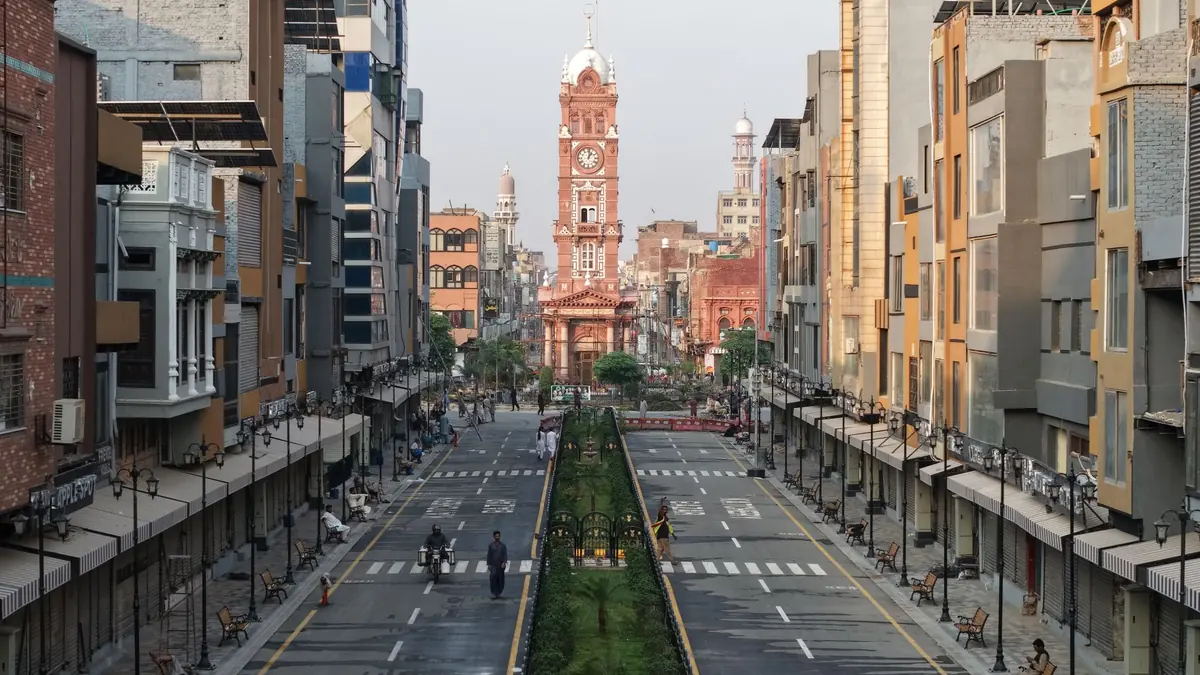
If you are planning a Faisalabad rent a car with driver day for fabric or wedding shopping, the short answer is this: don't plan to park. Plan to be dropped. The eight bazaars that fan out from the Clock Tower were laid out more than a century ago, long before anyone expected a family estate car to come hunting for a space. A good shopping day works the other way round. The driver drops you at the mouth of one bazaar, waits or circles somewhere sensible, and collects you at an agreed point a street or two away when you ring. Your bags go into the boot in batches, not all at once at the end. And the day is shaped around Friday midday prayers, shop opening habits and the drive back to Lahore or the airport.
Why Faisalabad is worth a dedicated shopping day
Faisalabad, once Lyallpur, is widely described as the Manchester of Pakistan. Its Wikipedia entry records that the city is treated as the centre of Pakistan's textile industry and that it accounts for about half of the country's textile shipments. For families visiting from the UK, the Gulf or North America, that translates into one practical fact: this is where a lot of the cloth sold elsewhere starts life, and the choice of unstitched lawn, cotton, chiffon and wedding fabric is wide.
It is also Pakistan's third-largest city, with a 2023 census population of about 3.69 million. A city that size, with its commercial heart concentrated around one monument, gets crowded. That is the reason a car with a driver pays for itself here more than in many places: the walking is between shops, not between the shops and a car park.
The eight bazaars around the Clock Tower
The Clock Tower (Ghanta Ghar) had its foundation laid in November 1905 and took two years to build, in red sandstone brought from Sangla Hill, about 50km away. According to the Clock Tower's Wikipedia article, eight markets radiate from it and are linked by the circular Gole Bazaar, so that from the air the whole layout resembles the Union Jack. For Faisalabad Clock Tower bazaar shopping, that design is the single most useful thing to understand before you set off, because it tells you how to plan pick-ups: every bazaar has an outer end away from the tower, and the outer ends are where a car can realistically stop.
The eight bazaars, with the specialities commonly associated with them on the Faisalabad article:
| Bazaar | Commonly associated with | Useful for a shopping day? |
|---|---|---|
| Montgomery Bazaar | Yarn and raw cloth | Core stop for fabric buyers |
| Rail Bazaar | Gold and cloth | Jewellery and fabric in one run |
| Chiniot Bazaar | Medicines, cloth and blankets | Second fabric stop; bedding; pharmacy errands |
| Katchery Bazaar | Mobile phones and accessories | Chargers, cases, a spare handset |
| Bhawana Bazaar | Electrical goods and electronics | Adapters, small appliances |
| Aminpur Bazaar | Stationery and décor | Wedding cards, envelopes, decorations |
| Jhang Bazaar | Fish, meat and produce | Fresh food; heavy, awkward bags |
| Karkhana Bazaar | Herbal medicines | Specialist errands |
Treat the "associated with" column as a starting point, not a rule. Shops mix, specialisms drift, and your relatives in Faisalabad will have their own favourite doorways. What the table does help with is sequencing. Fabric-heavy families usually spend most of the day between Montgomery, Rail and Chiniot bazaars, while phone, stationery and electronics errands can be folded into short hops.
Where to park in Faisalabad bazaars: mostly, you don't
People often ask where to park in Faisalabad bazaars, and the honest answer for a family day is that parking is the wrong goal. The inner lanes near the tower are busy with pedestrians, motorcycles, rickshaws and delivery handcarts. A car that stops there holds everyone up, and a driver who is trying to guard a parked car is not a driver who can come to you when you ring.
So agree three kinds of point with your driver at the start of the day.
1. The drop-off point
Pick a spot at the outer end of the bazaar you are starting in, on a road wide enough for the car to pull over for thirty seconds. A landmark you can both name helps: a bank branch, a mosque gate, a well-known sweet shop. Avoid dropping at the tower roundabout itself; it is the busiest point of the whole system.
2. The waiting area
Ask the driver where they will wait. Often this is a side road, a paid parking lot or simply a loop around the outer ring. You don't need to know exactly, but you do need to know roughly how long it takes them to reach you. If the honest answer is fifteen minutes, you should ring fifteen minutes before you want to leave the shop, not when you are standing on the pavement with six bags.
3. The pick-up point
This is often not the same as the drop-off. If you walk in from the outer end of Montgomery Bazaar and drift towards the tower and round the Gole Bazaar into Rail Bazaar, it may be quicker for you to walk out of Rail Bazaar's outer end than to retrace your steps. Before you leave the car, agree the likely pick-up points for each bazaar you plan to visit.
A shopping trip with a driver: what to agree before you set off
A shopping trip with a driver is really a timed chauffeur duty with a lot of short stops. The questions below are the ones that stop misunderstandings later. Our car and driver service page explains how Pakistan Taxi handles these journeys, and our hourly duty sheet guide has a fuller checklist for times, changes and cost approval.
- Start and finish time. Where the driver collects you, and when the day is expected to end, including the journey home.
- Waiting and overtime. Shopping days overrun. Ask how extra time is handled and who approves it, rather than assuming.
- Fuel, tolls and parking fees. Who pays for paid lots near the bazaars, and how motorway tolls on the way back are handled.
- Meal and prayer breaks for the driver. A long day needs them; build them in rather than hoping.
- The number of passengers. Aunts join shopping days. Tell the planner the real number so the vehicle fits people and bags.
- The route home. Lahore, Lahore airport, Faisalabad airport or a relative's house in another town all change the finish time.
Nothing here is a guaranteed arrangement until the details have been confirmed with you. When you plan your journey with us (planned link), include the number of stops you expect and the latest time you need to be back, and ask questions if anything in the reply is unclear.
Keeping purchases secure in the car
The UK Foreign, Commonwealth & Development Office notes in its Pakistan safety and security advice that street crime is a risk, particularly in crowded areas, and it asks visitors to be mindful of large crowds. A packed bazaar is exactly that kind of place. It doesn't make the day risky in itself; it means the habits you use in any busy market apply here, plus a few that are specific to a car holding your shopping.
In the bazaar
- Carry only what you need for the next stop. The rest can wait in the boot.
- Keep cash for fabric purchases split between two people rather than in one wallet.
- Hold phones in hand only when you need them; a phone held loosely at the kerb while waiting for the car is the easiest thing to lose.
- Ask shops to pack purchases into a few large, closed bags rather than many small open ones.
At the car
- Load bags straight into the boot, not onto the back seat. Shopping visible through a window invites attention whenever the car is stopped.
- Load quickly and together. One person hands bags over, one watches the pavement, the driver closes the boot.
- Keep jewellery, receipts and passports with you, never in the car. High-value, small items belong in a handbag or on a person.
- Ask the driver to stay with the car where possible. This is one of the main advantages of having a driver rather than a self-drive hire; a car with someone in it is far less of a target.
If you are travelling back to the UK or elsewhere, check your airline's baggage allowance and the customs rules of the country you are flying to before you buy in bulk. Those rules change, so rely on the official pages rather than on what a cousin was told last year.
Boot space for fabric rolls and wedding shopping
A day of lawn and fabric shopping Faisalabad-style tends to produce two very different kinds of load. Unstitched suit pieces, packed in their shop boxes or bags, are light and flat but add up fast. Rolls or bolts of cloth, bedding sets, and boxed wedding items (crockery sets, gift trays, sweet boxes) are bulky, and some are fragile.
A rough way to think about vehicle choice, as a planning guide rather than a promise of capacity:
| What you are buying | Typical shape | Vehicle to ask about |
|---|---|---|
| Suit pieces for yourself and a few relatives | Flat, light, many bags | A standard saloon is often enough for two or three shoppers |
| Wedding shopping for a whole family | Mixed boxes, bags, some fragile items | A larger family vehicle with a proper boot |
| Rolls of cloth, bedding sets, gift trays | Long, bulky, awkward | A people carrier or estate-style vehicle; mention lengths when you enquire |
| Shopping plus suitcases for the airport run | Luggage and purchases together | The largest vehicle you can arrange, or a second car |
Our family vehicle page (planned link) explains what larger vehicles suit, and the guide to choosing a vehicle when your family has lots of luggage is useful if the shopping day ends at the airport.
A few practical points:
- Tell the planner what you expect to buy, not just how many people are coming. "Four adults and about twenty suit pieces plus two crockery sets" is a far more useful description than "four adults".
- Keep fragile boxes on the floor of the boot, heavy fabric on top of nothing fragile. Bumpy stretches and speed breakers do the rest.
- Leave room for the return journey. If relatives are giving you gifts to take home, the boot at 7pm will be fuller than it was at 3pm.
Timing around Friday and closing hours
The Clock Tower bazaars are not a place to arrive at opening time and expect everything to be ready, nor somewhere to count on late-night browsing. Shop hours vary from one bazaar to the next and from season to season, and they can be changed by local orders, so ask your relatives or the shops you plan to visit a day ahead. What you can plan for with confidence is the shape of the week and the weather.
Friday
Friday prayer is held at midday and replaces the usual Zuhr prayer, as the Friday prayer article explains, and it is congregational, with a sermon before the prayer. In practice, many shopkeepers step away around that time and some shops shut for a while. Your driver will almost certainly want to attend too. The simple fix:
- Plan to be in a shop you are happy to sit in, or at lunch, around Friday midday.
- Agree with the driver where and when you will meet after the prayer.
- If you only have one shopping day and it falls on a Friday, put the most important fabric stops in the late morning or the afternoon.
Heat, monsoon and winter
Faisalabad summers are extremely hot, and the city's recorded maximum is 48°C, according to its Wikipedia climate data. Rain is concentrated in the July to September monsoon. In summer, start in the late morning, take an indoor break in the hottest hours and allow extra pick-up time after heavy rain.
In winter, the journey home is the part to watch. The city's climate notes describe winters as often cloudy with frequent fog, and fog on the roads slows everything down. Check the National Highways & Motorway Police travel advisory before leaving, and don't plan a tight evening drive to catch a flight.
Ramadan and Eid
During Ramadan, the FCDO advises visitors not to eat, drink, smoke or chew gum in public in the daytime, and it specifically includes your car. On a hot shopping day that takes planning: have a proper drink before you leave the house and save snacks for indoors. It also notes that driving can be unpredictable around dusk, when people are hurrying home to break the fast. The weeks before Eid are some of the busiest of the year in any Pakistani bazaar, which means more crowding at pick-up points and more time to allow.
Heading back to Lahore or the airport
Most visiting families treat Faisalabad as a day out from Lahore, or fit a shopping day between an arrival and a wedding elsewhere in Punjab. The way home shapes when you need to stop shopping.
Back to Lahore
Two motorways are worth knowing about. The M-4 motorway runs through Faisalabad and links to the M-2 at Pindi Bhattian, which then heads to Lahore. The M-3 motorway, opened in 2019, runs about 230km from Lahore south-west to Abdul Hakeem, roughly parallel to the Ravi, with interchanges at Sheikhupura, Jaranwala and Samundri along the way. Non-motorway roads exist too. Which one your driver uses depends on where in Lahore you are going, traffic at the time and roadworks, so ask rather than insisting on one.
For the fuller picture of the Lahore end of the day, including visiting relatives on the same trip, our guide to organising a Lahore to Faisalabad day of visits covers the journey itself in more detail.
To an airport
If the shopping day ends at a flight, there are two realistic airports.
- Faisalabad International Airport (LYP), about 10km south-west of the city centre off Jhang Road, is operated by the Pakistan Airports Authority. Its Wikipedia entry lists Gulf services including Dubai, Sharjah, Abu Dhabi, Jeddah and Madinah, alongside domestic flights. Routes change, so check with your airline.
- Allama Iqbal International Airport, Lahore (LHE) has far more international services, but adds the full Faisalabad to Lahore drive plus the cross-city journey to the airport.
For either, finish shopping early, pack the purchases into your suitcases before you leave rather than at the terminal, and allow for traffic leaving the bazaar area. If you are going to Lahore, see our Lahore Airport journey guide (planned link) for the arrival and departure end.
Faisalabad rent a car with driver, or drive yourself?
You can hire a car and drive yourself to the Clock Tower. For a shopping day, it is usually the harder option. The FCDO's advice notes that local driving standards are erratic, especially at night, and that UK licence holders need the right documents, including a 1968 International Driving Permit. Even with the paperwork sorted, a self-driver faces the one problem this whole guide is built around: someone has to stay with the car, or the car has to be parked somewhere, and neither works well when every member of the family wants to be in the fabric shop.
A driver solves that, and a few smaller problems besides:
- Local knowledge of the outer bazaar roads, including where a car can stop without blocking traffic.
- Someone with the car while purchases are in the boot.
- No one in the family has to skip the shopping to drive or to stand guard.
- A rested driver for the return, rather than a tired shopper doing a motorway drive after dark.
If you want to understand what is normally part of a driver day and what affects the price, our sister service iDrive, the network behind Pakistan Taxi, explains what a car with driver in Pakistan includes in a straightforward breakdown.
Safety and travel advice for the Faisalabad area
At the time of writing, the FCDO travel advice for Pakistan does not include Faisalabad or Lahore among the areas it advises against travelling to. Within Punjab, the area it lists is Dera Ghazi Khan, which is far from this route. The advice also asks visitors to stay away from demonstrations, political gatherings and large public events, to follow local media and the advice of local authorities, and to allow extra time and check routes before travelling. Advice changes, sometimes quickly, so read the current page before you travel and follow local news on the day. If a demonstration is under way near the Clock Tower, your driver may suggest a different bazaar entry, or a different day; take that seriously.
Questions people ask
Can the driver wait outside the shop while we buy fabric?
Usually not directly outside. The lanes near the Clock Tower are too busy for a car to sit still. The driver waits nearby and comes when you call, which is why agreeing pick-up points matters.
Is a shopping day in Faisalabad possible as a day trip from Lahore?
Yes. It is a common day out for families staying in Lahore. Start early enough to arrive by late morning, allow for Friday prayers if relevant, and leave before the evening rush, particularly in winter fog season.
When you are ready, share your dates, number of shoppers and finish point through Plan your journey (planned link), and we will come back to you with what can be arranged.