
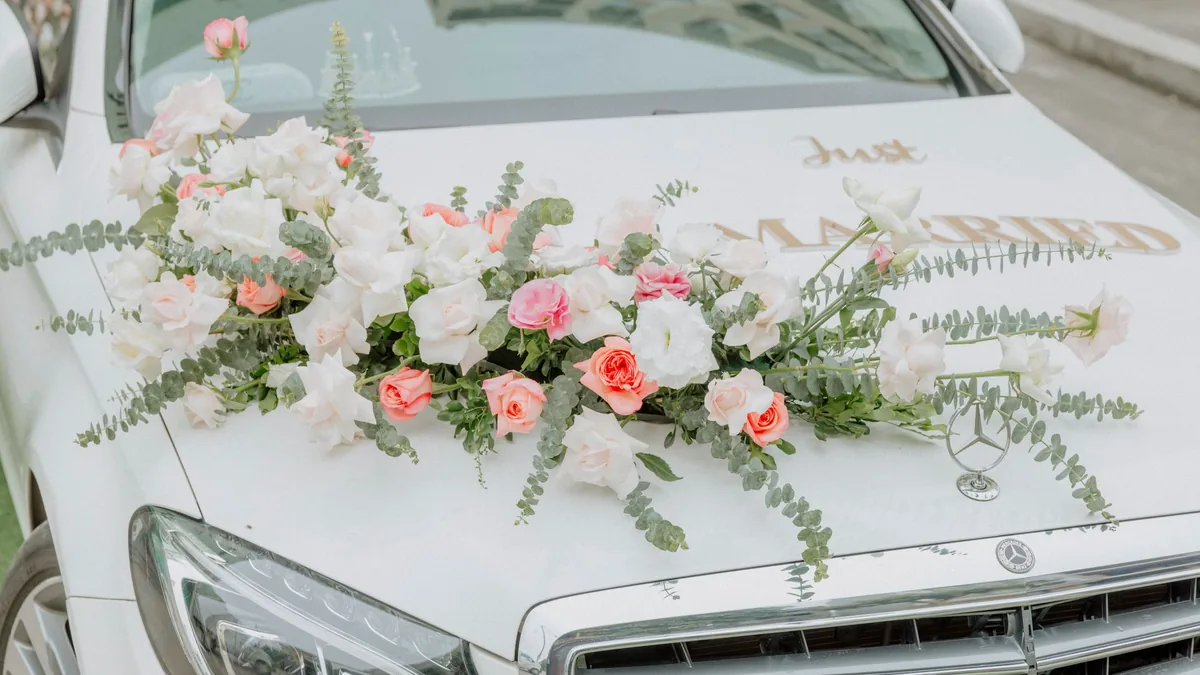
The groom wedding car is chosen for the photographs, and then someone counts heads. A decorated sedan has five seat belts, one of which belongs to the driver, and the groom in a sherwani with a sehra takes more room than a normal passenger. So the honest answer is this: plan for the groom plus two, at most three, in the lead car, and put everyone else who must arrive "with" him in a matching follow car that travels directly behind. Decide the lead-car list by role, not by seniority or by who shouts first, and fix it before the day. The rest of this guide shows you how to count real seats, who genuinely needs to be in the groom's car, how to pair a second vehicle so the arrival still looks like one entrance, and how to line the cars up at the venue gate.
It is written for families running a baraat in Pakistan, including those organising it from the UK, the Gulf or North America, where the person making the decisions may land only a few days before the event.
Why the seat gap appears in the first place
Most wedding car options are picked from a photo: a white sedan wrapped in roses, a black SUV with a floral bonnet, sometimes a vintage-looking car. Nobody asks how many adults in formal clothes fit inside until the morning of the baraat, when the groom's father, two brothers, a best friend, the youngest cousin with the camera and an elderly uncle all expect a seat.
Three things shrink the usable space:
- The driver's seat is not yours. A five-seat sedan such as the Honda City is listed by the manufacturer as a five-passenger car, and one of those five is the person driving.
- The groom is wider than usual. A sherwani with a stiff collar, a long shawl or a dupatta over the shoulder, a sehra or turban, and a garland of notes or flowers all need space. Squeezing him into the middle of a back bench crushes the outfit before the photographs start.
- Decoration eats cabin room. Floral work on the rear parcel shelf, a bouquet on the dashboard, and ribbon anchored through the door frames can make a door awkward to shut or block the view out of the rear window. Ask your decorator what goes inside the car, not just on it.
The result is predictable. The car that looked right in the booking photo now carries the groom and two people comfortably, and the plan quietly assumed five.
What the law and common sense say about seats
Before you consider squeezing a sixth person in, know where the lines sit.
The National Highways Safety Ordinance published by the National Highways & Motorway Police forbids carrying people on a running board or "otherwise than within the body of the vehicle", and prohibits letting anyone sit or stand in a way that hampers the driver's control. Strictly, the ordinance governs national highways and motorways, and city streets fall under provincial motor vehicle rules, but the principle is the one any sensible driver applies everywhere: no cousins on the bonnet, no nephew half out of the sunroof, and nobody perched on the handbrake.
On seat belts, the Pakistan Safety Council explains that the national law as it stands requires the driver to wear one, and that passenger belt use is not covered in the same way. Treat that as a floor, not a target. A car moving slowly through a wedding procession can still brake hard, and the groom in the front passenger seat with a belt on is a much better picture than the groom bruised on the dashboard. Provincial traffic police can also apply their own rules in city limits, so if you are unsure, ask your operator what the local position is and keep everyone belted.
A simple rule works: one person per seat belt, and no one in the driver's line of sight or reach. If the list is longer than the belts, you need another car, not a tighter squeeze.
Real seat counts for popular wedding car types
Different wedding car types give you very different numbers. The table below counts seats a family can realistically use for a formal party, with the driver already excluded. Treat these as planning figures; always ask for the exact model and its seat layout when you enquire, because trims and versions differ.
| Vehicle type | Seats listed (including driver) | Comfortable with the groom in full dress | Good for |
|---|---|---|---|
| Five-seat sedan (for example a Honda City) | 5 | Groom + 2, or groom + 3 if the rear passengers are slim and the outfit is simple | The classic decorated lead car |
| Five-seat SUV | 5 | Groom + 3 | A taller lead car with an easier step in and out |
| Seven-seat SUV (for example a Fortuner in its three-row form) | 7 | Groom + 3 in the first two rows, plus two in the third row for short, slow city runs | A lead car that also carries the closest family |
| Large MPV (for example the 11-seat Kia Carnival) | 11 | Up to about 8 adults in formal clothes with room to move | A follow car for elders, or a family shuttle |
| Passenger van | Varies by version and fit-out | Depends entirely on the seat layout supplied | Cousins, friends and a photographer behind the lead pair |
A few notes on that table:
- Toyota Pakistan's specification sheet puts the Fortuner at 4,795 mm long and 1,855 mm wide, and Toyota's Fortuner page lists rear air-conditioning controls for the second and third rows. That third row is tight for adults in formal dress and competes with luggage space, so confirm it is fitted, folded down and usable on the day if you are counting on it.
- Kia's Pakistan partner lists the Carnival's seating as 11 seats. Eleven belts is not the same as eleven comfortable adults in lehngas and sherwanis, so plan on fewer.
- Vans are the least predictable. The same model can arrive with bench seats, captain's chairs or a mix. Ask for the seat count of the actual vehicle, not the brochure.
If you want a deeper look at matching the look of a car to the number of people it needs to carry, our guide on choosing a wedding vehicle for appearance and passenger fit goes through that trade-off in more detail.
Who must ride with the groom
This is where families argue, so settle it early and in writing. The lead car has a job: get the groom to the venue on time, looking composed, with the people who have a defined role in the arrival. Everyone else can travel one car-length behind and still be in every photograph.
The short list
In most families the lead-car list, beyond the groom himself, comes down to some combination of these:
- One senior male relative, usually the father or, where the father has passed away or cannot travel, an uncle or elder brother. This is the person who will greet the bride's family at the gate.
- The shahbala, if your family follows that custom. He is often a young boy, which is convenient, because children take less room.
- One practical helper, a brother, cousin or close friend whose job is the groom: straightening the sehra, holding the phone, carrying the envelope or the garland, passing water.
That is three people. In a five-seat sedan they fit, with the groom in the front passenger seat or behind the passenger seat where the door opens widest.
Who does not need to be in the lead car
- The photographer or videographer. They need to be out of the car first, so ride them in the follow car or send them ahead.
- Elderly relatives who find low sedans hard. A taller follow SUV or MPV is kinder on knees and saves them squeezing in behind the groom's outfit.
- A second or third brother who simply wants to be there. Put him directly behind in the follow car. The guests see two decorated cars arrive together; nobody counts who sat where.
- Anyone carrying bags, gifts or trays. Mithai boxes and gift trays are follow-car cargo. They crush in a lap and take a seat that a person could use.
Adding a matching follow car
The fix for the seat gap is almost always a second vehicle that looks like it belongs with the first. Done well, it reads as a pair: the lead car with the groom, and a companion car carrying the family, both arriving in one movement.
What "matching" really means
You do not need two identical cars. You need three things to line up:
- Colour family. White with white, black with black, or silver with white works. A white sedan followed by a red hatchback reads as an accident of planning.
- Decoration level. The follow car should carry lighter decoration than the lead: a ribbon and a small floral piece on the bonnet, not a full rose wrap. That keeps the groom's car clearly first while tying the two together.
- Driver presentation. Ask for both drivers to be dressed similarly and briefed together. It sounds minor, but a wedding car with driver in a neat shirt standing by the door looks planned. One driver in uniform and one in a tracksuit does not.
How far behind it should travel
Close enough that nothing cuts in between, far enough to stop safely. In city traffic at procession pace, one car-length is usually right. On a faster road between, say, a family home in one part of the city and a marquee on the outskirts, let the drivers keep a sensible gap and close up only for the last stretch before the venue. Both drivers should have the same destination pin and each other's phone number.
Book them together
Enquire for both cars in the same request so the operator can plan them as one job: same start point, same timings, same waiting arrangement. Splitting the lead car and the follow car between two unconnected suppliers is how you end up with one car at the house at 6:30 and the other still looking for the street at 7:15. If you plan through Pakistan Taxi, say clearly in your wedding transport enquiry that the cars must travel as a pair and arrive together.
Sedan, SUV and van combinations that work
Here are practical pairings for different sizes of party. They are examples to help you think, not fixed packages; availability of specific models varies by city and date.
Small party: sedan plus sedan
Groom, father, shahbala and helper in a decorated sedan; mother (if she travels with the baraat in your family), sisters or close cousins in a second sedan with light decoration. This suits a smaller nikah or a baraat where most guests make their own way.
Medium party: sedan plus seven-seat SUV
The classic decorated sedan stays as the lead for the look. A seven-seat SUV follows with elders and close family, giving higher seats that are easier to climb into and a boot for gift trays. This is the combination that most often solves the "we have six people who must arrive with him" problem.
Large party: SUV lead, SUV follow, van behind
For a bigger baraat, lead with an SUV, which gives the groom headroom for a tall turban or sehra, and follow with a matching SUV. A van or MPV behind carries friends, cousins and the photographer. If the groom's side wants a formal look, our VIP SUV journeys (planned link) page explains how that class of vehicle is arranged, and iDrive, the network behind Pakistan Taxi, shows the full-size models in that class on its VIP SUV page. Availability varies by city and date, so treat either page as a starting point, not a promise of a particular car.
Quick decision guide
| Must arrive with the groom | Suggested pairing |
|---|---|
| Up to 3 people | One decorated sedan |
| 4 to 6 people | Decorated sedan plus matching seven-seat SUV |
| 7 to 10 people | Decorated SUV plus matching SUV or MPV |
| More than 10 | Lead pair plus vans or a coaster for the rest |
Making room for the sherwani, sehra and bridal dress
Seat counts assume ordinary clothes. Wedding clothes change the arithmetic, and a creased sherwani or a flattened lehnga is not something anyone forgets.
For the groom
- Seat him where the door opens widest. On most sedans that is the rear seat behind the front passenger, or the front passenger seat itself. He should be able to step out without ducking hard, because a sehra catches on door frames.
- Push the front passenger seat forward if he sits behind it. The person in front loses a little legroom; the groom gains space for a long kurta and a shawl.
- Keep the middle rear seat empty if you can. That empty seat is the difference between a crisp outfit and a crumpled one.
- Headroom for the turban or sehra. In a low sedan, a tall pagri may touch the roof lining. If the groom is tall or the headwear is high, an SUV lead car is worth considering for that reason alone.
- Garlands and money wreaths go on at the door, not in the car. Give them to someone in the follow car, who hands them to the helper at the gate.
For the bride on the rukhsati journey
The return journey is different. The bride in a heavy lehnga or gharara needs a full rear bench, ideally with one companion at most. Plan the rukhsati car as its own seating plan: bride and groom in the back, one relative in the front, and everyone else in the follow car. If the same decorated car is used for both journeys, ask the decorator to keep the rear bench clear of loose petals and pins that can snag fabric.
Arrival order when two cars reach the gate together
The arrival is the part everyone watches, so plan it like a short sequence rather than a free-for-all.
- Follow car stops first, slightly short of the gate. The photographer and the family inside get out quickly; the photographer takes position facing the lead car.
- Lead car pulls up to the marked spot. Agree this with the venue in advance. Some marquees and halls have a strip of carpet or a spot where the dhol and the welcoming party stand. The senior relative steps out first and walks forward to greet the bride's family.
- The helper opens the groom's door. Not the driver, who stays at the wheel ready to move the car, and not an excited cousin.
- Groom steps out, garland goes on, procession starts. The shahbala walks beside him.
- Both cars clear the gate. The drivers move to the parking area together so the entrance stays open for guests. Tell them where they will wait and roughly how long.
Timings and the day-before check
Seats solve half the problem; timing solves the rest. A few practical checks:
- Share one timeline with both drivers: pickup at the groom's home, any stop (a mosque, a shrine, a relative's house), and a target arrival time at the venue.
- Build in waiting. Baraats rarely leave on time. Agree with the operator how waiting time is handled before the day, so nobody is negotiating in the street.
- Walk through the car the day before or ask for photographs of the actual vehicle with decoration. Our guide to putting together a wedding car quote request lists what to ask for.
Planning the groom's car from overseas
A lot of these decisions are made by a parent or sibling in Birmingham, Dubai or Toronto who flies in a week before the wedding. Settle the lead-car list on a family call before you fly, ask for the exact vehicles and seat counts in writing, and name one relative on the ground as the drivers' contact for the morning.
Check travel advice for the whole route, too. The UK Foreign, Commonwealth & Development Office keeps up-to-date travel advice for Pakistan, including areas where it advises against all or all but essential travel. Most wedding runs stay within one city, but if the venue or the bride's family home is in another district, read the advice for that area before you commit. The FCDO also notes that local driving standards can be erratic, especially at night, which is one more reason to use an experienced driver for a late rukhsati.
A checklist to send to the family group
Copy this, fill it in, and share it:
- Number of people who must arrive with the groom: ___
- Lead car: vehicle type, colour, seat count, decoration level
- Follow car: vehicle type, colour, seat count, decoration level
- Names in the lead car (maximum three beyond the groom in a sedan)
- Names in the follow car, plus one spare seat
- Pickup address and time
- Any stop on the way
- Venue gate: where the lead car stops, who opens the groom's door
- Waiting arrangement and return after rukhsati
- Local contact name and number for the drivers
Your next step
Once you know how many people must arrive with the groom, you can describe the pairing you need. Use Plan Your Journey (planned link) to send the details: the event date, the pickup and venue locations, the vehicles you would like as lead and follow cars, and the number of passengers in each. The team will come back to you about what can be arranged; nothing is fixed until they confirm it with you directly.