
Knowing how to inspect a rental car matters most in the ten minutes nobody plans for: the car has just pulled up outside your uncle's gate, the supplier's agent wants to get back across town, your children are asking whether they can sit in the front, and it is 41 degrees in the shade. The answer is to walk round the car in the same fixed order every time, starting at the driver's door and finishing at the fuel gauge, and to refuse to sign anything until every existing mark is written on the handover sheet in words the agent has read. The order: outside, tyres and spare, cabin with the engine running, paperwork. Take a slow video as you go. Allow fifteen minutes in daylight and more after dark. If something important fails, such as the AC, a warning light or a missing spare, say so before the keys change hands, not after the first toll plaza.
Why a Pakistan handover needs its own routine
Most car rental checklists assume a rental desk, bright lighting and a printed damage diagram. In Pakistan the car may be delivered to a house, a hotel porch, a petrol station forecourt or the arrivals pickup lane, handed over by the owner's driver, with nothing more than a clipboard sheet or a message thread.
Three local conditions change what you should look at:
- Heat. In the plains, the mean June temperature is around 38°C and peaks can pass 50°C, according to the climate record for Pakistan. An AC that is only "a bit weak" at the gate becomes a real problem on a four-hour motorway drive with elderly passengers.
- Monsoon. The monsoon runs from about late June to late September. Wiper blades, tyre tread and door seals suddenly matter.
- Road surfaces. The UK government's Pakistan safety and security advice notes that outside the major motorways road quality is variable and conditions can be poor. Tyres, the spare and the jack are not an afterthought here.
Before the car arrives: set up the handover
- Ask what the handover sheet looks like. Is it paper, a form on the agent's phone, or photos sent on WhatsApp? You want to know in advance where the marks will be recorded.
- Agree the handover point. A quiet side road or a driveway beats a main road. If you are staying with relatives, pick a spot with space to walk right round the car.
- Ask a family member to handle the family. One adult inspects. Another keeps the children, the luggage and the curious neighbour busy. This is the single most useful thing you can arrange.
- Have your documents ready. Your licence, and if you are a UK licence holder the 1968 international driving permit, which the FCDO says you need alongside your UK licence when driving in Pakistan. Our guide to self-drive eligibility, deposits and handover questions for overseas bookers covers what suppliers typically ask for.
The self-drive hire page explains how Pakistan Taxi plans a self-drive enquiry with a car-hire supplier. The exact car and terms come from the supplier's confirmation, so read it before handover day.
The fixed walk-round order: your car rental checklist
The trick is not a longer list. It is doing the same list in the same direction every time, so your eyes never skip a panel because the agent started chatting. Walk clockwise from the driver's door and do not change the order.
- Driver's door and front wing. Paint, dents, the wing mirror housing and the mirror glass.
- Front bumper and bonnet. Stoop down. Look at the lower lip of the bumper, where kerbs and speed breakers leave scrapes.
- Windscreen and headlights. Chips, cracks, and whether both headlight lenses are clear.
- Passenger side, front to back. Front wing, both doors, the sill under the doors, the rear wing.
- Rear bumper, boot lid and tail lights. Include the number plate and the reversing camera if there is one.
- Driver's side rear. Rear door, rear wing, and back round to where you started.
- All four tyres and wheels. One by one, in the same clockwise order.
- The boot floor. Spare wheel, jack, wheel brace, warning triangle if supplied.
- The cabin, engine running. AC, dashboard lights, fuel level, mileage, wipers, horn, windows, seat belts.
- The paperwork. Registration document, handover sheet, fuel and mileage noted, both signatures.
Film steps 1 to 8 as one continuous walk, narrating as you go: "front bumper, scrape on the left corner." One unbroken video shows that nothing was skipped between shots.
Body, bumpers, glass and lights
This is where most rental car pre-existing damage hides, and it is where a quick glance fails. Paint damage is easiest to see at an angle, not face-on. Crouch at each corner and look along the side of the car towards the light. Ripples, dents and scuffs catch the reflection.
What counts as a mark worth recording
Record anything you can see or feel. Suppliers differ on what counts as normal wear, so write it down and let them decide it does not matter.
- Scratches that catch a fingernail, and fine scuffs on bumper corners.
- Dents of any size, including the small round ones hail or car park doors leave.
- Chipped paint on the bonnet's front edge, which takes stones on every highway.
- Cracked or loose bumper clips, where the bumper does not sit flush with the wing.
- Mirror damage, including a cracked indicator lens in the mirror housing.
- Alloy wheel scuffs from kerbs.
- Interior marks: seat tears, burn holes, stains, a cracked dashboard or a broken cup holder.
Glass
Look through the windscreen from the driver's seat as well as outside; a small chip shows up best with the light behind it. Then check the side windows and the rear screen.
Lights
Ask the agent to stand at the front while you switch on sidelights, dipped beam, main beam and both indicators, then swap to the rear for brake lights, reversing lights and the hazard lights. It takes ninety seconds, and a dead brake light is a safety issue you do not want attributed to you.
Tyres, spare and jack: check rental car tyres and AC before leaving
The four road tyres
For each wheel, check:
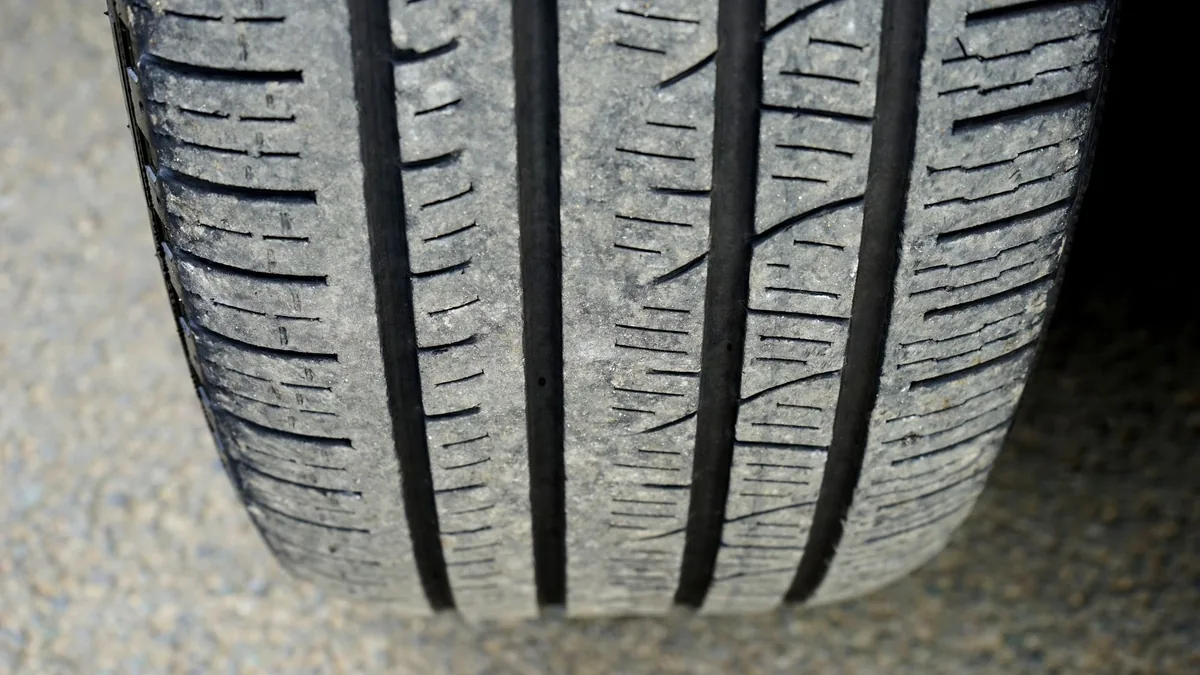
- Tread. Look across the width of the tyre, not just the middle. Uneven wear on one edge can point to alignment problems. If the tread looks shallow compared with the other tyres, say so.
- Sidewalls. Look for bulges, cuts and cracking. A bulge on the sidewall is a reason not to drive the car until the tyre is replaced.
- Pressure. A tyre that looks flatter than its partner on the same axle needs checking at a petrol station air pump before a long drive. Recommended pressures are often on a placard in the driver's door frame.
- Age. Find the letters "DOT" on the sidewall. The last four digits after it give the week and year of manufacture, so "2322" means week 23 of 2022, as the tyre code reference explains. Rubber ages in heat. If the dates are very different from tyre to tyre, it is worth a note.
The spare, the jack and the wheel brace
Lift the boot floor. This is the step most people skip, and the one that matters most if a tyre goes on a quiet stretch of GT Road at dusk.
- Is there a spare at all? Some cars have a repair kit or nothing.
- Is it inflated? Press it hard with your thumb. A flat spare is no spare.
- Is it full size or a space-saver? A compact temporary spare is only for short distances at reduced speed; the spare tyre reference quotes a typical limit of 80 km/h. That changes your plan if you are heading up the motorway.
- Jack and wheel brace. Both present, and does the brace actually fit the wheel nuts? If the car has locking wheel nuts, the locking key must be in the car. Without it the spare is useless.
If any of these is missing, write it on the sheet and ask the agent whether a replacement can be brought before you set off.
Inside the cabin: AC, warning lights and fuel at the start
Sit in the driver's seat and start the engine. This stop takes five minutes, and it is where the heat catches people out.
AC
Run the AC on its coldest setting and full fan for a few minutes with the doors closed. You are checking three things:
- Does cold air come out quickly? The vents should feel clearly cold after a short run, not merely less warm.
- Does it stay cold with the engine idling? Some weak systems only cool when the car is moving. Let it idle.
- Do the rear vents work if the car has them? In a seven-seater with grandparents in the back row, this is not a luxury.
Listen for rattling or squealing when the compressor cuts in, and notice any musty smell. If the AC is weak in Karachi in May, it will not improve on the way to Hyderabad. Raise it now.
Dashboard warning lights
Ignore what flickers as the engine starts and watch what stays lit once it is running. The engine management light is the important one: a steady light points to a fault that should be serviced as soon as possible, while a flashing light indicates a severe fault that makes the car unsafe to drive, according to the check engine light reference. Also note any oil, battery, brake, airbag, ABS or temperature warnings. Photograph the dashboard with the engine running so the lights, the mileage and the fuel gauge are in one picture.
Fuel and mileage
Make sure the fuel gauge reading and the odometer go on the handover sheet in figures. If the agreement says full, the needle should be on full, not "nearly".
Everything else in two minutes
- Wipers and washers. Essential in monsoon. Streaky blades are worth noting.
- Windows and locks. Every window up and down, central locking, the key fob.
- Seat belts. Pull each one out and let it retract, including the rear middle seat.
- Child seat, if you asked for one: check it is the right type and that it fits the car before the supplier leaves.
Getting marks written on the handover sheet
Your video is the backup; the handover sheet is the record. A mark on the sheet with the agent's signature makes any later conversation short.
How to write marks so they mean something
Vague notes like "minor scratches" help nobody. Use location, type and size:
| Vague note | Useful note |
|---|---|
| Scratches on side | Scratch, passenger rear door, about 10 cm, below handle |
| Bumper damage | Scuff, front bumper lower left corner, paint through to plastic |
| Tyre ok | Front right tyre visibly lower than front left; to be checked at pump |
| Glass fine | Chip on windscreen, passenger side, lower edge, about 5 mm |
| AC working | AC cold at front vents, rear vents weak |
| Fuel full | Fuel gauge at 3/4, odometer 48,215 km (example figures) |
If the sheet has a car outline diagram, mark each item on it with a number that matches a written line. If there is no diagram, write the list on the sheet anyway, or send it as a message to the supplier's number while the agent is standing there and ask them to reply to confirm. A timestamped reply is far better than silence.
What to check on the paperwork itself
- The registration document matches the plate on the car. Plates in Pakistan are issued by an agency of the provincial or territorial government, and each province has its own plate design, as the overview of Pakistani number plates shows. All you need is for the number on the document and the number on the car to agree.
- Your name, dates and return time are correct on the agreement.
- The fuel level and mileage are written in, not left blank for "later".
- The supplier's contact number for breakdowns is on the sheet or in your phone before the agent leaves. On the motorways and national highways, enforcement and recovery fall to the National Highways & Motorway Police, but the supplier still needs to hear from you first.
- You receive a copy. A photo of the signed sheet is fine.
Read the Pakistan Taxi booking terms (planned link) before handover day so you know how damage, fuel and deposits are handled in principle, and treat the supplier's own agreement as the document that governs the car in front of you.
When the agent is in a hurry
They have another delivery and would like you to "just sign, it is all fine". Stay friendly and keep going: "I'll be quick, I just want us both to have the same list." If they genuinely cannot wait, send your video and list of marks to the supplier before you drive away, and note on the sheet that the inspection was cut short.
Handovers at night or at the airport kerb
Darkness and places where you cannot stop for long both make a proper inspection harder. Plan for them.
| Situation | What goes wrong | What to do instead |
|---|---|---|
| Night handover outside a house | Torchlight flattens dents and hides fine scratches | Use the phone torch held low and at an angle along each panel; ask for the car under a porch or streetlight |
| Airport arrivals pickup lane | Wardens move cars on; you are tired after a long flight | Do the tyres, spare, fuel, lights and warning lights at the kerb; agree to finish the body check at the first safe stop |
| Petrol station forecourt | Busy, other cars around you | Park at the air pump bay, which also lets you check pressures |
| Handover in rain | Water beads hide scratches | Dry a panel with a cloth where you suspect damage; note "inspected in rain" on the sheet |
| Supplier delivers while you are out | A relative receives the keys | Send them this walk-round order in advance and ask them to film it |
Night handovers
A dent that is obvious at noon disappears under one overhead streetlight. Shine your phone torch along each panel rather than straight at it, so scratches throw small shadows, and film with it on. Write the time and "inspected at night" on the sheet. If you spot anything in daylight next morning, message the supplier with photos before you drive anywhere. And unless you have to, don't start a long drive straight after a night handover: the FCDO notes that local driving standards are erratic, especially at night.
Airport kerb handovers
Arrivals areas at the big airports are built for quick pickups, not twenty-minute walk-rounds. If the supplier is meeting you there, split the check:
- At the kerb, before driving: confirm the plate matches the paperwork, check all four tyres by eye, look at the spare, start the engine and read the dashboard, fuel and mileage, and test the lights and AC.
- At the first safe stop: a hotel car park, a relative's driveway or a quiet service area. Walk the body with your video running, and send the list of marks to the supplier within the hour.
Agree this split before you land; our help and journey planning page (planned link) is the place to ask how a handover will work. If you are too tired to drive after the flight, a car with a driver from the airport and a daylight self-drive handover at the house next morning may suit you better.
One more point for arrivals from abroad: before you plan any self-drive route, read the UK Foreign Office's travel advice for Pakistan. It advises against all travel to some areas, including all of Balochistan, many districts of Khyber Pakhtunkhwa and the area within 10 miles of the Afghan border, and against all but essential travel to others, and it warns that travel insurance may be invalidated if you go against that advice. A careful handover does not make a route safer.
If you find a problem before you drive off
Finding something is the handover working. What you do next depends on what it is.
- Cosmetic marks (scratches, scuffs, small dents): record them precisely and carry on.
- Safety items (a bulging tyre, a missing or flat spare, a flashing engine light, failed brake lights, a seat belt that will not latch): do not accept the car until the supplier fixes or replaces it. Ask what they propose and note it on the sheet.
- Comfort items that are really safety items in summer (an AC that barely cools with elderly or very young passengers aboard): raise it firmly. Ask whether another car is available. The supplier may or may not be able to offer one; get the answer in writing either way.
- Paperwork mismatches (plate and registration document do not agree, wrong name on the agreement): do not drive until it is sorted.
If the car cannot be made right, you are better off rearranging than setting off with a problem. You can plan a journey with Pakistan Taxi (planned link) as a fallback for that day while the supplier sorts the car.
At the end of the hire: repeat the same walk
When you return the car, walk round in exactly the same order, film it the same way, and ask for the return sheet to record fuel, mileage and "no new damage" or the specific new marks. Your pickup video and your return video, taken in the same order, tell a simple story. For a wider view of how self-drive hire is arranged across the country, our sister service iDrive, the network behind Pakistan Taxi, sets it out on its self-drive car rental in Pakistan page.