
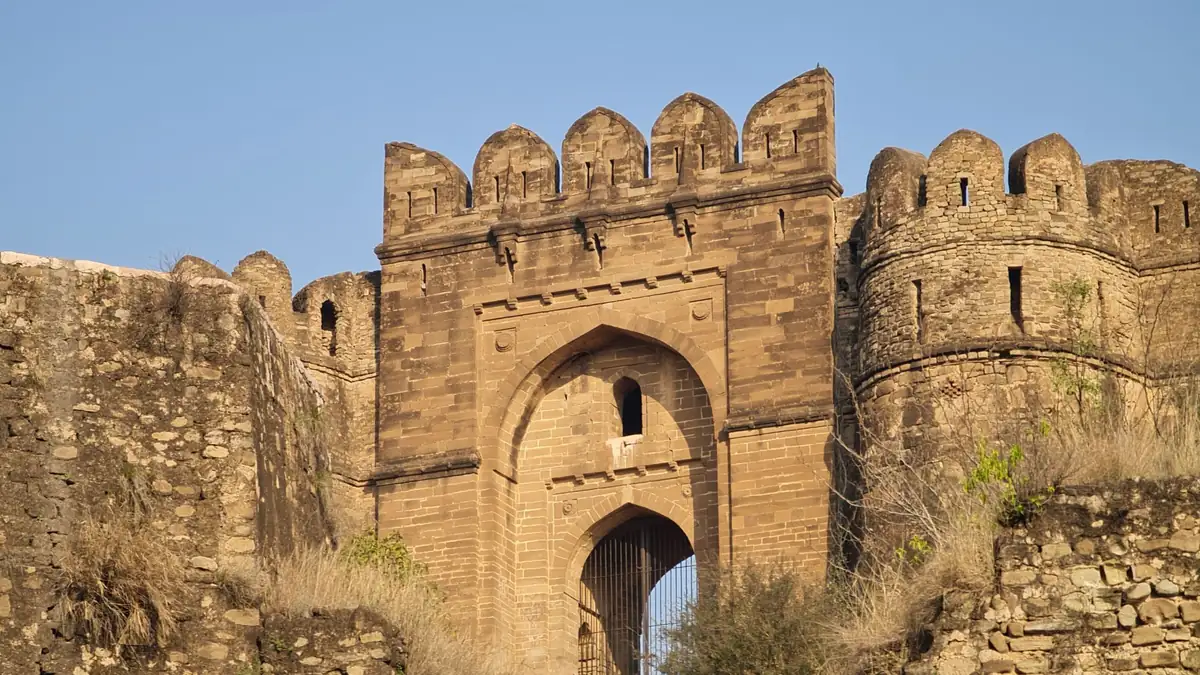
If you are looking at Jhelum rent a car with driver options for a sightseeing day, the honest shape of that day is simpler than most plans make it. Rohtas Fort is the anchor: it sits in a gorge roughly 16 km north-west of Jhelum city, near Dina and a few kilometres off the GT Road (N-5). A car and driver can get you to the fort, but the fort is also a lived-in village, so plan for being dropped at a gate and walking rather than parking beside every monument. Mangla is a different matter. The dam straddles the Punjab and Azad Jammu and Kashmir boundary, Mangla Fort and the cantonment sit on the AJK side of the Jhelum River, the old fort is army-administered and not open to the public, and the UK government currently advises against all but essential travel to Azad Jammu and Kashmir. Tilla Jogian is not a drive-up site at all: there is no developed road to the summit, and the usual approach is a hike of about 3 km from Bhet village.
So the realistic day is Rohtas done properly, a family visit or two around Jhelum and Dina, and an honest decision about whether Mangla or Tilla Jogian belongs in it. The rest of this guide explains why, and how to set the day up so the driver, the parking and the timings work for you.
Read this first: the safety position around Mangla
Before anything else, check the UK FCDO travel advice for Pakistan. At the time of writing it advises against all but essential travel to Azad Jammu and Kashmir, and against all travel within 10 miles of the Line of Control. Jhelum district itself, on the Punjab side of the river, is not named in those warnings.
That matters for this day because Mangla is not simply "near Jhelum". Mangla town and cantonment are in Mirpur district, about 12 km from Mirpur city, and much of the reservoir lies on the Azad Jammu and Kashmir side. The river marks the boundary between Punjab and AJK here, so "just over the bridge" can mean a different advisory position.
What this means in practice:
- Treat Mangla as sightseeing only if you have already weighed the advice. We will not encourage a leisure detour into an area the FCDO advises against, and you should not let a driver or a relative talk you into one casually.
- Family visits are a separate conversation. Many travellers in Jhelum have relatives across the river in Mirpur. If you decide a family visit there is essential, that is your call, but check what your travel insurance says about FCDO-advised areas before you go.
- Advice changes. Read the live page on the morning you set off rather than relying on anything written here.
The rest of this guide is built so the day still works well if Mangla is left out entirely.
Rohtas Fort: what you are actually driving to
Rohtas is big. UNESCO describes walls more than four kilometres in circumference, 68 bastions and 12 monumental gateways enclosing about 70 hectares; it was begun in 1541 under Sher Shah Suri and was inscribed as a World Heritage Site in 1997. You can read the UNESCO World Heritage listing for Rohtas Fort for the architectural case. For a day plan, three facts matter more:
- It is a fort with a village inside it. People live within the walls, with schools, a post office, a small bazaar and mosques. Cars that reach the interior share lanes with residents, school runs and motorbikes.
- It sits above a river. The Kahan (also written Ghan) runs in the gorge below. Crossings used to be awkward in the monsoon; reporting in The News on Rohtas conservation notes a newer bridge that made the approach much easier.
- Its scale is on foot. The interesting parts, the gates, the stepwells, Haveli Man Singh and the Shahi Masjid, are spread across the site. Nobody sees Rohtas from a car window.
The gates, and which ones matter to your driver
Different sources count the gates differently (UNESCO says 12 monumental gateways; other histories list up to 14 openings). For a visitor with a car, you only need a handful of names:
| Gate | Why it matters on the day | What to tell your driver |
|---|---|---|
| Sohail Gate | The ceremonial main entrance; the Sher Shah Suri Museum is in its upper storey | Ask for a drop here if you want the museum and the classic first view |
| Khwas Khani Gate | Historically the original main entrance from the GT Road side | Useful if you want to start where the old road came in |
| Kabuli Gate | Faces north-west, towards Kabul; described as housing a visitor information centre | A sensible pickup point if you finish on the western side |
| Shah Chandwali Gate | The double gate linking the inner citadel to the main fort | A walking landmark rather than a car stop |
| Langar Khani and Talaqi gates | Part of the northern and western defences | Walking landmarks; agree meeting points by name, not by "the gate" |
The practical rule: pick one drop gate and one pickup gate, name them to the driver before you set off, and do not assume the car can follow you around inside.
Parking at Rohtas: plan for uncertainty
There is no point pretending we can tell you exactly where a car will fit on the day. Weekends, school hours, a local wedding or repair work can all change what is sensible. What we can tell you is how to make it not matter.
The drop-and-wait plan works best for most families:
- The driver drops you at your chosen gate, with elders going in first.
- The driver finds somewhere safe and legal to wait, outside the busiest lanes, and sends you the location.
- You agree a pickup time and a fallback time, for example "12:30 at Sohail Gate, or 13:00 if we are late".
- If plans change, you call; the driver comes to you rather than you hunting for the car.
This is where a car with driver earns its keep over self-drive. You are not circling a village lane with a hired car, and nobody has to stay with the vehicle.
A checklist before you leave for Rohtas:
- Everyone's phone charged and the driver's number saved on at least two phones.
- Flat, closed shoes. The paths are uneven stone, with steps at the stepwells.
- Water and a cap in the warm months; a layer in winter.
- A short plan for anyone who cannot walk far: which gate, which bench, who stays with them.
- Cash in small notes for any entry charge, tea, or a local guide if one is offered.
Rohtas Fort timings: what we can and cannot say
We could not verify current Rohtas Fort timings or ticket prices from an official source for this guide, and they can change with season, holidays and conservation work. The fort is managed by the Punjab government's archaeology directorate as a protected antiquity, so that is the authority to check with. On the day, the simplest approach is to ask your driver to confirm opening on arrival and to keep your plan flexible by an hour either side.
What you can plan around with confidence:
- Give the fort a proper block of time. Two to three hours on foot is a sensible minimum for gates, walls and the stepwells without rushing children or elders. Treat that as an example, not a rule; keen walkers will want longer.
- Go early in hot months. Stone walls and open ground hold the heat, and there is limited shade on the ramparts.
- Leave light to spare. Aim to be back at the car well before dusk, so the drive out through the village lanes happens in daylight.
A Mangla Dam visit: what access really looks like
People say "let's see Mangla" as if it were a viewpoint with a car park. It is a major piece of national infrastructure. The dam impounds the Jhelum and Poonch rivers; it was built between 1961 and 1965 and was the first major dam of the Indus Basin Project. It stands about 147 m high and 3,140 m long, and a raising project between 2004 and 2009 added 30 feet to its height and displaced more than 40,000 people. The water, power and security interests around it are real, and access reflects that.
What we can say from the sources we checked:
- Mangla Fort is not open to the public. It is administered by the Pakistan Army, with a substantial WAPDA presence, and much of it was submerged when the reservoir filled.
- The cantonment sits across the river in Azad Jammu and Kashmir. Land around Baral and Sultanpur Thill was taken over for the cantonment after the dam was completed.
- The reservoir shore is long and mostly on the AJK side. Its perimeter is described as around 400 km.
So a Mangla Dam visit is not something to promise a family as a casual stop. If you are considering it:
- Read the FCDO position above, then decide whether your trip into AJK is essential.
- Do not assume a driver can take you onto dam or cantonment roads. Security checkpoints may turn a car around, and that is not something to argue with.
- Do not photograph checkpoints, installations or uniformed staff.
- If a relative with local knowledge suggests a particular viewpoint, ask who controls the road and whether you need permission, before you set off.
For many families the better answer is to see the Jhelum River from the Punjab bank near Jhelum city, where the old railway bridge dates back to 1873, and keep the day focused on Rohtas and family.
Tilla Jogian road: why this is not a car destination
Tilla Jogian gets mentioned in the same breath as Rohtas, and it is extraordinary: a hilltop monastery complex at about 975 m in the Salt Range, roughly 25 km west to south-west of Jhelum. Guru Nanak is said to have meditated there for forty days in the early 1500s, and in the early 19th century Maharaja Ranjit Singh added a stone-lined pond and a small monument marking the spot.
The problem for a car plan is simple. There is no developed Tilla Jogian road to the top. The commonly described route is a hiking trail from Bhet village on the northern slope, about 3 km long with close to 500 m of climbing. The site is not officially protected, is privately owned, and its structures are deteriorating.
What that means for vehicle choice:
- A standard car can only get you to the start of the walk, at best. How far the approach track to Bhet is suitable for a saloon, and in what weather, is something to ask your operator and driver directly, not assume.
- Do not plan it as a same-day add-on to Rohtas with elders or small children. A 500 m climb on an uneven trail is a half-day in its own right for fit adults, before you count the drive.
- If you do go, go as a separate, early-start day with sturdy footwear, plenty of water, someone who knows the trail and a firm turnaround time.
Timing the day around GT Road traffic
Jhelum sits on the N-5, the GT Road. Going north towards Rawalpindi, the road passes Dina, Sohawa, Gujar Khan and Rawat; going south it runs through Kharian and Gujrat towards Lahore. In normal conditions Jhelum is often described as about an hour and a half from Islamabad and around three hours from Lahore, but those are guides, not promises. The GT Road runs through towns, markets and junctions, and a single slow stretch can add a lot.
Some habits that make a Jhelum day trip by car calmer:
- Leave early. An early start gets you to Rohtas in the cooler part of the day and puts the GT Road stretches behind you before towns get busy.
- Put the fort before the family lunch, not after. Lunches run long. If Rohtas comes second, it often gets cut to twenty minutes.
- Keep Fridays in mind. Plans around Jumu'ah prayers shift, both for your family and for the driver. Build that in rather than fighting it.
- Allow slack on the return. If you are heading back to Islamabad or Rawalpindi the same evening, agree a latest departure time from Jhelum and hold to it.
- Watch the weather. Monsoon rain affects river crossings and rural lanes more than the main road, and fog can slow the GT Road in winter mornings. The National Highways & Motorway Police publish travel advisories worth checking before a long return leg.
If you are coming straight off a flight, do not try to fit Rohtas into the arrival day. Land, rest, and do the fort the day after. Our Islamabad Airport journey guide (planned link) covers the arrival side, and if you only need a one-way airport run, our sister service iDrive (the network behind Pakistan Taxi) has a dedicated Islamabad Airport to Jhelum transfer page.
Combining sightseeing with family visits
For many visitors, the real purpose of a Jhelum trip is family, and the sightseeing fits around it. That is fine, as long as the day is designed that way from the start.
A driver on a day duty waits at each stop, whether that is a pickup in Jhelum Cantonment, lunch in Dina or tea at a second house, and you can drop an older relative home after the fort without breaking up the day. Our guide to planning a multi-stop family journey goes deeper on sequencing addresses, and the chauffeur duty or separate transfers worksheet helps if you are unsure whether you need the car all day or just a couple of legs.
An example day plan
This is an example to adapt, not a timetable we can guarantee:
| Time (example) | Stop | Notes |
|---|---|---|
| 07:30 | Pickup at the family home in Jhelum | Water, snacks, shoes checked |
| 08:15 | Drop at Sohail Gate, Rohtas | Driver waits nearby and shares location |
| 08:15-11:00 | Rohtas on foot | Museum, walls, stepwells; elders rest at an agreed point |
| 11:15 | Pickup at the agreed gate | Fallback time already set |
| 12:00 | Relatives in Dina | Lunch; driver takes a proper break |
| 15:00 | Second family visit in Jhelum | Short stop; agree a leaving time on arrival |
| 17:30 | Drop home | Or the start of a return to Islamabad, if planned |
Mangla and Tilla Jogian are missing on purpose; neither belongs in a day built around elders and lunch.
Jhelum rent a car with driver: choosing the vehicle
The vehicle matters less than the plan, but a few points help:
- For two to four adults with day bags, a standard saloon is usually enough. You are not carrying luggage, and a smaller car copes better with narrow village lanes.
- For larger families or elders who need space to get in and out, a seven-seater MPV is more comfortable, though it may need to wait further from the gates.
- If anyone uses a wheelchair or walking frame, say so up front. Rohtas is largely uneven stone, so plan a shorter visit around one gate and the nearest sights, and let the driver know where you will need the car closest.
Tell the booking team about the fort, the family stops and any walking limits. That shapes the vehicle suggestion far more than headcount alone.
How to set up the day with Pakistan Taxi
Our journey flow is a planning and enquiry tool, not an instant booking. You tell us what the day looks like, we check it with the operator network, and you get a response to review. Fares, vehicles and availability are confirmed with you before anything is arranged, and nothing here should be read as a fixed price or a guaranteed car.
- Write down the stops in order. Start address, Rohtas gate, each family address, the final drop. Use landmarks as well as addresses.
- Decide the hours. A day duty is easier to plan when you give a start time and a latest finish time.
- Note the walking plan. Who goes into the fort, who waits, and where.
- Say what you are leaving out. If Mangla or Tilla Jogian is not in the plan, say so, so there is no confusion on the day.
- Send it through the planner. Use plan your journey (planned link) to share the details, or read more about our car and driver service first.
- Confirm the driver brief the night before. Pickup time, first gate, fallback times and the family addresses.
A driver brief you can copy
Pickup 07:30, [home address]. Drop at Sohail Gate, Rohtas Fort. Please wait nearby and send your location. Pickup at [gate name] 11:15, fallback 11:45. Then lunch at [Dina address], then [Jhelum address]. Finish by 17:30. No Mangla, no Tilla Jogian today.
Questions people ask
Can a car drive right up to Rohtas Fort?
A car can reach the fort and its gates via the road from Dina and the bridge over the Kahan. Inside the walls there is a living village, so expect to be dropped at a gate and walk. Agree drop and pickup gates in advance.
Is Mangla worth adding to a Rohtas day?
For most families, no. Mangla Fort is not open to the public, the dam area is security-sensitive, and the cantonment and much of the lake are in Azad Jammu and Kashmir, where the FCDO advises against all but essential travel.
Can we drive to Tilla Jogian?
Not to the top. There is no developed road to the summit, and the usual route is a hike of about 3 km from Bhet village with nearly 500 m of climbing. Treat it as a separate, early-start walking day.