
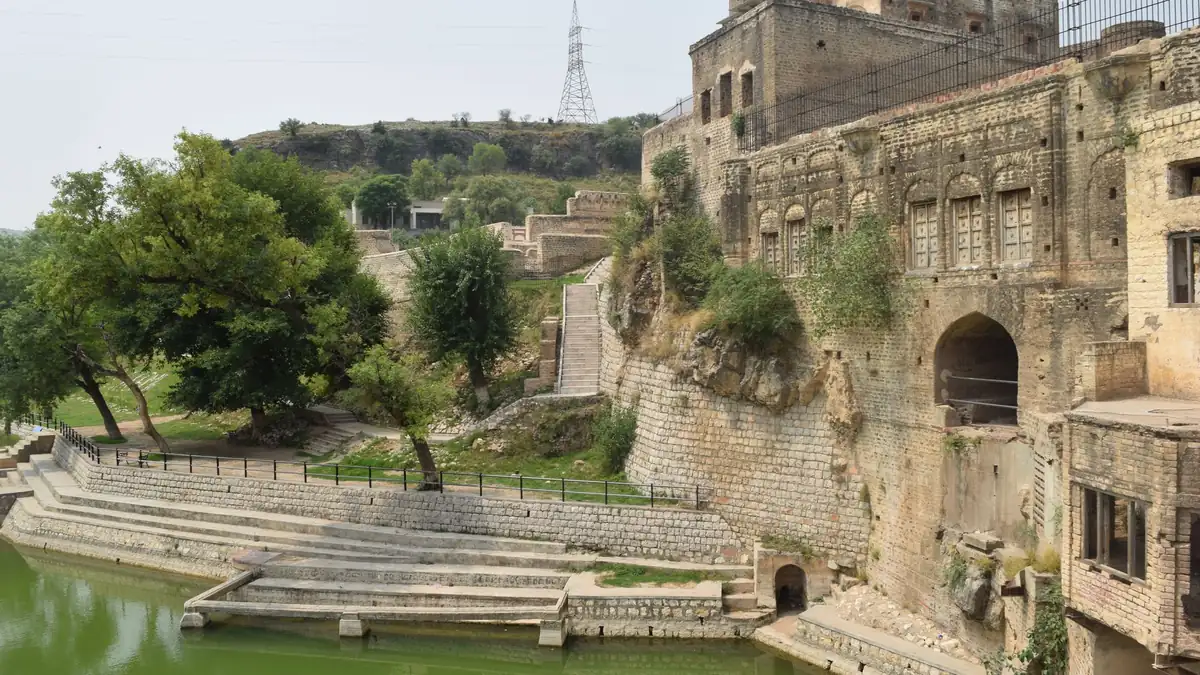
The Katas Raj temple complex sits in the Salt Range of Chakwal District, about 6 km from the town of Choa Saidan Shah, and you reach it from the Kallar Kahar interchange on the M-2 motorway between Islamabad and Lahore. That makes it a realistic day out from either city rather than an expedition. For a group, the trip succeeds or fails on three things: leaving early enough to arrive before the midday heat, choosing vehicles where the older passengers sit near a door and are not climbing over luggage, and planning the walk around the sacred pond so that nobody is pushed up to the higher temples before they are ready.
Is it safe and permitted to visit?
Start with the official picture, because families abroad will ask. The UK Foreign, Commonwealth and Development Office's Pakistan travel advice lists the areas it advises against visiting, and in Punjab the only named district under an "all but essential travel" warning is Dera Ghazi Khan. Chakwal District, the M-2 motorway, Islamabad and Lahore are not on those lists. That is not the same as a guarantee. The FCDO still carries country-wide guidance on security and protests, so read the current page in the week you travel and again the night before.
The Evacuee Trust Property Board is the federal body that manages Hindu and Sikh religious properties in Pakistan, and its officials are the ones who speak for Katas Raj in the press. When you need a firm answer on opening arrangements, festival access or a large group, the ETPB's Lahore office is the place to ask. Its website lists a Lahore landline and weekday office hours.
Where Katas Raj is, and which motorway exit to use
Katas Raj is on the Potohar Plateau, in the Choa Saidan Shah tehsil of Chakwal District, at roughly 2,000 feet above sea level according to the Wikipedia entry on the Katas Raj Temples. The nearest town, Choa Saidan Shah, lies in a bowl-shaped valley on the Chakwal to Khewra road. Wikipedia's Choa Saidan Shah article places the town about 35 km south of Chakwal, around 10 km north of Khewra, and roughly 27 km from the M-2.
The M-2 motorway is 375 km from end to end and is maintained by the National Highway Authority. Its interchange list names three exits that matter here:
- Kallar Kahar Interchange, which the interchange list signs for Kallar Kahar, Choa Saidanshah and the Katas Raj Temples. This is the exit for most groups.
- Balkassar Interchange, on the Talagang to Chakwal road, useful if you are combining the trip with Chakwal town.
- Lilla Interchange, on the Pind Dadan Khan road; Wikipedia puts the Khewra Salt Mine about 30 km off this exit.
How far it is from each city
Wikipedia puts Khewra about 160 km from Islamabad and about the same from Lahore. Katas Raj sits a short distance north of Khewra on the same Salt Range road, which is why the temples work as a day trip from either end of the motorway. Whichever city you start from, you share the same slower final section on the local roads after the interchange, where speed drops and the road climbs through the hills.
Road time: plan it rather than promise it
There is no official door-to-door time for this trip, and anyone who quotes you one to the minute is guessing. Motorway speed is predictable; the local road after the interchange, a stop for tea, fog on winter mornings and the time it takes a group of eight to use the washrooms are not. The National Highways and Motorway Police publish travel advisories and run the FM 95 road information radio. Check both before you set off, and again on a winter morning.
A simple way to build the day is to work backwards from when you want to be at the pond. Here is an illustrative template only, not a timetable:
| Step | What to allow for |
|---|---|
| Pickup | Collect everyone from one address if you can; each extra pickup inside Lahore or Islamabad adds real time |
| Motorway run | Your driver's estimate for the M-2 to your chosen interchange, plus one planned stop |
| Service area stop | Kallar Kahar is one of the five M-2 service areas on each side, with fuel, food and washrooms |
| Local road | The slower stretch from the interchange through the Salt Range to Choa Saidan Shah and the temples |
| At the site | At least two hours for a relaxed walk with elders, more at festival time |
| Return | The same again, plus a margin so you are not on the local road after dark |
The service areas are listed in the M-2 article as Sukheki, Sial, Bhera, Kalar Kahar and Chakri, with an average of 60 to 80 km between them. For a group with older passengers, agree the stop in advance. A scheduled halt beats six separate requests to pull over.
Tolls and the M-Tag
Motorway tolls on the M-2 are payable through the M-Tag system introduced in December 2021. Toll amounts change, so we do not print them here. If you want the numbers and some wider context on drive times, iDrive, the network behind Pakistan Taxi, keeps a page on motorway tolls and drive times on the M-1, M-2 and M-4. On a hired journey, ask whether the tolls are included in the price you are quoted or charged on top, and get the answer in writing.
What you will find at the Katas Raj temple complex
Katas Raj is not one temple. It is a cluster of buildings from different centuries gathered around a single pond, and knowing the layout before you arrive lets you plan a route for the less mobile members of the group.
The sacred pond
The pond is the heart of the site. In Hindu tradition it formed from the tears Shiva shed after the death of his wife Sati, which is why pilgrims treat the water with such reverence. Wikipedia records the pond's area as two kanals and 15 marlas, with a maximum depth of about 20 feet.
The water has a difficult recent history. Dawn reported in May 2017 that the pond was drying out for the second time in five years, with locals blaming the many water bores of nearby cement factories. The Supreme Court took up the case, and its 2018 ruling directed the factories to draw water from other sources. Then the opposite problem arrived. After unprecedented rain in Chakwal on 16 and 17 July 2025, Dawn reported that the complex stood intact but the pond overflowed, flooding the lawn and damaging the entrance walls and main gate, while a boundary wall about 600 feet from the temples collapsed in three places.
The lesson for a group: the ground around the pond can change between visits. Ask the site staff where it is safe to walk, and keep children back from the edge.
The temples, the haveli and the older ruins
The main complex has 12 temples joined by walkways around the pond. An ETPB official quoted by Dawn after the 2025 floods noted that the temples "are located at a height", which is the practical detail that matters most if you are walking with elders: the pond is at the bottom, and the temples rise above it.
Other parts of the site are spread further out:
- The Satghara group, a separate cluster to the south-west, originally seven temples of which five survive. Wikipedia dates the oldest to the late sixth century CE and the main temple to the tenth century, built by the Odi Shahi dynasty; the group resembles Kashmiri temples, with fluted pillars, trefoil arches and pointed rooflines.
- Hari Singh Nalwa's haveli, a rectangular fortified residence with four corner bastions, walls about five metres high and a central courtyard with an arched veranda. Dawn's 2025 report flagged its ceiling as needing repair.
- The remains of a Buddhist stupa, which early accounts described as about 200 feet tall and ringed by ten springs.
Shivratri and visiting yatri groups
Katas Raj has been one of the most important stops for Hindu pilgrimage in Pakistan for centuries, and Maha Shivratri is when it is busiest. The festival follows the Hindu lunar calendar, so its date moves each year; in 2017, for example, it fell in February. Check the date for your year before you fix anything else.
Two kinds of pilgrim arrive at that time:
- Pakistani Hindu families and community groups from around the country. Wikipedia cites around 2,000 Pakistani Hindus attending each year in 2010 and 2011.
- Organised yatri groups from India, who come on pilgrim visas issued for the occasion. Pakistan issued 154 such visas in 2025, and in February 2017 about 200 Indian pilgrims travelled for the Katas Raj Dham festival. These groups travel on an official programme, and Wikipedia records that Indian pilgrim visits stopped after the 1965 war until 1984, and again after the 2008 Mumbai attacks.
What this means for your own group:
- Expect more people and more security. Organised yatra days are managed events. Parking, entry and movement around the pond may be controlled, and you should follow instructions from site staff and police without argument.
- Ask the ETPB before you commit to a festival date. If your group is not part of an organised yatra, confirm whether general visitors are admitted on the main days and at what times. The ETPB is the body to ask.
- Pick a quieter day if devotion is not the purpose. If your group is coming for the heritage rather than the festival, a weekday outside Shivratri gives elders more space, more shade and a slower pace.
- Build in waiting time. On busy days, a vehicle may not be able to wait near the entrance. Agree with your driver where to meet, and give one person in the group the driver's number.
Seats and steps: planning for elders
Plenty of family trips to Katas Raj include a grandparent, and the site has the slopes and steps you would expect of temples built above a pond. The ETPB's own comment that the temples sit at a height is your cue to plan the walk, not just the drive.
In the vehicle
A few seating rules make a long day kinder on older knees:
- Front passenger seat, or the first row behind the driver, for the least mobile person. Those seats have the easiest step in and out, and the most legroom.
- No one elderly in the rear bench of a seven-seater. Getting to the third row usually means folding a seat and climbing, which is hard on a hip and harder again after a long sit on the motorway.
- Folding wheelchair or walker goes in last, so it comes out first. Mention its size when you enquire so there is boot space once everyone's bags are in.
- Medicines in a small bag on the elder's lap or beside them, not packed under luggage.
For more than six people, the choice is usually between one van and two cars. Two cars let you split the group by pace, so the elders can leave early while the younger members stay to explore the Satghara ruins. A van keeps everyone together. Our guide on choosing a group van or several cars walks through that trade-off.
On the ground
- Walk the pond first. It is the lowest point and the centre of the site. Let elders sit near the water while the more energetic members climb to the upper temples and the haveli.
- Choose one or two temples, not all twelve. Agree with the family beforehand which temple matters most to them, and walk to that one at their pace.
- Take a folding stool. Seating is limited on a site built for walking.
- Avoid the middle of the day in summer. Arrive in the morning and plan to be heading back by mid-afternoon.
- Carry water. Dawn reported in 2025 that the water filtration plant inaugurated there in January 2017 had not worked for several years, so bring enough for everyone.
- Leave the haveli and the Satghara group to those who are steady on their feet. Both are away from the pond, and the Satghara group is a separate walk.
Making it a Chakwal day trip: what to pair it with
Katas Raj sits in the middle of a compact cluster of Salt Range sights, and the question most groups face is not what to add but what to leave out. The honest answer is one extra stop, two at most, if there are elders or young children in the car.
| Pairing | Why go | Access notes | Best for |
|---|---|---|---|
| Kallar Kahar | Lake town that the emperor Babur praised in his memoirs, singling out Takht-e-Babri | Kallar Kahar interchange and M-2 service area | A relaxed stop on the way in or out |
| Khewra Salt Mine | Tunnels and salt chambers run by the Pakistan Mineral Development Corporation; a narrow-gauge train runs inside | Wikipedia gives the route via Lilla interchange towards Pind Dadan Khan | Families with children; stays about 18 to 20 °C all year |
| Choa Saidan Shah | The town next door, known for roses and perfume, with the shrine of Saidan Shah Shirazi | On the Chakwal to Khewra road, about 6 km from the temples | A short stop for tea and a look around |
| Chakwal town | District headquarters | About 35 km north of Choa Saidan Shah; Balkassar interchange is on the Talagang to Chakwal road | Groups with relatives in the district |
A few notes on each:
- Kallar Kahar is the easy pairing because it is already on your route. Babur described the area as a "child of Kashmir", and the town is known for the peacocks that once lived there in large numbers, though Wikipedia notes their numbers have fallen sharply.
- Khewra is the big one. It draws around 250,000 visitors a year, according to the Khewra Salt Mine article, and includes a mosque built from salt bricks, a salt bridge over a brine pond and an assembly hall 75 metres high. It needs its own block of time, and the walking inside is real walking. For a group with elders, choose Khewra or a long visit at the temples, not both.
If you want the Salt Range in one day and the temples at a slower pace, it can be kinder to split the trip: Katas Raj and Kallar Kahar on one day, Khewra on another.
Katas Raj from Islamabad or Lahore: which start works better?
Groups often ask whether it makes sense to go from one city and return to the other, especially overseas families who land in Islamabad and fly home from Lahore, or the reverse. It can, and Katas Raj works as a natural break halfway along the motorway.
| Option | Works well when | Watch out for |
|---|---|---|
| Katas Raj from Islamabad, return to Islamabad | You are staying in the capital or Rawalpindi and want a single day out | A late return on a Friday or holiday evening |
| Katas Raj from Lahore, return to Lahore | Family base is Lahore; you want a dawn start and home by evening | The longer day for elders; plan two service-area stops |
| Islamabad to Lahore via Katas Raj | You are moving between cities anyway and want to use the journey | Luggage for the whole group has to fit alongside the wheelchair or walker |
| Lahore to Islamabad via Katas Raj | Your flight home leaves from Islamabad | Do not plan this on the day of an international departure |
A one-way trip with a stop is a city-to-city journey with a planned halt, and should be described that way when you enquire. For a full day where the car and driver stay with you, including waiting time at the site, a chauffeur day hire is the clearer arrangement.
A group checklist for the day
Print this, or paste it into the family group chat the night before.
The week before
- Read the current FCDO Pakistan advice and any local news for Chakwal.
- If your date is near Shivratri, confirm access with the ETPB.
- Settle the headcount, the number of elders, and any wheelchair, walker or child seat.
- Decide on one extra stop at most, and whether the trip is a return day or one-way between cities.
The night before
- Check the NHMP advisories for fog or closures on the M-2.
- Charge phones and share the driver's name and number with two people in the group.
- Pack water, snacks, a folding stool, sun hats, medicines and a light shawl for the evening.
On the day
- Leave early and agree the service-area stop before you set off.
- Walk the pond first, choose the temples that matter most, and let elders rest while others explore.
- Head back while it is still light.
Dress and conduct
Katas Raj is a place of worship. Dress modestly, cover shoulders and knees, and follow any request to remove shoes or keep away from particular areas. Ask before photographing worshippers, and keep voices low near the temples during puja.
Planning the journey with Pakistan Taxi
When you send us a request, the details that help most are the ones in this guide: your start city, whether you are returning or continuing, the number of people, how many elders or children, and what mobility equipment is coming. Mention the date and whether it falls near Shivratri, because that changes the timing at the site. Our group travel service page explains how we approach larger parties.
To start, plan your Katas Raj journey (planned link) with the pickup address, the date and your preferred time. It is a planning enquiry, not a booking: we come back to you with options to consider, nothing is fixed until you have agreed the details, and no vehicle is promised before that point.