
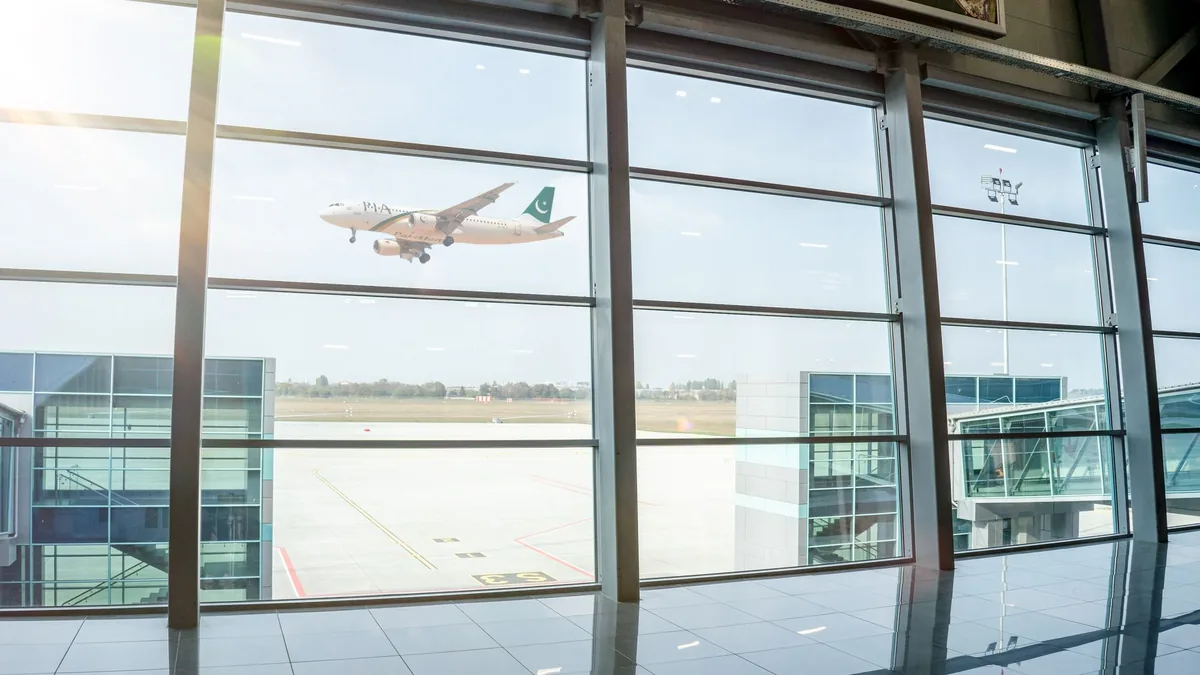
If the Lahore airport gate number you were given no longer matches what you see when you walk out, stop moving and stay put on the airport side of the exit. Send your driver one message saying exactly which door or exit you came through and what you can see around you, then a second saying what you are wearing and how many bags you have. Let the driver come to you. At Allama Iqbal International Airport the real risk is rarely the gate change itself. It is the passenger walking towards the "old" gate while the driver walks towards the "new" one, and both losing signal or patience on the way.
Below: why exits get relabelled, what the airport actually publishes, and how to redirect relatives already gathered at the wrong spot.
Why the Lahore airport gate number you were told can be out of date
Gate numbers get passed around like family recipes. A cousin met someone at "Gate 3" last winter, so everyone is told Gate 3. The trouble is that the airport has been a building site for some time, and the route from the arrivals hall to the kerb has not been a fixed thing.
Business Recorder reported in December 2025 that the Pakistan Airports Authority (PAA) had scheduled the expansion of the Lahore terminal for completion by September 2026. Earlier, in June 2024, The News reported on a ministry inspection of the works, noting that connected roads were being widened to reach the airport car park and that car park entrances and exits would be doubled once the roads were finished.
While a terminal and its approach roads are reworked, the layout changes in stages: a barrier moves, a walkway opens, last year's obvious door becomes staff-only. Any gate number heard second-hand is a starting point, not a fact.
There is also a simpler reason: people use "gate" to mean different things. Your uncle may mean a vehicle gate on the approach road. Your driver may mean a pedestrian gate from the car park. You may be thinking of the door you walk out of. Three people, one word, three different places.
Lahore airport gates and entrance points: what is actually published
It helps to know what the airport's own pages say, because that tells you which words are official and which are folklore. The PAA-run Lahore airport entrance page talks about a Main Vehicle Entrance Gate and a Pedestrian Gate, with Airport Security Force (ASF) checks at vehicle check points. It does not publish a numbered list of arrival exits for meeters and greeters. If someone insists on a specific number, treat it as their local shorthand.
| What the official pages describe | What it means for your pickup |
|---|---|
| Vehicle check points where ASF carries out under-vehicle searches | Your driver's car is searched on the way in; allow for a queue at busy times |
| A Pedestrian Gate where people on foot may be body-searched | Relatives walking in from outside also pass a check and may be asked for ID |
| International arrivals clear immigration, baggage claim and customs, then exit | Nobody meeting you can reach you before customs; you come out to them |
| After exit, passengers go to the car park, a cab or taxi service, or walk to the Pedestrian Exit Gate | There is more than one way out; say which one you took |
| A car park for passengers, meeters and greeters, plus a drop lane | The driver may be parked, not waiting at the kerb |
The arrival procedure page spells out that final step for international passengers: after customs you may proceed to the car park area, use cab or taxi services, or walk to the Pedestrian Exit Gate. Domestic passengers exit into the Arrival Concourse Hall. Those phrases are worth using in your messages, because they are the words the signs and staff are most likely to use.
For the terminal itself, including what to expect from the arrivals hall and the road out towards the city, our Lahore airport journey guide (planned link) is the better starting point. This article is only about the moment the exit does not match the plan.
A note on a "lahore airport map"
People search for a Lahore airport map hoping for a plan with every door numbered. During a phased expansion, a map drawn a year ago can be as misleading as a stale gate number. Use a map for orientation (which side of the building is arrivals, where the car park sits relative to the road) and use the signs in front of you for the final few metres.
Before you fly: set the pickup up so a changed exit barely matters
The best defence against a changed gate is a plan that never depended on the gate number in the first place. Do these before you board.
- Agree a person, not a place. Confirm who is meeting you, their mobile number, and that they have yours in the format that works from abroad (with the +44, +971 or whichever country code applies). If a driver is meeting you, get the driver's name and number, not just an office line.
- Agree how you will talk. Decide whether it will be a call, SMS or WhatsApp. Do not build the plan around airport Wi-Fi; make sure it works on ordinary mobile data or a plain phone call. Our late-night arrival contact plan goes through roaming, eSIMs and backup numbers in detail.
- Share the flight number, not just the time. Your driver can then follow the actual landing time rather than guess.
- Agree a fallback spot. Choose one simple rule, such as "if we have not found each other in 20 minutes, I wait just inside the arrivals exit and you come to me". Write it down.
- Keep the destination address ready. A changed exit is stressful enough without also hunting for the house address. Our guide to getting from Lahore airport to a family home covers landmarks, pin drops and the details drivers actually need.
If you are planning a pickup through us, the Pakistan Taxi journey planner (planned link) lets you set out the flight, passengers and luggage so the details are in one place. It is a planning and enquiry tool: it does not fix a fare or confirm a vehicle by itself, so keep your contact details accurate and watch for a reply.
Reading the signs on the way out
Your chance to note the correct exit comes in the last few minutes inside the terminal, so use them. The international arrival sequence at Lahore, as the airport describes it, runs roughly like this:
- Immigration. Desks are split by category. The airport lists separate queues including all passports, overseas Pakistanis and card holders, foreigners, senior citizens and special persons, and women travelling alone or with children. The airport also lists a special desk for overseas Pakistani passengers, staffed around the clock.
- Baggage claim. Check the flight information screen for your belt. Trolleys are free. Porters are available for a charge, through a slip from the Passenger Facilitation Services counter.
- Customs. Green channel if you have nothing to declare, red channel if you do.
- Exit. From here you head out towards the car park, the cab and taxi services or the Pedestrian Exit Gate.
Between customs and the exit, do three small things:
- Read the sign above the door you are about to use and take a photo of it. The photo is more useful than your memory at 3am.
- Note what is directly opposite as you step out: a car park entrance, a pedestrian gate, a kiosk, a covered waiting area. Landmarks survive relabelling better than numbers do.
- Check your phone before you leave the building. If there is a message saying "we have moved to the other side", you want to read it while you are still somewhere calm, not while pushing a trolley through a crowd.
Do not walk out to "find better signal" and then keep walking. An easy mistake is drifting away from the exit with a trolley and ending up somewhere neither you nor the driver can describe.
Two short messages that tell the driver everything
When the exit is not what you expected, long voice notes and "where are you?" loops waste time. Two short texts do the job. Send them the moment you are through customs, before you look for anyone.
Message one: where you are
Say which way you came out and what you can see. Use the airport's own words where you can.
Example: "Landed, out of customs. Came out through the international arrivals exit towards the car park, not the pedestrian gate. Standing by the pillar opposite the car park entrance. Photo attached."
Attach the photo of the sign above the door. A driver who knows the airport will usually recognise the spot from a picture faster than from any number.
Message two: who to look for
Describe yourself and your group so the driver can spot you across a crowd.
Example: "Two adults, one child, four suitcases on two trolleys. I'm in a navy jacket, my wife is in a green shawl. I'll stay here until you reach us."
That last sentence matters. It tells the driver you will not move, which means they can commit to walking to you rather than guessing where you might drift.
Where to wait while the driver comes to you
Once you have sent both messages, the hardest part is standing still. Pick the best nearby spot and stay there.
- Stay close to the exit you used. Just outside the arrivals exit, on the passenger side, is easy to describe and easy for your driver to find again.
- Choose somewhere with a fixed landmark. A pillar, a sign, a counter, a covered bench. Not "near the crowd".
- Keep your trolley against a wall or pillar, with bags in front of you. The airport's own passenger guidance tells travellers to take care of their luggage and not to hand their bags to anyone; that applies just as much on the way out as it does at check-in.
- Politely decline unsolicited "help". If someone you did not arrange approaches offering to take your bags or find your driver, a simple "no thank you, my driver is coming" is enough. Only accept porter help through the official porter slip at the facilitation counter inside.
If you are unsure you are in a permitted waiting area, ask an ASF officer or airport staff member. They would rather point you to the right place than find you blocking a lane.
One refinement: if you have signal at the baggage belt, send both messages while you wait for your bags. Your driver is then already moving by the time you clear customs.
When the driver has to re-park or come back through security
Sometimes the driver is in the right car park but on the wrong side, or has been waiting on the approach road because the car park was full. Moving from one side of an airport to the other is rarely a short walk, and it can mean driving back out and joining a queue again.
Here is what that can involve, based on how the airport describes its entry procedure:
- Vehicle searches on entry. The ASF carries out under-vehicle searches at vehicle check points on the way into the airport premises. A driver who leaves and comes back goes through that again.
- Queues and ID checks. The airport asks people to queue at the Main Vehicle Entrance Gate and the Pedestrian Gate, remove hats and sunglasses, and show a CNIC, passport, ticket or airport entry pass if asked. Staff also ask people to keep off their mobile phones while waiting, so do not panic if your driver goes quiet for a few minutes at a check point.
- Parking time. Parking is charged, and the airport publishes its rates on its parking information page. Rates can change, so check there rather than relying on an old figure. There is also a drop lane, but a drop lane is for dropping off, not for waiting.
What this means for you: if the driver says "stay there, I'm coming round", believe them and wait. Telling them to hurry does not shorten a check point queue. If they ask you to walk to them instead, make sure they describe the route using landmarks you can see, and only move once you understand it.
Relatives waiting at the old gate: how to redirect them
A driver can adapt quickly. A group of eight relatives with garlands, a camera and an elderly grandmother cannot. If family members are meeting you, plan for the chance that they are standing at the gate everyone "always" uses.
Keep numbers realistic, too. Answering the question of why visitors are sometimes not allowed into the airport premises, the ASF's frequently asked questions page says that, on government instructions, only three persons including the driver are allowed with one passenger in a private vehicle, to avoid unnecessary rush in the concourse halls and car parks. A big welcome party may simply not be allowed where you expect them.
To redirect relatives calmly:
- Appoint one family coordinator before you fly. One person with a charged phone, who passes messages on to everyone else.
- Send the coordinator the same two messages you send the driver. Same photo, same description.
- Pick one group to move, not everyone. If the driver is already heading to you, the relatives can meet you at the car afterwards, or at home. Crowds moving across an airport forecourt at night are how grandparents get separated.
- Move the welcome, not the pickup. Garlands and photos are just as good at the car park, or at the house. If you have questions about how a planned pickup works, our help and journey planning page (planned link) is the place to start.
- Tell the coordinator when you are in the car. It sounds obvious. It is also the easiest one to forget, and it stops the family standing at the old gate for another hour.
If you still have not met after 20 minutes
Twenty minutes is a sensible point to stop waiting passively and switch to the fallback you agreed before flying. At that point:
- Call rather than text. A live call lets the driver describe what they can see, and lets you do the same.
- Go back to your agreed fallback spot rather than inventing a new one.
- Use the facilitation desks if you need help. The airport runs Passenger Facilitation Services counters, and it lists a special desk for overseas Pakistani passengers. They are the right people to ask about the building, not strangers on the forecourt.
- Contact whoever arranged the pickup. If the journey was planned through us, reply on the same thread or channel you used to plan it, so the history is in one place.
Do not accept a ride from someone who says your driver "sent them" unless your driver or the organiser confirms it by phone and the name matches.
The Lahore airport new terminal: what to expect as works finish
The PAA's target for the Lahore airport terminal expansion, as Business Recorder reported it in December 2025, was September 2026. Targets for big public works can slip, and even once a new terminal area opens, it is normal for exits, car park access and signage to be adjusted over the following months as traffic settles.
So, for the next season of arrivals, assume three things:
- Signs are more reliable than memory. Believe what is above the door, not what a relative remembers from the last trip.
- Landmarks are more reliable than numbers. "Opposite the car park entrance" will outlast "Gate 2".
- Your driver's live description is more reliable than both. If they say the pickup area has moved, it has.
If you are travelling on to another city or need a car for business arrivals, iDrive, the network behind Pakistan Taxi, has more on Lahore airport transfers for corporate and onward journeys.
Safety and official advice before you travel
The UK Foreign, Commonwealth and Development Office (FCDO) publishes travel advice for Pakistan. Lahore itself is not among the areas it currently advises against travelling to. Within Punjab, it advises against all but essential travel to Dera Ghazi Khan and to anywhere within 5 miles of the India border, with exceptions for the Grand Trunk road via Wagah and the Kartarpur Corridor (both crossings are listed as closed at the time of writing). That matters only if your onward journey heads that way. Its safety and security page also warns of a high threat of terrorism throughout Pakistan and names transport hubs, including airports, among possible targets, which is one more reason to wait in a known spot rather than wander the forecourt. Advice can change at short notice, so read the latest version shortly before you fly, and check your own government's advice if you are not travelling on a UK passport.
A habit worth carrying to other airports
The same "stop, describe, wait" routine works at any busy arrivals hall. If you are also travelling for Umrah or Hajj, our sister company Hajj Umrah Taxi has a guide on what to do if you can't find your driver at Jeddah airport arrivals that covers the Saudi side of the trip.
To set out the flight, passengers and onward address before you travel, use the Pakistan Taxi journey planner (planned link).