
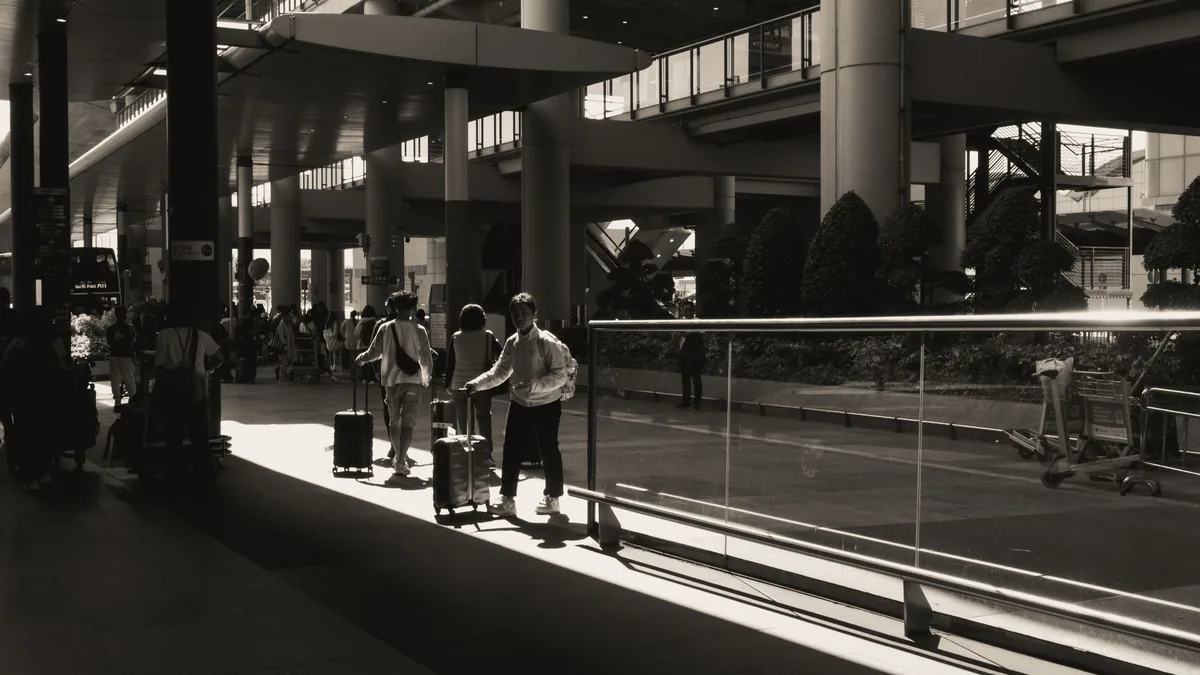
If two adults are landing at Lahore on the same day, say your brother on a Gulf flight and your aunt on a domestic hop from Karachi, the first thing to know is that "Lahore airport terminal 1" is not a separate building you must drive between. Allama Iqbal International Airport handles both international and domestic passengers in its main passenger terminal. Each stream comes out of its own arrival lounge, and the airport's own taxi page lists cab counters in the International Arrivals and Domestic Arrivals (Level-I) as well as in the Concourse Hall. So one car can usually collect both people, as long as you pick a single meeting point, the gap between the two landings is one someone can realistically wait through, and the vehicle has room for two sets of airport luggage.
The rest of this guide works through those three decisions in order: where to meet, whether to wait or split the pickup, and what size of vehicle actually fits. It finishes with the part families most often skip, which is deciding who tells the driver when each person is really out.
How many airports in Lahore, and what "terminal 1" means
For passenger flights, Lahore has one working airport: Allama Iqbal International Airport (code LHE), about 15 km from the city centre according to its Wikipedia entry. That same summary lists three terminals on the site:
- the Allama Iqbal passenger terminal, which serves both international and domestic flights
- a separate Hajj terminal for pilgrim flights
- a cargo terminal for freight
Walton, the older airfield inside the city, served Lahore before the current airport opened in 1962. It is not where your relatives will land.
The airport's own arrival and facilities pages talk about arrival lounges and the concourse hall, not a "Terminal 1" or "Terminal 2". When people type "lahore airport terminal 1" into a search bar, they almost always mean the main passenger terminal, the one with the international and domestic arrival lounges. If a relative's ticket or a friend's message says "terminal 1", read it as "the main building", then confirm the flight is international or domestic, because that tells you which lounge they will walk out of.
The one real exception is Hajj season. Pilgrim flights can use the separate Hajj terminal, so if either person is returning from Hajj, ask the airline or the group organiser which building they will exit. Do not assume the main terminal.
Building work you may notice
The terminal is being expanded. In June 2024 The News reported that roads to the car park were being widened and that car park entrances and exits were to be doubled. In December 2025 Business Recorder reported the Pakistan Airports Authority's target of finishing the terminal expansion by September 2026. Target dates slip on projects of this size, so expect some diversions, temporary signage or changed walkways, and don't rely on how the forecourt looked on your last visit.
Which flights come out where
Here is how the two arrival streams work, taken from the airport's arrival procedure page.
| Domestic arrival | International arrival | |
|---|---|---|
| Where they enter | Domestic Arrival Lounge, by boarding bridge or bus | International Arrival Lounge, by boarding bridge or bus |
| Checks before the exit | Baggage belt, and a tag check by the airline if asked | Immigration, baggage belt, then customs through the red or green channel |
| Trolleys | Free | Free |
| Porter (on payment, from the PFS counter) | Rs. 200 | Rs. 400 |
| Where they come out | Into the Arrival Concourse Hall, then the car park or cab service | Out towards the car park, the cab service or the Pedestrian Exit Gate |
| What slows them down | Bags coming off the belt | The immigration queue, the belt and customs, in that order |
Porter charges are the figures on the airport's passenger facilitation page when we checked. They can change, so treat them as a guide rather than a promise.
The practical point is the last row. A domestic passenger with a bag that comes off early can be outside well before anyone expects them. An international passenger has three stages to clear, and when several Gulf flights land close together, each of those stages gets slower. The same landing time does not mean the same exit time.
Checking Lahore airport arrivals today and tomorrow (terminal 1)
The airport publishes a live flight schedule with separate Departure and Arrival views, filters for flights and airlines, and a status column showing scheduled and actual times. For Lahore airport arrivals today at terminal 1, that page plus the airline's own tracker is where to look. For example, Emirates' flight status page lets you search by flight number or route and sign up for alerts.
Lahore airport arrivals tomorrow for terminal 1 are a different job. You are checking the schedule, not the status. Look the evening before, note both scheduled times, and then look again on the day. Lahore's international schedule runs through the night. When we checked the board on a September morning, it listed departures to Doha, Baghdad, Jeddah, Baku, Muscat, Dubai, Riyadh and Abu Dhabi, all scheduled before 5am. The airport is busy in the small hours, so assume one or both pickups may fall at an unsociable time and plan for it.
Walking between halls with luggage
Because both arrival lounges are in the same passenger terminal, one of your two relatives will almost certainly have to walk to the other once they are out. What you want to avoid is that walk happening in the wrong direction, against the flow, with a loaded trolley and a phone at 4% battery.
A few things make it easier:
- Keep the trolley. Trolleys are free, according to the airport's arrival procedure page. A passenger who gives the trolley up at the exit door and then has to carry two suitcases along the forecourt will not thank you.
- Take a porter if the load is heavy. The porter service is paid and only available from the Passenger Facilitation Services (PFS) counters. For arriving passengers, those counters are near the baggage area in the arrival lounges. The airport says the service is meant for, among others, women with children, senior citizens and families of two or more. It tells passengers to keep the printed slip themselves and to pay only once, at the counter.
- Don't hand bags to strangers. "Helpful" offers to carry luggage outside the official counter are exactly what the porter guidance warns against.
- Nobody goes looking. Each person walks once, to the agreed meeting point, and then stays there. Two people searching for each other on a crowded forecourt is how a ten-minute reunion becomes an hour.
The official pages don't publish walking distances between the two lounges, and with building work under way the route can change. So don't promise your aunt it's "just two minutes". Tell her which sign to follow and who will be waiting at the end of it.
Who may stand where
The meeting-and-greeting side of Lahore airport is controlled. The Airport Security Force's instructions ask that only the minimum number of meeters and greeters come to the airport, that they carry their NIC or other photo ID, and that nobody leaves anything unattended. According to the airport's entrance page, ASF runs under-vehicle searches at the vehicle checkpoints and body searches for pedestrians, and a CNIC, airline ticket, passport or airport entry pass may be asked for at the Main Vehicle Entrance Gate or the Pedestrian Gate.
This matters for a two-person pickup, because the reflex in many families is to send three cousins "to help". Send one person, or better still just the driver. Every extra body is one more person to find in the crowd.
Choosing one meeting point for both passengers
A single meeting point beats "we'll find each other". Choose it before either flight takes off, write it in the family chat, and don't change it on the day unless the driver asks you to.
You have three sensible options:
- The exit of the lounge whose passenger lands second. The first arrival walks over and waits there. This works well when the gap is short, because the driver only has to hold one position.
- The Arrival Concourse Hall. The airport's domestic arrival steps finish with an exit to the Arrival Concourse Hall, and its taxi page lists cab counters there as well as in both arrival lounges. It is a natural common ground, but it can be crowded. Agree on a specific landmark within it rather than just "the hall".
- The car park. The airport's parking page confirms that parking is available for meeters and greeters, alongside a drop lane. Meeting at the vehicle suits families who would rather not wait inside, but the passengers then need clear directions to a specific spot, which is harder at night for someone who hasn't been to Lahore in years.
Whichever you pick, send both passengers the same three-line message before they fly:
Meet at: [the exact spot]
Wait there even if your phone dies
Driver: [name, car colour, number plate, phone number]
That last line is the one people forget. The international passenger may not have a working Pakistani SIM when they land, so a description of the car and the driver's number, written down, beats "call me when you're out".
Gap between flights: when one car can wait
This is the real decision, and it depends less on the landing times than on the likely exit times, and on how the first person will feel sitting on a bench while they wait.
Work it out in this order:
- Write down both scheduled landing times. Use the airline's booking, not a relative's memory.
- Adjust for the type of arrival. A domestic passenger usually comes out sooner after landing than an international one, because there is no immigration or customs. If the domestic flight lands second, the gap can shrink a lot.
- Add a margin for the second flight being late. Check the live status on the day, not just the timetable.
- Ask who is doing the waiting. A fit 30-year-old with a backpack can sit out a long wait. A parent coming back from a long-haul flight, or anyone with health needs, should not be left waiting for the sake of saving a second vehicle.
A rough decision guide
| Realistic gap between the two people coming out | Usual approach | What to watch |
|---|---|---|
| Short: the second person is likely out soon after the first | One vehicle, one meeting point | Make sure the first person knows to wait, not to go looking |
| Medium: a noticeable wait but not a long one | One vehicle, if the first person is comfortable waiting and the driver's waiting time is agreed | Confirm how waiting time is handled before the day |
| Long, or the second flight is prone to delay | Two pickups, or collect the first person and come back | Collecting twice means two trips through security at the gate |
| Overnight or unknown | Two separate plans | Don't make a tired traveller wait through the night |
Take this as a framework, not a rule. The right cut-off for your family depends on the people, the hour and the bags. For the wider question of whether guests on different flights should share a vehicle at all, our guide to group pickups across multiple flights goes into it in more depth.
An example, clearly hypothetical
*Example only.* Say your brother is due from Dubai at 03:30 and your aunt from Karachi at 05:15. On paper that's a gap of about an hour and three-quarters. But your brother has immigration, the belt and customs to clear, while your aunt only has the belt, so the gap in who comes out when is likely to be smaller than the timetable suggests. A single car could well make sense here, with your brother told to wait by the domestic exit. If your aunt's flight was then delayed by three hours, the calculation changes, and the honest answer is a second pickup or the driver taking your brother home first.
Vehicle size for two passengers and all their bags
Two adults sounds like a small-car job. Two adults off an overseas flight to Pakistan often isn't. Suitcases packed for a family visit, a wedding or a long stay add up quickly: large checked cases, cabin bags, sometimes a box tied with rope and a duty-free bag on top.
Before you choose a vehicle, count:
- the number of large checked cases for both people, not just one
- cabin bags and anything bulky, such as a wheelchair, a folded pram or gift boxes
- who else is travelling in the car, since a relative going along to greet them takes a seat
- where you are going afterwards. A family home in the Walled City lanes is a very different drop-off from a hotel on a main road
As a starting point, a family-sized car suits two adults with moderate luggage, and a van suits heavy luggage or anyone travelling with them. Our family vehicle page (planned link) explains what to tell the booking team. If the bags clearly won't fit in a car, our sister service iDrive, the network behind Pakistan Taxi, describes the van class on its group van page, so you can see the kind of vehicle you would be asking about.
It's better to over-size by one step than to leave a suitcase on the pavement at 4am.
Who tells the driver when each person is out
Most shared pickups that go wrong don't go wrong at the airport. They go wrong in the phone calls. The driver gets one call from the brother, one from the aunt, two from a cousin in Manchester and one from you, and each call says something slightly different.
Pick one coordinator. It can be you from abroad, or a relative in Lahore, but it has to be one person, and the driver needs to know who that is. Then agree these points in advance:
- The coordinator watches both flights on the airport board and the airline trackers, and tells the driver about any delay.
- Each passenger sends one message when they are through. "Out, at the meeting point" is enough. International passengers can send it on a roaming plan or any Wi-Fi they can connect to. If they can't send it, the rule is to wait at the agreed spot.
- Only the coordinator changes the plan. If the second flight is badly delayed, the coordinator decides whether the driver takes the first passenger home. Nobody else overrides that.
- The driver's number and vehicle details go to both passengers before they fly, not while they are standing in the concourse.
- Agree a fallback in case someone can't be found. For example: if there's no contact 30 minutes after the second landing, the coordinator calls the driver and they agree the next step together. The figure is an example; set your own.
This is the whole point of a shared pickup from different terminals, or in Lahore's case from two different lounges in the same building. The car is the easy part. The information flow is what saves the time.
If the flights slip
Delays at Lahore aren't rare. Winter fog is the classic cause: in December 2025, Dawn reported that dense fog disrupted PIA's schedule at Lahore, Multan, Sialkot and Faisalabad, and the airline told passengers to check flight status before setting off. A shared plan should say in advance what happens if either flight moves by more than an hour. Collecting someone always needs more slack than dropping them off, and with two people landing you need that slack twice.
Safety and official advice
At the time of writing, the UK Foreign, Commonwealth & Development Office's Pakistan travel advice does not name Lahore or its airport among the places it advises against travelling to. In Punjab it advises against all but essential travel to Dera Ghazi Khan, and within 5 miles of the border with India, with the Grand Trunk road to the Wagah border among the listed exceptions. That advice changes, so check it again before either person flies, especially if the onward journey after the airport goes beyond Lahore.
At the airport itself, follow the ASF rules: carry photo ID, keep bags with you, don't park in the drop lane, and cooperate with the vehicle checks at the gate.
Planning the pickup with Pakistan Taxi
If you would like help thinking through a two-arrival pickup, start with the Lahore airport journey guide (planned link) for the local picture, then use the plan your journey form (planned link) to send both flight numbers, the luggage count and the destination. Our airport transfers page explains how Pakistan Taxi handles airport journeys. It's a planning and enquiry service. The team will come back to you about what could work, including whether one vehicle or two is more sensible, but sending an enquiry doesn't fix a fare or guarantee a vehicle until the details are agreed with you.
Send it early, with both flight numbers, and name your coordinator. That one line saves more trouble than anything else in this guide.