
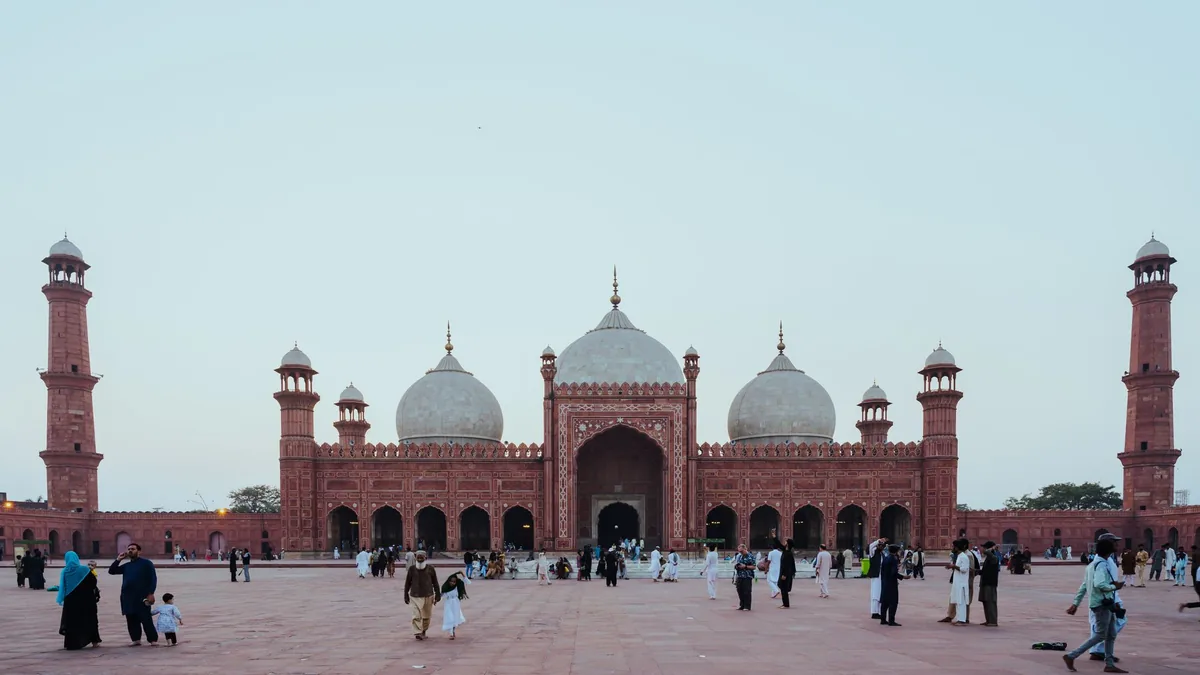
If you are visiting family and want a Lahore city tour by car, give it a day of its own. Don't tack it onto the morning you drive in from Islamabad or the afternoon before a flight. One good day covers the Walled City on foot, Lahore Fort and Badshahi Mosque across Hazuri Bagh, a long rest through the hottest hours, and the Wagah border ceremony in the late afternoon. Anything that has to happen on time, such as an airport run, an intercity drive or a wedding pickup, should sit on a different day with its own driver instructions. Book the sightseeing as a car with a driver who waits for you, and agree the drop-off and pickup points before you set off, because in the old city the car can't follow you.
The rest of this guide covers why the split matters, a day plan you can adapt, and what to tell the driver so the day runs calmly with children, grandparents and a phone full of relatives' requests.
Why a sightseeing day and a travel day should never share one booking
A travel day has a fixed end. The flight leaves, the motorway toll plaza closes behind you, a relative is waiting at the gate in Faisalabad. Everything on that day serves the arrival time, and every stop is a cost against it.
A sightseeing day works the other way round. The arrival time doesn't matter. What matters is how long your mother wants to sit in the shade of the fort, whether the children have had enough of mosques by eleven, and whether you stay for the whole ceremony at Wagah or leave before the crowd does.
Put both on one booking and one of them loses. Usually it's the sightseeing, cut short because "we still have to get to Islamabad", or the travel leg, started late and tired after dark. The UK Foreign Office says plainly that local driving standards are erratic, especially at night, and advises care on long road journeys (FCDO safety and security advice for Pakistan). A tired family on the M-2 at 10pm, after a day of walking, is exactly the situation that advice describes.
There is a practical side too. A transfer is priced and planned as a point-to-point job. A city day is a block of time with waiting built in. If you mix the two, the driver, the operator and you can easily end up with three different ideas of what was agreed. Our worksheet on chauffeur duty versus separate transfers sets out who is responsible for what under each model. Read it before you decide.
If you are planning a longer visit with Lahore as one stop among several, sketch the whole trip first with our guide to turning a multi-city Pakistan visit into a bookable itinerary. Then slot the Lahore day into a gap between travel days, not on top of one.
Is Lahore safe for a family sightseeing day?
Check the official position before you plan anything, and check it again the week you fly.
At the time of writing, the UK Foreign, Commonwealth & Development Office does not include Lahore among the areas it advises against visiting. It does advise against all but essential travel within 5 miles of the Pakistan–India border, which is where Wagah sits. It makes a specific exception for the Grand Trunk highway via the Wagah border. The crossing point itself is closed, but the FCDO says visitors can still reach and attend the daily Wagah border ceremony (FCDO warnings and insurance). That position can change quickly when India–Pakistan relations are tense, so read the page again on the morning of your trip.
The same advice notes that attacks have taken place in major cities including Lahore. It lists tourist sites, religious sites and crowded places among the locations to be careful around, and it warns about street crime in crowded areas. British nationals of Pakistani origin are singled out as having been targeted by criminals because they are often seen as wealthier. None of this means you should stay indoors. It does mean:
- keep phones and wallets zipped away in the Walled City lanes and at Wagah,
- don't wear obvious jewellery for a day of walking,
- let your driver and one relative at home know the plan and roughly when you will be at each stop,
- and follow instructions at security checks without argument.
Wagah has a history that explains why security there is taken seriously. On 2 November 2014 a suicide bomber struck a parking area near the border just after the ceremony, and at least 60 people were killed (Wikipedia summary of the 2014 Wagah attack). Families still go in large numbers, but it's a place to arrive calmly, sit where you are told and leave in an orderly way.
A one-day Lahore plan with family
Here is an example of how one day in Lahore with family can run. It's a template to adjust, not a timetable that anyone guarantees. Opening hours at the heritage sites and the time of the Wagah ceremony both change through the year, so confirm them locally a day or two before.
| Part of the day | Where | What the car does | Who it suits |
|---|---|---|---|
| Early morning | Delhi Gate and the Shahi Guzargah walk to Wazir Khan Mosque and Shahi Hammam | Drops you at Delhi Gate, then drives round to meet you near the fort | Anyone who can walk 30 to 60 minutes on uneven ground |
| Late morning | Lahore Fort, Hazuri Bagh, Badshahi Mosque | Parks and waits; you walk between the three | Everyone, with benches and shade breaks |
| Midday to mid-afternoon | Lunch and rest at home or the hotel | Takes you back, then waits or returns at a set time | Essential in the warmer months |
| Late afternoon | Wagah border ceremony | Drives out east on the Grand Trunk Road and waits for the return | Families happy with crowds, noise and security checks |
| Evening | Home, or dinner if energy allows | Brings you back | Depends on how the afternoon went |
Morning: the Walled City on foot
Start early, while the lanes are cooler. The Walled City once had 13 gates, and Delhi Gate is the natural way in for a first visit. From there the Shahi Guzargah, the old royal route, runs west towards the Wazir Khan Mosque. The stretch between Delhi Gate and the mosque was restored in a project that began in 2012, with the first phase completed in 2015 (Wikipedia on the Walled City of Lahore).
Two stops make this walk worth the effort:
- Shahi Hammam, the Mughal bath house from 1635, just inside the gate. Its frescoes were restored, and the project won a UNESCO award of merit in 2016.
- Wazir Khan Mosque, built between 1634 and 1641 and often called the most ornately decorated mosque of the Mughal era. Look at the tile work on the façade before you go in.
The lanes beyond are narrow and busy with handcarts, motorbikes and shoppers. A car can't shadow you through them, and trying to make it do so wastes the driver's morning and your patience. This is the single most useful thing to agree before you start: where the driver drops you, and where and roughly when he picks you up again.
Late morning: the Badshahi Mosque and Lahore Fort visit
The fort and the mosque face each other across Hazuri Bagh, so a Badshahi Mosque and Lahore Fort visit is really one stop with a garden in the middle. Roshnai Gate, between the two, is the only Walled City gate that largely survives in its original form.
Lahore Fort is a UNESCO World Heritage Site, inscribed in 1981 together with the Shalimar Gardens. Its most famous interiors are the Sheesh Mahal, the mirror-work palace built under Shah Jahan in 1631–32, and the Picture Wall, a long decorated wall with scenes of elephant fights, polo and court life (Wikipedia on Lahore Fort). The fort covers more than 20 hectares. Older relatives should pick two or three sections rather than try to see it all. The Walled City of Lahore Authority manages the fort and publishes visitor notices on its official website. Check it for current timings, ticketing and any closures before you go.
Badshahi Mosque was commissioned by Aurangzeb and completed in the early 1670s. It was the largest mosque of the Mughal era, and its courtyard alone is big enough to hold an enormous congregation on Eid (Wikipedia on Badshahi Mosque). That courtyard is also wide open to the sky, which matters on a June morning.
The FCDO's guidance on dress applies directly here. Men and women should cover their shoulders and legs in public, and women should cover their heads when entering mosques and holy places. Pack a light scarf for every woman and girl in the group, including anyone who doesn't usually wear one. Plan for shoes coming off too: bring socks for walking on stone that has been in the sun, and a bag to carry sandals.
If you want to see the Minar-e-Pakistan as well, it stands in Greater Iqbal Park, close by, and its rostrum faces the Badshahi Mosque. A short look from the car or a quick walk is usually enough for children who have already done the fort.
Midday: stop, eat, rest
Families don't plan this part, and it's the part that decides whether the evening works. Go back to the house or hotel, have lunch, and let the grandparents and small children sleep. The car either waits or comes back at a set time. Settle which before you leave in the morning, because it affects the driver's day and possibly the cost.
Late afternoon: the Wagah border ceremony
Wagah lies on the historic Grand Trunk Road between Lahore and Amritsar, and the border is about 24 km from Lahore. The flag-lowering ceremony is carried out each evening by the Pakistan Rangers on one side and India's Border Security Force on the other.
The key thing about Wagah border ceremony timing is that it follows the sun, not the clock. Because the ceremony is tied to sunset, it starts earlier in winter and later in summer, and you need to be seated well before it begins. When tensions between the two countries rise, arrangements at the border can change at short notice; the FCDO notes that the crossing point is currently closed even though the ceremony continues. Confirm on the day, and let the driver, who will have done this run before, suggest the departure time.
Things to know before you go:
- Security screening is part of the visit. Expect checks on the way in, and carry as little as you can. Leave large bags in the car.
- Crowds. Crowds are loud and it can be hard to keep a group together. Agree a meeting point in case anyone gets separated, and give each child a card with your number on it.
- Parking and the walk. Don't assume the car can wait right beside the entrance. Before you get out, fix with the driver exactly where you will come back to, and how long he should wait before calling. Leaving takes time because everyone leaves at once.
- Children and noise. The ceremony is loud and theatrical, with exaggerated marching by the guards and a crowd that cheers along. Some children love it. Very small children and anyone sensitive to crowds may be happier with a shorter visit.
What changes with the season
Lahore's weather shapes the whole day, so plan around the month you are travelling.
- Early summer, peaking in June. June is the hottest month, and temperatures routinely pass 45°C. Do the walking early, take the long midday break seriously, and carry water for everyone.
- Monsoon (late June to September). July, August and September are the wettest months. Evening thunderstorms are common and flash flooding is possible. Keep the Wagah trip flexible and have an indoor fallback.
- Winter (December to January). January is the coolest month and can bring dense fog. Fog affects driving more than sightseeing: allow extra time for the Wagah run, and be wary of evening intercity drives. That is one more reason to keep the travel day separate.
- Spring and autumn. Usually the most comfortable time for a full day on foot.
Climate details are summarised on Wikipedia's Lahore climate section. Check the forecast the evening before, not just the season.
Prayer, meals and pace for a sightseeing day with a driver
A sightseeing day with a driver works best when everyone knows where the pauses are.
Prayer. Badshahi Mosque makes Zuhr easy if you are there at midday. On a Friday, expect far bigger crowds around Jumu'ah, and consider putting the fort and mosque on another day of your trip or visiting after prayers have finished. Tell the driver if you want to stop for Asr on the way to Wagah, so he can pick a mosque with parking.
Meals. Fort Road Food Street, near Roshnai Gate, is pedestrianised and close to the fort. It suits a late lunch or an evening meal, but not both. Choose it for the day you skip Wagah, or for a separate evening.
Pace. Two big sites and one ceremony is plenty for one day. If you have older relatives, cut the morning walk or the fort, not the rest.
Water, cash and phones. Bring water, small notes for entry tickets and snacks, a charged phone and a power bank. Save the driver's number and send him your live location if you get separated in the old city.
Booking the day as a car with driver
When you ask for a sightseeing day, give the operator enough detail to plan it properly. Send it as one message, before the day:
- Date and number of hours. For example, 8am to 7pm, with a midday return home.
- Pickup address with a pinned location. Our guide to getting a Lahore family home address right explains why a pin beats a street name in Lahore.
- Passengers. Adults, children, anyone who needs a car seat, and anyone with limited mobility.
- Stops in order. Delhi Gate drop-off, fort pickup point, home, Wagah, home.
- Waiting. Where the driver waits and when, including the midday break.
- Things you don't want. For example, no shopping detours, and no leaving Wagah before the family is back together.
- What happens if plans change. Who approves extra hours, and how.
A driver day is priced on time and distance rather than on a fixed route, so extra hours and extra stops can change the cost. Ask for that in writing before the day.
To plan a day like this with us, see what our car and driver service covers, then send your plan through Plan Your Journey (planned link). The team will review it and come back with what can be arranged. Nothing is confirmed until you have agreed the details with them.
If you are weighing up whether to drive yourself instead, the analysis from our sister service iDrive on self-drive versus a car with driver in Pakistan lays out the trade-offs. For a first day in the Walled City, with parking and the Wagah crowds to handle, most families find a driver the easier choice.
When one day isn't enough
Lahore rewards a second day if your visit allows it. Shalimar Gardens and Jahangir's Tomb in Shahdara are both managed by the Walled City of Lahore Authority, and neither fits comfortably into the plan above. Put them on a separate, shorter day.
Book each sightseeing day on its own, just like the first. If the day after is a travel day, keep the evening before it quiet. Pack, charge phones, and let the driver on the travel booking know your pickup time without it depending on how the sightseeing went.
The families who get the most out of Lahore are rarely the ones who see the most. They are the ones who didn't try to fit an intercity drive into the same twelve hours.