
If you are looking at a Multan rent a car with driver between May and August, the thing to decide first is not the size of the car but whether its air conditioning can hold a cabin cool with the engine idling outside a shrine at two in the afternoon. Multan's hottest months are May and June, its mean daily maximum in May sits above 40°C, and the city recorded 50.0°C on 27 May 2010, according to the climate data summarised on Multan's Wikipedia page (NOAA and Deutscher Wetterdienst figures). In that heat, a well-maintained sedan with strong AC and rear vents will do more for an elderly passenger than a larger vehicle with a tired compressor.
So the short answer: ask for a car with proven AC and rear air outlets, tinted rear windows, room for a cool box, and a driver who is happy to keep the cabin pre-cooled. Then plan the day so that the two great shrines inside the old fort area, Bahauddin Zakariya and Shah Rukn-e-Alam, are visited early in the morning or in the evening, with the hottest hours spent indoors. The rest of this guide explains how to check each of those things before the car turns up, and when a heat alert means you should simply move the day.
Why AC strength matters more than car size in a Multan summer
Large families naturally ask for "something big". In Multan's summer, the better question is whether every seat in that vehicle will be cool.
A few things decide that:
- Cabin volume against cooling capacity. A large van or SUV has more air to cool and more glass letting the sun in. If its system only blows from the dashboard, the third row can stay uncomfortably warm on a long wait.
- Condition, not age alone. A newer car with a system that has not been serviced can be worse than an older one that has. You cannot inspect it from abroad, but you can ask direct questions (listed further down).
- Idling performance. Much of a shrine day is stopping, parking and waiting. Some systems cool well at motorway speed and struggle at a standstill. Ask how the car copes when parked with the engine running.
- Power at the door. Heat and electricity cuts have gone together in Pakistan before: during the June 2015 heatwave, grid failures stopped air conditioners and water pumps working in Karachi. A cool car is one of the few spaces you control if the power goes at your hotel or family home.
Car AC in Pakistan summer: questions to ask before you confirm
You are entitled to ask these plainly. A good operator will not be offended.
- When was the AC last serviced or re-gassed?
- Does the vehicle have rear-seat vents, a roof-mounted rear unit, or dashboard vents only?
- Can the driver arrive 10 to 15 minutes early and have the cabin cooled before anyone gets in?
- Is the driver comfortable keeping the engine running while you are inside the shrine, and is that allowed where he will be waiting?
- Are the rear windows tinted, and are there sunshades for the side windows?
- Is there space for a cool box or a crate of water bottles without blocking a seat?
If an answer is vague, that is information too. You can put these questions straight into your journey notes when you plan a journey with Pakistan Taxi (planned link), and ask for a vehicle description in reply rather than a vehicle "category".
Rear AC vents and window tint: the two features families overlook
Rear vents
For anyone sitting behind the driver, rear vents are the difference between a comfortable day and a long, sticky one. This matters most for:
- grandparents in the back seats, who are often the people least able to tolerate heat;
- small children in car seats, which trap heat against the back;
- anyone in the third row of a seven-seater.
If the only suitable vehicle available has dashboard vents alone, seat the most heat-sensitive passenger in the front passenger seat and keep the trip segments short.
Window tint and sunshades
Tint reduces the glare and radiant heat coming through side glass, which is where the afternoon sun hits a car parked outside a monument. Rules on window tinting in Pakistan are set and enforced locally and can change, so do not ask a driver to add film for your trip. Ask instead whether the car already has it, and whether it has simple removable sunshades for the rear side windows. Clip-on shades come off in seconds and make a real difference for a child who falls asleep against the window.
Best car for hot weather: a quick comparison
This describes trade-offs, not a promise about any particular vehicle.
| Vehicle type | Suits | Heat strengths | Heat weaknesses | What to ask |
|---|---|---|---|---|
| Sedan | 1 to 3 adults, light luggage | Small cabin cools quickly, even at idle | Rear passengers rely on how well the front system reaches them | Rear vents? Recent AC service? |
| Family vehicle (seven-seater or people carrier) | Families with grandparents or small children | Room to spread out, space for a cool box | Large glass area; third row can stay warm without rear AC | Is there a roof or rear AC unit? |
| Premium SUV | Small groups wanting comfort over long days | Often better insulated with multi-zone climate control | Higher cost; more cabin to cool if the system is dashboard-only | Which zones are controlled from the back? |
| Hiace-style van | Larger groups, wedding guests | Seats many in one vehicle | Very large cabin; comfort depends heavily on the rear unit | Does the rear unit work, and how is it controlled? |
For most families of four to six, a family vehicle for Pakistan journeys (planned link) with confirmed rear air is the sensible default. If your group is smaller and you will be spending long hours in the car, a premium SUV with a driver (planned link) is worth asking about, provided you check that the back seats get their own airflow.
Timing Bahauddin Zakariya and Shah Rukn-e-Alam visits
Most visitors to Multan want to see the two landmark shrines, and both sit within the old Multan Fort area, which keeps the driving between them short.
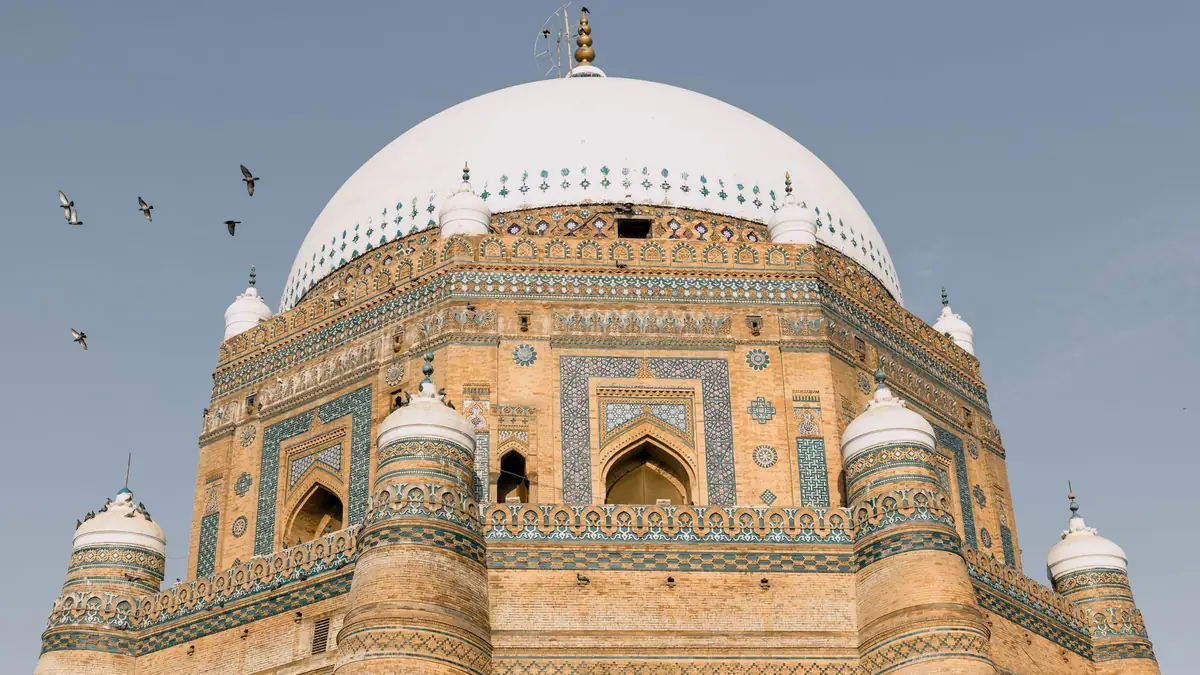
- Shah Rukn-e-Alam. At the northwestern edge of the fort, this 35-metre tomb of red brick and dark blue, azure and white tilework went up between 1320 and 1324 under Ghiyath al-Din Tughluq, according to Wikipedia's article on the Tomb of Shah Rukn-e-Alam. It is on UNESCO's tentative World Heritage list.
- Bahauddin Zakariya. The saint's mausoleum, square in plan beneath an octagon and a hemispherical dome, was damaged during the 1848 siege and later restored, as the article on Bahauddin Zakariya sets out.
Multan shrines visit timings: a heat-first plan
We are not publishing opening hours here, because shrine arrangements are set locally and can change for religious occasions, security or maintenance. Confirm on the day with your driver or your family in Multan. What you can plan around is the sun.
Early morning (roughly from sunrise to mid-morning). This is the best window. Brick and stone have not yet soaked up the full day's heat, courtyards are more comfortable barefoot, and you are finished before the city's traffic builds. If you can manage only one visit, make it this one.
Late morning to late afternoon. Avoid open courtyards and long walks. Stone floors get hot, and at shrines you should expect to remove your shoes. If you must be out at this time, keep the stop short and have the driver waiting close by with the engine and AC running.
After sunset. The evening is the second good window, and many visitors like the atmosphere after dark. Floors cool slowly, so check the surface with a hand before an elderly relative walks on it.
A reasonable heat-first shape for the day (an example, not a fixed plan):
- Pickup soon after sunrise; car pre-cooled.
- Shah Rukn-e-Alam first, then the short move to Bahauddin Zakariya.
- Back to the hotel or family home before the late-morning heat.
- Lunch, prayer and a proper rest indoors through the afternoon.
- Evening outing: a second shrine visit, a relative's house, or a bazaar.
Urs days change everything
Both shrines hold an annual urs, and Wikipedia notes that more than 100,000 pilgrims attend the urs of Shah Rukn-e-Alam. On those days roads close or clog, parking moves further away, and the walk from the car to the shrine gets longer. If your visit falls near an urs, add time, expect a longer walk, and think twice about bringing a frail relative in the middle of the crowd. Ask locally for the dates when you are planning, because they follow the Islamic calendar and move each year.
Water, shade and elderly passengers
The overseas visitors most at risk in a Multan summer are often not the travellers themselves but the parents and grandparents they bring along. Heat stroke is a medical emergency in which body temperature rises above 40°C and the person becomes confused or disoriented; the elderly and young children are among the groups most at risk, as the overview on heat stroke explains.
What to have in the car
- Enough bottled water for everyone for the whole day, kept in a cool box rather than rolling around in the boot.
- Oral rehydration sachets from a pharmacy, particularly if anyone has had an upset stomach.
- A small towel or cloth that can be wetted and put on the neck.
- Hats or dupattas for head cover, and loose, light-coloured clothing.
- Any regular medication, with a note of which tablets are affected by heat or dehydration (ask the prescribing doctor before you travel).
How to run the day with an older passenger
- Keep outdoor stretches short. Plan each stop as "in, see, out" rather than a long wander.
- Offer water on a schedule. Do not wait for someone to say they are thirsty; the heat stroke guidance is clear that thirst is a poor signal.
- Use the car as a cool room. Between stops, let them sit in the cooled car while younger family members go ahead.
- Watch for the warning signs. Confusion, a headache, dizziness, red skin or unusual behaviour mean stop the plan, get them into the cool and seek medical help.
- Let the driver know. Tell the driver who is vulnerable, so he parks close and keeps the engine and AC running.
If your parents will be travelling on their own while you arrange things from abroad, our guide to arranging an airport pickup for parents covers how to pass on names, phone numbers and a clear plan to both driver and passengers.
Travelling in Pakistan heatwave conditions: alerts and when to postpone
Pakistan has two official places to watch for heat warnings.
- The Pakistan Meteorological Department (PMD) publishes forecasts and current temperatures on its site at pmd.gov.pk. Check it in the days before your Multan outing, not just the morning of.
- The National Disaster Management Authority (NDMA) posts weather advisories on its advisories page and hosts heatwave planning documents in its guidelines section. Provincial disaster authorities also issue their own alerts.
When to move the day
There is no official threshold that tells a family "do not visit a shrine today". Use judgement, and lean towards caution when:
- PMD or NDMA has issued a heatwave warning covering south Punjab;
- your hotel or family home has had long power cuts, so nobody has slept properly;
- anyone in your group is elderly, pregnant, very young, unwell or fasting;
- a dust storm is forecast, since Multan does get summer dust storms and they reduce visibility on the roads.
If you want to keep the option of moving the day by 24 or 48 hours, say so at the start. When you send your plan, explain that the date is flexible and heat-dependent, and ask what notice the operator would need to change it and whether any charge applies.
Safety advice for Multan and the roads around it
At the time of writing (advice updated 22 September 2026), the UK government's FCDO travel advice for Pakistan does not name Multan among the areas where it advises against travel. Within Punjab, it advises against all but essential travel to Dera Ghazi Khan, which lies to the west of Multan. It also advises against all but essential travel to Sindh north of Nawabshah. If your summer plans include a family visit or a drive in either direction, read the current advice before you commit, because the lines on that map do change.
The FCDO's safety and security page lists places of worship and religious sites among the kinds of places at risk from terrorist attack across Pakistan, and warns that monsoon flooding can occur, usually from late June to early October. Neither is a reason to cancel a Multan shrine visit on its own, but both are good reasons to keep your plans flexible, follow local instructions at the gate and keep your driver's number saved.
Afternoon rest and evening plans
The classic mistake is running a Multan summer day like a UK sightseeing day: out at ten, back at six. Above 40°C, that plan has everyone flagging by lunch.
A better rhythm is to split the day into two short outings with a long rest between them.
The afternoon
Build the rest in from the start, rather than hoping for it. Tell the driver the car is not needed between, for example, noon and five, and agree whether he waits nearby or leaves and returns at a set time. That conversation matters because a car and driver day is usually arranged around hours, and an agreed break can change what is included. Get the break written into the plan.
The evening
Once the sun is down, Multan becomes much easier. Good uses of the evening include:
- a second, slower visit to one of the shrines, or to smaller ones such as the shrine of Shah Yousaf Gardezi near Bohar Gate;
- buying sohan halwa, the sweet Multan is best known for, to take home;
- visiting relatives, which is often the real reason for the trip;
- a short drive past the Clock Tower and the old city before dinner.
Evening traffic in the older parts of the city is slow, and parking near busy areas can be hard. Agree a pickup point with the driver before you step out, and share a location pin on WhatsApp so nobody is searching in the dark.
Arriving in Multan from the UK or the Gulf
Many overseas families arrive through Multan International Airport, which Wikipedia describes as south Punjab's largest and busiest airport, with its modern terminal opened in March 2015. Airline schedules change, so check with your carrier, but the airport's listed routes include Gulf and Saudi destinations such as Dubai, Sharjah, Doha, Muscat and Jeddah. That makes Multan a natural starting or finishing point for families combining a visit home with Umrah.
If that is your plan, the same heat logic applies at the other end. Our sister company Hajj Umrah Taxi has a guide on the best time of day for Ziyarah tours in Makkah and Madinah to avoid heat and crowds, which is worth reading alongside this one.
For a summer arrival, ask for the car to be cooled before you come out of the terminal, and if you land in the middle of the day, go straight to where you are staying and leave sightseeing for the next morning.
Multan rent a car with driver: what the day should include
Before you confirm anything, be clear about what the day covers. Our network partner iDrive, the platform behind Pakistan Taxi, sets out the usual points in its guide to what a car with driver in Pakistan includes, including what tends to change the cost. In summer, add these heat-specific items to your request:
- the vehicle description, including whether it has rear AC;
- an agreement that the car is pre-cooled before each pickup;
- whether engine-running waiting is expected and accepted;
- the agreed afternoon break and what happens to the hours during it;
- how and when you can move the day if a heat warning is issued.
Pakistan Taxi's journey form is a planning and enquiry tool. Sending it does not create a confirmed booking or a fixed price, and a vehicle is only arranged once an operator has reviewed your details and replied.
Your summer day checklist
Copy this into your notes or send it to the family member who will be with the driver.
Two or three days before
- [ ] Check PMD and NDMA for heat warnings for south Punjab.
- [ ] Re-read the FCDO advice if your plans leave Multan.
- [ ] Confirm the vehicle, rear AC and pickup time with the operator.
- [ ] Ask locally whether an urs or other large gathering falls on your date.
The night before
- [ ] Freeze or chill water bottles; pack the cool box.
- [ ] Lay out hats, light clothing and head coverings.
- [ ] Pack medication, rehydration sachets and a wet cloth.
- [ ] Save the driver's number and share the pickup pin.
On the day
- [ ] Leave early; see the shrines before the heat builds.
- [ ] Keep each outdoor stop short.
- [ ] Offer water to older passengers every stop.
- [ ] Rest indoors through the afternoon.
- [ ] Go out again after sunset.
When you are ready, send your Multan day plan to Pakistan Taxi (planned link) with your dates, the number of passengers, anyone who needs extra care in the heat, and the questions about AC from earlier in this guide. You will get a reply to review before anything is arranged.