
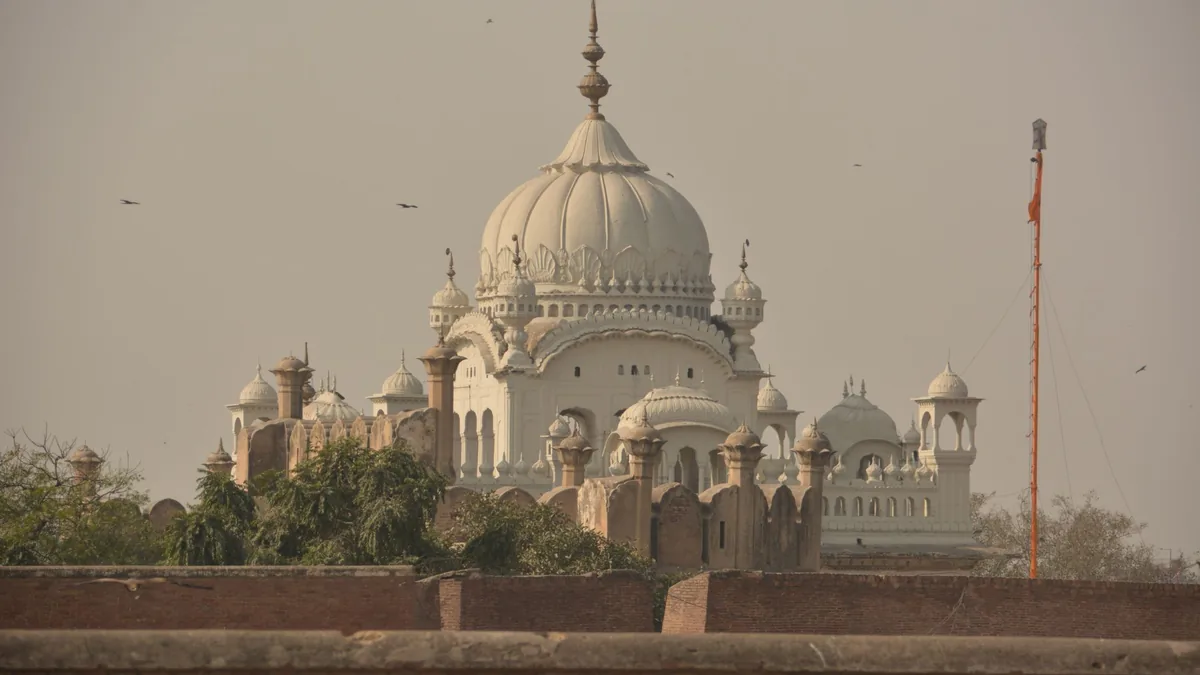
A Nankana Sahib yatra from the UK, Canada or the Gulf usually means three places and two very different road days: Lahore as your base, Nankana Sahib to the west of the city for Gurdwara Janam Asthan, and Gurdwara Panja Sahib at Hasan Abdal, north-west of Islamabad. If you are travelling with an organised group, most of the ground logistics are handled for you. If you are an independent family, you arrange everything yourself: the visa, the hotel, a vehicle for each leg, and enough slack in the day for security checks. The practical plan that works for most families is simple. Stay in Lahore, do Nankana Sahib as a same-day return by road, then move north for Panja Sahib rather than trying to squeeze it into a Lahore day trip. Unless you are travelling with an organised group, avoid pinning your first visit to the exact festival day, because that is when roads can be sealed and movement is tightest.
Read the travel advice before you plan the route
Start with safety, because it shapes which parts of a Sikh pilgrimage you can sensibly include.
As of its September 2026 update, the UK FCDO travel advice for Pakistan does not place Lahore, Nankana Sahib, Hasan Abdal or Islamabad in its "against all travel" or "against all but essential travel" areas. It does advise against all but essential travel to places within 5 miles of the Pakistan–India border, and that matters for one site many families ask about.
Gurdwara Darbar Sahib at Kartarpur sits about 4.7 km from the border, according to the Kartarpur Corridor entry on Wikipedia, so it falls inside that band. The FCDO makes a specific exception for the Kartarpur Corridor for Sikh pilgrims visiting Darbar Sahib, but it also notes the corridor is currently closed for crossings; Indian authorities suspended corridor services on 7 May 2025. Canadians should know their own government's advice is stricter: it says to avoid all travel within 10 km of the India border, except at official crossings; the only Indian-border exception it names is Wagah and the GT Road leading there (currently closed), and it does not mention Kartarpur at all. If Kartarpur is on your wish list, treat it as a separate decision: check your government's latest wording and your travel insurance before you commit to it, and do not assume it can be added on the day.
On the wider picture, the FCDO's safety and security page says there is a high threat of terrorism throughout Pakistan and names places of worship and religious gatherings among likely targets. It asks visitors to be careful at public events, including religious gatherings, and to always carry photo ID. Canada's official travel advice for Pakistan asks travellers to exercise a high degree of caution countrywide and to carry photo identification at all times.
None of this means a family visit is out of the question. It means you plan it the way the organisers do: short, purposeful road days, known vehicles and drivers, no wandering off the itinerary, and a flexible plan for festival crowds.
Vaisakhi in Pakistan and Gurpurab at Nankana Sahib: when the crowds come
Two dates dominate the Sikh calendar in Pakistan.
- Vaisakhi falls on 13 or 14 April. In Pakistan the main observances are at the Panja Sahib complex in Hasan Abdal, the gurdwaras of Nankana Sahib and historic sites in Lahore, with Vaisakhi fairs at places such as Eminabad.
- Guru Nanak Gurpurab follows the lunar calendar, landing on the full moon of Kartik, which usually means late October or November. In 2025 it fell on 5 November. The main ceremony is at Gurdwara Janam Asthan in Nankana Sahib.
The Evacuee Trust Property Board (ETPB), which looks after Sikh shrines in Pakistan, lists Vaisakhi, Guru Nanak's birthday and Khalsa Janam Din among the events it organises for.
What does a festival week actually look like on the ground? A Dawn report from November 2015 described more than 2,500 Indian Sikh pilgrims arriving at Panja Sahib by special trains via Wagah, plus around 500 pilgrims from other countries. The roads and streets leading to the gurdwara were sealed, nearby markets were shut, and pilgrims were kept to the gurdwara grounds. Numbers and arrangements vary from year to year, but that is the kind of control to plan around.
What that means for your plans
If Gurpurab at Nankana Sahib is the reason for the trip, accept that the day itself will be slow. Cars may be held at cordons, you may walk the last stretch, and the timings you agreed with your driver may slip. If you can be flexible, a visit a few days before or after the peak is likely to be calmer, with fewer cordons to work around.
Official jathas and independent families: who arranges what
Most news coverage of a Sikh yatra in Pakistan is about official jathas, the organised groups of pilgrims from India. ETPB says it provides visa facilitation, welcome arrangements at the border, and hospitality for Indian Sikh visitors. The 2015 Dawn report gives a sense of the structure: a nine-day itinerary with fixed dates for Panja Sahib, Nankana Sahib, Farooqabad, Lahore and Kartarpur, then a return to India.
A British, Canadian or Gulf-based family travelling on its own does not sit inside that structure. Here is how the two compare.
| What needs sorting | Organised group (jatha) | Independent diaspora family |
|---|---|---|
| Visa | Arranged through the group's process | You apply yourself, usually online |
| Arrival | Often by land at Wagah, on a fixed date | Usually by air into Lahore or Islamabad |
| Transport between gurdwaras | Group buses on a set programme | You arrange a car or van for each leg |
| Lodging | Group accommodation, often at or near the gurdwaras | Hotel or family home you choose |
| Security | Movement managed with the authorities | You follow local instructions and advice |
| Flexibility | Very little | Full, but you carry the planning |
The independent route gives you control over pace, which matters a lot with grandparents or young children. It also means nobody else is checking that your driver knows the gurdwara gates, or that your van has room for a wheelchair.
Your visa
The FCDO's entry requirements page says British citizens need a visa arranged in advance, through the Pakistan Online Visa System. The portal itself says applicants should plan travel only once they have a valid visa. Your passport must be valid for at least six months after the date of your visa application. Holders of a Pakistani NICOP or SNICOP can enter without a visa, according to the same FCDO page. Rules change, so check both official pages before you book flights, not after.
Lahore to Nankana Sahib: planning the road day
Nankana Sahib is about 91 km west of Lahore, according to its Wikipedia entry. The town has more than one gurdwara worth your time: Janam Asthan is the heart of it, but there are also Patti Sahib, Bal Leela, Mal Ji Sahib, Kiara Sahib and Tambu Sahib, each tied to a part of Guru Nanak's early life.
The M-3 motorway runs from the Lahore end of the M-2, past the Ravi toll plaza and south-west towards Abdul Hakeem, and it has an interchange for Nankana Sahib. For a family in a hired vehicle the motorway is usually the simpler approach, though your driver will know whether the older roads are better on the day. Motorway tolls vary by vehicle class and change from time to time. Our sister service iDrive, the network behind Pakistan Taxi, keeps a practical guide to motorway tolls and drive times if you want to understand how that side of the cost works.
A sensible same-day return
Nankana Sahib works well as a day trip from Lahore, which saves you a second hotel and keeps luggage out of the picture. A day plan that most families can manage looks like this:
- Leave Lahore early. Traffic leaving the city grows through the morning, and an early start gives you a quieter first visit at Janam Asthan.
- Agree the gurdwara order in advance. Tell your driver which gurdwaras you want to visit and in what order, so they can plan parking and pickup points.
- Build in langar time. If you intend to eat langar, allow for it instead of treating lunch as an afterthought.
- Set a turnaround time. Pick a time to leave Nankana Sahib, and stick to it. Driving back to Lahore after dark is avoidable on a planned day.
- Keep the evening light. Elders who have been on their feet and doing parikrama all day will not want a late dinner across town.
On a Gurpurab or Vaisakhi day, add generous time to every step, and have a phone number for your driver that works when the car is held behind a cordon.
For more on turning several towns into one clear plan, our guide to planning a multi-city Pakistan visit covers how to lay out each day before you share it with a booking team.
Panja Sahib Hasan Abdal visit: fitting it into the route
Gurdwara Panja Sahib sits at Hasan Abdal in Attock district. The town is about 40 km north-west of Islamabad and about 48 km from Rawalpindi, according to the Hasan Abdal entry on Wikipedia, and it sits at the meeting point of the M-1 motorway and the Karakoram Highway, close to the Grand Trunk Road. The gurdwara is known for the rock bearing a handprint that Sikh tradition links to Guru Nanak's visit, and for its spring.
The key planning point is distance. Panja Sahib is near Islamabad, not Lahore. A Lahore base covers Nankana Sahib and the gurdwaras of the city, but Panja Sahib belongs to the northern half of the trip. You have three reasonable ways to handle it.
Option 1: a one-way move north
Spend the first part of your trip in Lahore, then travel north by road with your luggage, stopping at Panja Sahib on the way. Finish at a hotel in Islamabad or Rawalpindi and fly home from Islamabad. This avoids doubling back and suits families who arrived in Lahore and can leave from a different airport.
Option 2: a day trip from Islamabad
If you land in Islamabad or have family there, Panja Sahib is a straightforward day out. It is a short drive compared with the Lahore–Nankana day, which makes it a gentle first outing after a long flight.
Option 3: two bases, two day trips
Stay in Lahore for Nankana Sahib, move to Islamabad by road or rail, then do Panja Sahib as a separate day trip. It adds a transfer day, but each visit stays short and unhurried, and nobody sits in a car with a suitcase at their feet.
Vaisakhi is the big day at Panja Sahib, and the 2015 Gurpurab cordons described above show how tightly the approach roads can be controlled when large groups arrive. If Vaisakhi is the whole point of your trip, speak to the group or committee organising the visit before you finalise transport.
Choosing vehicles for elders, children and luggage
The vehicle question is where a family yatra often goes wrong. A car that suits a Lahore airport pickup may not suit a long day of getting in and out at several gurdwaras.
Think about three things before you ask anyone for a quote:
- How many people, and who they are. Five adults is not the same as two grandparents, two parents and three children. Older passengers need easy steps and seats they can get out of without help.
- What travels with you each day. On a Lahore day trip it may be a bag of shoes, water and a rumaal each. On the move north, it is every suitcase you brought.
- Mobility. If someone uses a wheelchair or walker, say so at the start, and ask how it will be stored.
For groups that cannot fit in one family car, our guide to choosing between a group van and several cars sets out the trade-offs. One van keeps everyone together and means only one driver to coordinate. Two cars give you flexibility if half the family wants to stay longer at Janam Asthan while the elders head back early.
If you are bringing extended family from several cities, the group travel service page explains what to tell us about headcount, pickup points and timings so the planning starts from accurate information.
Security checks and what to carry into gurdwara premises
Expect checks at gurdwara gates, especially on festival days, and at police cordons on the approach roads. The best way to keep them short is to be ready for them.
Carry on the day
- Original passport with your visa, or your NICOP if that is how you entered. The FCDO says you may be detained until you can show valid ID, so a photocopy alone is not a good idea.
- A photocopy or phone photo of your passport and visa, kept separately from the original, as Canada's advice suggests.
- A head covering for everyone, including children.
- A small bag for shoes, or a plan for where you will leave them.
- Water and any medication for elders, since you may be away from the car for a long time.
- Your driver's name, phone number and the vehicle registration, written down as well as saved in your phone.
Leave behind or keep in the car
- Tobacco and alcohol, which have no place on gurdwara premises.
- Large bags and anything you would not want to put through a security check.
- Any habit of photographing everything. The FCDO notes that British nationals have been arrested on suspicion of spying, and it warns against photographing military establishments, airports or infrastructure. Treat police cordons and checkpoints the same way, and follow instructions from sevadars and police.
Who can enter
Not every gurdwara in Pakistan is open to every visitor. The Wikipedia entry for Gurdwara Dera Sahib in Lahore notes that visiting there is restricted to Sikhs or those with special permission from ETPB. If your party includes non-Sikh relatives or friends, or if your driver hopes to come in with you, check the rules for each gurdwara in advance instead of discovering them at the gate. Contact details for ETPB are on its official site.
Planning a Sikh pilgrimage to Pakistan from the UK: the order that works
Here is a sequence you can use from the start of planning to the day you land.
- Read the official advice. Check the FCDO (or your own government's) advice for Pakistan and each place on your list. Write down anything that affects your route, such as the 5-mile border band.
- Choose your dates. Decide whether you want the festival itself or the quieter days either side. Confirm the Gurpurab date for your year, since it moves.
- Sort the visa. Apply through the official online system and wait for the result before paying for anything you cannot cancel.
- Pick your airports. Flying into Lahore and out of Islamabad often suits a Nankana-then-Panja route better than a return to one city.
- Fix your bases. One hotel in Lahore, one in Islamabad or Rawalpindi, or a family home, and note the exact address and a landmark for each.
- Write the day plan. For each day, list pickup time, each gurdwara, a turnaround time and the return point.
- Ask for transport. Share the full plan, headcount, ages, luggage and any mobility needs, and ask what each quote includes.
- Share the plan with family. Send the driver details and day plan to someone at home, and to relatives in Pakistan if you have them.
Our city-to-city service page is the place to start if your trip includes the Lahore to Islamabad leg as well as the gurdwara days.
An example seven-day plan for a family of six
This is an illustrative example, not a fixed package. Picture a family from Birmingham: two grandparents, two parents and two teenagers, visiting in the week after Vaisakhi.
| Day | Plan | Transport need |
|---|---|---|
| 1 | Land at Lahore, check in, rest | Airport pickup with room for six people and luggage |
| 2 | Lahore gurdwaras and the Walled City area | Van for the day, short hops |
| 3 | Same-day return to Nankana Sahib | Van for a long day, early start |
| 4 | Rest day in Lahore | None, or a short local trip |
| 5 | Move north, stop at Panja Sahib, on to Islamabad | Van with all luggage, one-way |
| 6 | Family visits in Islamabad or Rawalpindi | Car or van as needed |
| 7 | Fly home from Islamabad | Airport drop-off |
Notice what the example avoids: two long road days back to back, a Panja Sahib day trip from Lahore, and any plan that depends on the festival day itself. The rest day after Nankana Sahib is there for the grandparents. Cut it only if everyone in the party is genuinely comfortable with long days on their feet.
Your next step
When your dates and bases are settled, share your day plan with us through the journey planning form. Tell us the headcount, the ages of your elders and children, luggage for each leg, and which gurdwaras you want to visit on each day. We will come back to you about vehicle options and what a quote would cover, so you can make the decision with the facts in front of you. Nothing is confirmed until a vehicle and driver have been agreed for your dates, so start the conversation early if your trip falls in festival season.