An open jeep for baraat day looks wonderful in photographs, but the first thing to check is not the colour of the flowers. It is how the groom will ride. If the plan involves anyone standing up, sitting on the edge of the body or perching on the bonnet while the vehicle is moving, change the plan before you book anything. Seat everyone properly, keep the open-air stretch short and slow, choose a time of day that suits the season, and arrange a closed car to take the groom the last part of the way so he arrives at the hall cool, clean and on time. Then ask the operator five plain questions: what exactly the vehicle is, whether it has a cover, who drives it, what happens if it breaks down, and when it will be at your door.
Open jeep, open-roof car or sunroof: which one you are actually getting
Families use "open car for baraat" to mean at least three different things, and operators use the words just as loosely. Settle which one you mean before comparing anything else.
| What people call it | What it usually is | Good for | Watch out for |
|---|---|---|---|
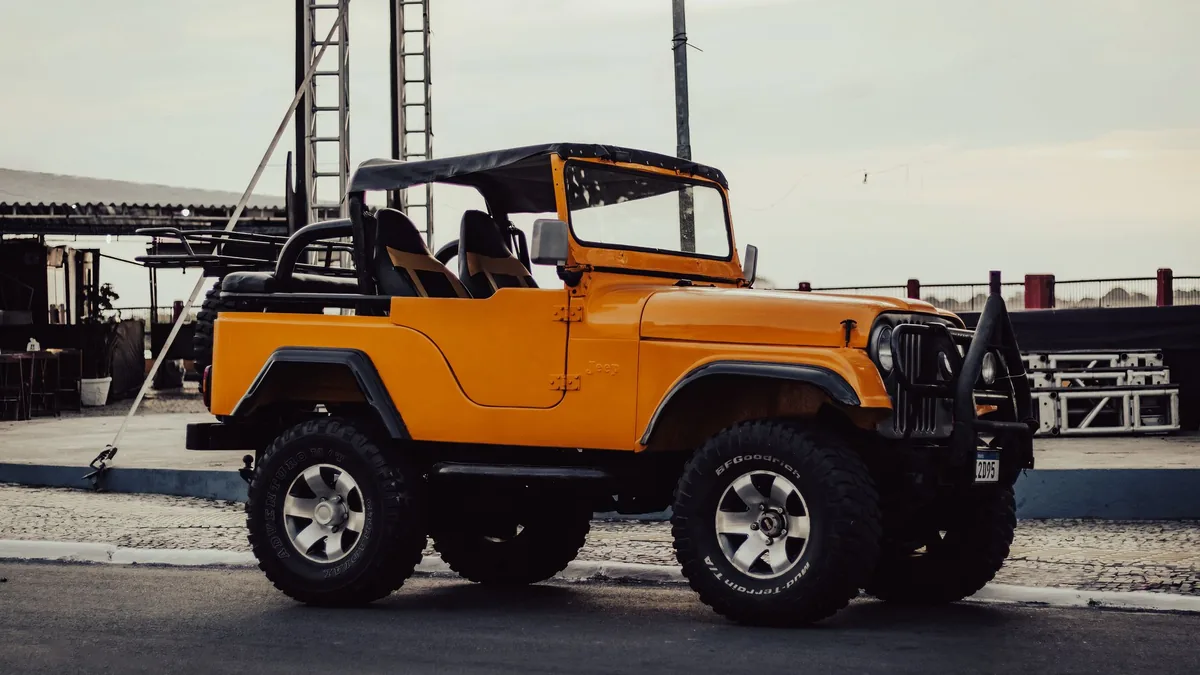
| Open jeep | A jeep-style 4x4 with the roof and sometimes the doors removed, or a soft top folded down | The classic entrance look; room for the groom plus one or two close relatives | No protection from sun, dust or rain; ask where the seat belts are and whether there is a roll bar |
| Open-roof or convertible car | A car whose roof folds or lifts away | A smarter, lower look; easier to climb into in a sherwani | Confirm one genuinely exists for your date; small back seats; the roof mechanism must actually work on the day |
| Sunroof or panoramic-roof car | A normal closed car or SUV with a glass panel that opens | Air conditioning, full seat belts, a closed car when you need one | People are tempted to stand through the opening; that is the wrong use of it |
| Decorated closed car | Any car or SUV dressed for the occasion | Heat, rain, long distances, older passengers | Less of a "moment" at the gate, which is why families pair it with a short open-air stretch |
If a relative promises you an open roof car for baraat day, ask which of these rows they mean; a sunroof and a convertible are very different evenings. A useful way to think about it: the open vehicle is for a few minutes of procession, not for transport. The closed car does the real work.
Ask for photographs of the actual vehicle
"Open jeep available" on a listing tells you nothing about which jeep, what condition it is in, or whether it will be the same vehicle on your date. Ask for recent photographs of the specific vehicle, including the seats, the floor and the underside of any soft top. If you are arranging this from abroad, ask for a short video walk-round as well. Our wedding car quote checklist covers how to write this into your request so the answer comes back in writing.
Who rides open-air, and for how long
The open-air seat is usually for the groom. After that, families tend to add one person who can steady him (a brother, a cousin, a close friend) and sometimes the photographer's assistant for a few frames. Resist the temptation to fill it. Every extra person makes the vehicle heavier, the ride slower to control and the photographs more crowded.
A few practical rules help:
- Seats before people. Count the seats that have a belt or at least a secure seat, and do not put more people in than there are seats. A jeep bench with three belts carries three, not five.
- No children loose in the back. A child on a lap in an open vehicle has nothing to hold them if the driver brakes. Children ride in the closed cars.
- Elderly relatives ride closed. Dadi and Nana do not need to prove anything. Heat, dust and a hard jeep seat are harder on older passengers than anyone else.
- Keep the time short. Plan the open section in minutes, not hours. A short final approach to the bride's home or the hall gate delivers the moment the family wants without cooking the groom.
Safety first on an open jeep for baraat: nobody stands while it moves
The instinct at a baraat is to stand up, wave, throw petals and dance in the back of the vehicle. On a moving vehicle, that is where injuries happen.
Pakistan's law is clear on highways and motorways. The National Highways Safety Ordinance, 2000, enforced by the National Highways and Motorway Police, says in section 54 that no one may carry a person on the running board "or otherwise than within the body of the vehicle". Section 55 says a driver must not allow anyone to stand, sit or be placed so as to hamper the driver's control, and section 67 makes it an offence to drive at a speed or in a manner dangerous to life or property having regard to traffic, road and weather. City streets fall under provincial motor vehicle law and are policed by city traffic police rather than NHMP, so check locally, but the principle is the same everywhere: people ride inside the body of the vehicle, seated.
In practice that means:
- Seated while moving. If the groom wants to stand for a photograph, the vehicle stops first, he stands, the photographer shoots, he sits, and only then does the vehicle move again.
- Nobody on the bonnet, the sides, the tailgate or the spare wheel. Not for ten metres, not "just at the gate".
- Hands and heads inside when passing poles, gates, trees, tent frames and overhead wires. Wedding lanes are full of low decoration and hanging lights.
- No one walking alongside touching the vehicle. Dancers and drummers ahead of an open jeep are a common sight; keep them far enough in front that the driver can stop, and never let anyone walk beside a wheel.
- Walking pace near the crowd. Once the procession reaches the lane or the hall entrance, the vehicle should move no faster than the people around it.
Fireworks, firing and loud crowds
Petals are fine. Anything that burns or bangs near an open vehicle is not. Keep fireworks well away from the jeep and its fuel tank, and make it clear to the family that there will be no weapons anywhere near the procession. If someone insists, the right response is to stop the vehicle and wait, not to drive through it.
The UK Foreign, Commonwealth and Development Office also notes in its Pakistan safety and security advice that outside the major motorways road quality is variable and local driving standards are erratic, especially at night. A baraat that leaves after dark in an open vehicle is exposed to all of that. Keep the open section in the lanes near the venue, not on a main road.
Heat, dust and rain: plan the cover before you plan the flowers
Pakistan's wedding calendar runs through every season, and each one changes how sensible an open vehicle is.
Summer heat
Check the city forecast from the Pakistan Meteorological Department for your date. On the plains, a May or June afternoon in an open jeep is punishing for anyone in a sherwani, and black seats left in the sun get hot enough to hurt. If your baraat falls in summer:
- Move the open-air stretch to the evening, after the sun has dropped.
- Ask for the vehicle to wait in shade until the moment it is needed.
- Keep water and a small towel in the vehicle for the groom.
- On unpaved farmhouse approaches, ask the driver to crawl so the dust stays off a cream sherwani.
- Have the closed car running with the air conditioning on, close by, for the moment the open stretch ends.
Monsoon rain
The FCDO notes that monsoon season usually runs from late June to early October, that flooding can affect all provinces, and that roads and bridges have been damaged or destroyed in many areas. A rain shower on an open jeep ruins the outfit, the sehra and the decoration in a minute. For a monsoon wedding:
- Check the PMD forecast the day before and again on the morning.
- Ask the operator whether the vehicle has a soft top or rain cover that can go up quickly, and who puts it up.
- Agree in advance that if rain is falling or forecast for the procession window, the groom rides in the closed car the whole way and the open jeep either follows empty for photographs or stays behind.
- Make that decision by a set time, for example two hours before departure, so nobody is arguing in the driveway.
Winter fog
Plenty of families choose the cooler months for weddings, and in Punjab that is also fog season. In January 2025 Dawn reported fog closing key motorway sections in Punjab, and closures of that kind recur most winters. An open vehicle in cold, damp air at night is uncomfortable, and if your wedding party is also driving between cities, fog can wreck the timetable before anyone reaches the lane. Build in extra time, and keep the open section very short.
The switch: moving the groom into a closed car before the hall
Most of the problems with an open car for baraat come from asking it to do the whole journey. The fix is simple: split the journey into two vehicles and plan the handover as carefully as the entrance.
A pattern that works for many families (adapt the details to your own day):
- The groom leaves home in a closed car with air conditioning, seat belts and room for the sehra. A decorated SUV or saloon does this job well. Our premium SUV journeys (planned link) page explains the kind of vehicle families usually choose for this leg.
- The open jeep waits at a meeting point close to the venue: a quiet side road, a relative's house, a petrol station forecourt with permission, or the far end of the lane. It should be decorated and ready before the groom arrives.
- The groom moves across, with the photographer and videographer already in position.
- The open-air procession runs the final stretch at walking pace to the gate.
- The closed car goes ahead or around and parks near the hall so it is ready for the rukhsati or for the groom's return.
For the evening of a hot day, or any day with doubtful weather, you can reverse the idea: the groom does the whole journey closed and uses the open jeep only for a stationary photograph at the gate.
Where the handover goes wrong
- The meeting point is on a main road. Traffic will not wait while the family rearranges itself. Choose somewhere the closed car can pull fully off the road.
- Nobody knows who decides. Name one person on the groom's side who says "move now". Everyone else follows that person.
- The decoration is not finished. Whoever decorates the jeep needs its location and access time. The guide to the wedding vehicle handover between family, decorator and operator sets out who confirms what.
- The jeep has not been tested with passengers. Climbing into a high jeep in a sherwani and khussa is harder than it looks. Do a dry run the day before if you can, or at least ask the driver to bring a step.
Route and speed: keep the open-air section short and quiet
Pick the open-air route with the same care you would pick a car park.
| Question | Good answer | Warning sign |
|---|---|---|
| How long is the open section? | A few minutes on a quiet approach | "From the house to the hall" across town |
| What kind of road? | A residential lane or venue approach road | A main road, bypass, flyover or any highway |
| What speed? | Walking pace in the crowd, slow between | Anything that needs the driver to keep up with traffic |
| Overhead hazards? | Checked in daylight, low wires and branches noted | Nobody has looked |
| Where does it end? | A clear spot at the gate with space to stop and unload | Double-parking in front of a busy hall |
| After dark? | Street lighting, the driver knows the lane | Unlit roads, a driver new to the area |
If the venue is on a main road with no quiet approach, the honest answer may be that the open jeep stays parked at the gate as a photo set and nobody rides in it while it moves. That is still a lovely picture.
Know the local picture
Wedding lanes in the big cities are often narrow, and a baraat with drummers and a slow-moving jeep can hold up traffic for longer than the family realises. If the procession will touch a public road, ask the hall manager what the local traffic police normally tolerate, and keep it moving. In September 2026 the FCDO also flagged planned protests in Islamabad, Rawalpindi, Peshawar and other cities, with past protests causing road closures, so check local news on the day and leave slack in the timetable.
If any part of the family's journey runs through areas the FCDO lists in its warnings for Pakistan, take that seriously. The FCDO currently advises against all travel to Balochistan and much of Khyber Pakhtunkhwa, including Peshawar, and against all but essential travel to places such as Dera Ghazi Khan and all of Sindh north of and including Nawabshah. That advice covers the whole journey, not just the procession. If you are travelling from the UK, follow it: the same page warns that travelling against FCDO advice could invalidate your travel insurance.
Questions to ask the operator before you agree to a baraat jeep
A baraat jeep may come from a small local owner rather than a large fleet, and the conversation can be informal. Keep it friendly, but get the answers in writing, on WhatsApp if nothing else.
About the vehicle
- Which exact vehicle is it, what model and year, and can you send recent photos or a video?
- How many proper seats does it have, and how many have seat belts?
- Is there a roll bar or fixed frame over the passengers?
- Does it have a soft top or rain cover, and how long does it take to put up?
- Is the vehicle registered and insured for carrying passengers, and will the documents be in the vehicle?
About the driver
- Who will drive it, and have they driven in a baraat before?
- Does the driver know the lane and the venue, or will they need a pin and a phone number?
- Will the driver stop the vehicle whenever anyone stands up, even if the family asks otherwise?
About timing and contingencies
- What time will the vehicle arrive at the meeting point, decorated or not?
- How long is it booked for, and what happens if the baraat runs late?
- If the vehicle breaks down or does not turn up, what is the fallback?
- Who decorates it, and when can the decorator have access?
- What is included in the price, and what counts as extra (waiting time, fuel, decoration, a second location)?
If the answers are vague, treat that as the answer. A good operator will be happy to talk about seat belts and rain covers; a poor one will talk about how many flowers fit on the bonnet.
What we can and cannot do
Pakistan Taxi is a planning service. You tell us about the day through our wedding transport service page, and we help you think through the closed cars, the guest vehicles and the timings around your open-air moment. We cannot promise a particular open jeep, a fixed fare or availability on your date; those depend on what a local operator can actually offer, and you should see it in writing. If you prefer to compare vehicles by specification, our sister platform iDrive, which runs the network behind Pakistan Taxi, lists its premium SUV and 4x4 range with seating and luggage details.
A checklist to send to the groom's side
Copy this and share it with whoever is running transport on the day.
- Vehicle type agreed in writing: open jeep, open-roof car or closed car with sunroof.
- Photos or video of the actual vehicle received.
- Number of open-air passengers fixed, all seated, each with a seat.
- Open-air stretch limited to the approach to the venue, at walking pace.
- Closed car booked for the main journey, air conditioning working.
- Handover point chosen, off the main road, with time to switch.
- One named person to give the "move now" call.
- PMD forecast checked the day before and the morning of the baraat.
- Rain decision time agreed, with the closed-car-only plan ready.
- Fireworks and anything that burns kept well away from the vehicle.
- Driver's name, phone number and arrival time confirmed.
- Fallback agreed if the jeep does not arrive.
When you are ready to plan the cars around the procession, start with plan your wedding journey (planned link) and tell us the dates, the addresses and how many people are travelling. We will come back to you with questions, options and what an operator can confirm, so the open-air moment is the easy part of the day.