
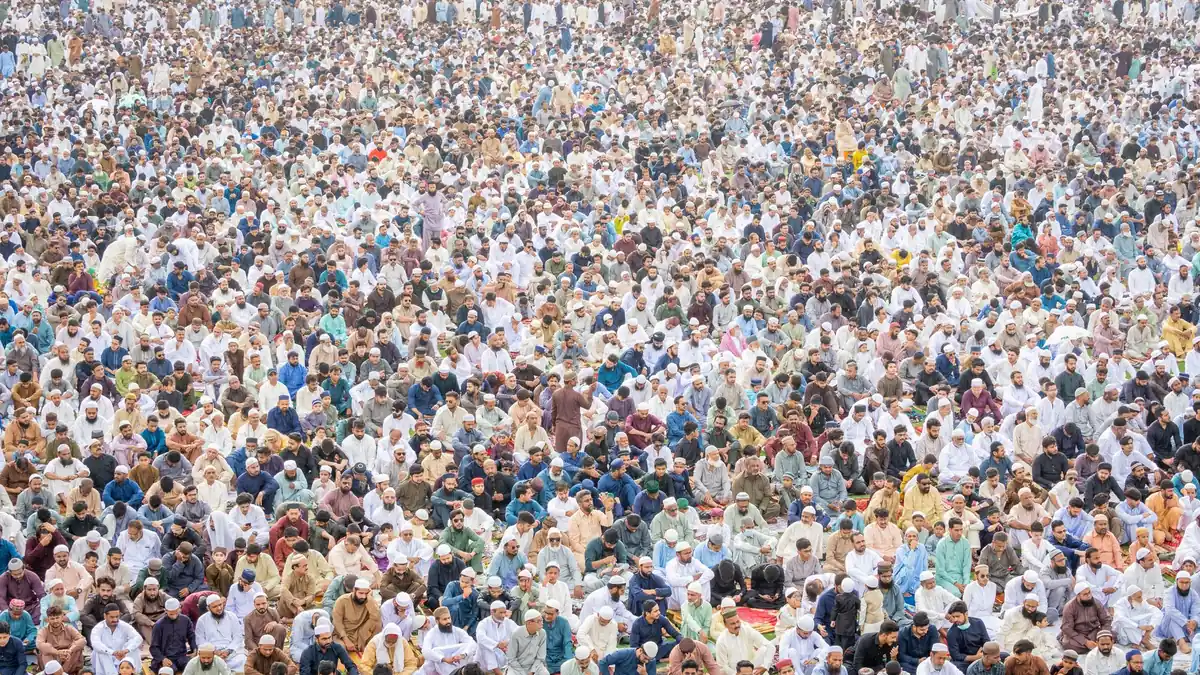
The Raiwind Ijtema traffic plan is not a fixed document. Lahore's City Traffic Police set out arrangements for each gathering, and the National Highways & Motorway Police add their own advisories for motorway and highway traffic heading into Lahore. You will not find the final diversions months in advance, so plan in two layers. First, fix the things you control now: who travels in which vehicle, who is responsible for each vehicle, where everyone meets and when you intend to leave. Then slot in the official routes and parking areas once they are announced. For most groups the hard part is not arriving. It is leaving after the final dua, when a very large crowd tries to empty the same fields and the same roads at the same moment.
Tablighi Ijtema Raiwind 2026: how the dates and phases are announced
The gathering takes place at Raiwind, the headquarters of the Tablighi Jamaat on the southern side of Lahore. Business Recorder puts Raiwind about 36 km from Lahore, and the gathering ground itself sits a few kilometres from the main Markaz building, according to the Wikipedia entry on Raiwind Markaz.
Because of its size, the Ijtema has been split into phases since 2011. Wikipedia's article on the Tablighi Jamaat records that each of the two 2011 phases drew around a million people. The current pattern, as the Raiwind Markaz entry describes it, is four parts spread over two years: two parts one year, the other two the next, each lasting three days. In practice that means your jamaat or family will usually be attending one three-day phase, not the whole event.
Raiwind Ijtema dates: treat early claims as provisional
The dates are set by the Markaz, not by the government, and they reach most people through their local markaz and halqa rather than through any public calendar. For reference, in 2023 Business Recorder reported that the second phase began on 9 November and closed with the final dua on the Sunday morning.
At the time of writing, in late September 2026, we could not find an announcement of the 2026 dates that we were able to verify. So:
- Treat any date circulating on WhatsApp or social media as provisional until your own markaz confirms it.
- Do not buy non-refundable flights or pay non-refundable deposits on the strength of a forwarded message.
- Once your phase is confirmed, note three things: the first day you must be on the ground, the morning of the final dua, and the day you actually need to be home or at the airport.
That third date matters more than people expect. Many attendees leave in jamaats for a chilla or a shorter khurooj straight after the dua. Business Recorder noted in 2023 that thousands formed groups at the close of the gathering to travel onward. If some of your group are going out in the path of Allah and others are going home, you are really planning two different departures.
Reading the Lahore Traffic Police and NHMP plans
Two authorities matter for most groups, and they cover different roads.
City Traffic Police Lahore handles the city roads and the approaches to Raiwind. Its website at ctplahore.gop.pk lists Helpline 15 for traffic information and promotes the Rasta app, which it describes as a way to keep citizens updated on jams and direct them to alternative routes. When the Ijtema plan is released, the city police version is the one to read for which roads into Raiwind are restricted, where heavy vehicles are diverted and where designated parking has been set aside.
National Highways & Motorway Police (NHMP) looks after the motorways and national highways that bring groups into Lahore from other cities. The NHMP website offers a travel advisory service and its Radio FM 95 station. If your group is coming from Rawalpindi, Faisalabad, Multan or Sialkot, their advisories are the ones that will affect the first few hours of your drive.
Raiwind road closures: what to pull out of the plan
Traffic plans are written for the whole city, so they are long and not organised around your group. When it is published, read it with a pen and pull out only these points:
- Which roads into Raiwind are closed or restricted, and from what time on which days.
- Where heavy vehicles are stopped or diverted. Coasters and larger vans may be treated differently from cars, so check which category your vehicle falls into.
- The designated parking areas for buses, coasters and vans, and how far they are from the gathering ground.
- Where the diversions begin. This decides which interchange or junction your driver should aim for.
- Any separate arrangements for the final day. Plans for the closing morning can differ from the earlier days.
Then forward a short, plain summary to every driver and every vehicle contact. A two-line message they can read at a toll plaza is worth more than a screenshot of a four-page notice.
One road-network note: the Southern Loop of the Lahore Ring Road has a section designated SL-3 that runs from Adda Plot near Raiwind towards Maraka. The Wikipedia article on the Lahore Ring Road says this 8 km stretch was stalled for years by litigation, that work resumed in 2023, and that no completion date had been fixed at its latest update. Before you build a route around it, check with your driver and the Rasta app whether the section you intend to use is open on your day.
Who publishes what
| What you need | Who publishes it | Where to check | When to check |
|---|---|---|---|
| Phase dates | The Markaz at Raiwind | Your local markaz or halqa | Before you book anything |
| City diversions and parking | City Traffic Police Lahore | Helpline 15, Rasta app, CTP website | Once your phase is confirmed, and again the day before |
| Motorway and highway advisories | NHMP | NHMP website, Radio FM 95 | On each travel day |
| Live jams on the day | City Traffic Police Lahore | Rasta app | During the event |
| Medical, rescue or a missing person | Punjab Emergency Service | 1122 for emergencies, 1192 lost helpline | Any time |
Transport to Raiwind Ijtema: drop-off and parking for vans and coasters
Groups usually move in one of three ways: several family cars, one or two vans, or a coaster for a whole jamaat. Each behaves differently near the ground.
Cars are the most flexible. They can often get closer and can peel away at different times. The price of that flexibility is coordination: five cars means five drivers, five routes and five sets of phone calls.
Vans such as a Hiace or similar carry a household or a small jamaat with bedding and bags. Our page on van journeys for groups (planned link) explains what to ask about seats and luggage space before you commit. Ijtema luggage is bulkier than people imagine: bedding, water and bags for three days.
Coasters and minibuses move a whole group as one unit, which is simpler to manage but slower to park and slower to leave. If you are pricing a coaster, iDrive, the network behind Pakistan Taxi, lists the Toyota Coaster with its seating details so you can compare it with a pair of vans.
Practical rules for the parking area
- Expect to walk. Designated parking for large vehicles may sit some distance from the gathering ground. Elderly relatives, children and anyone with a mobility problem need to know this before they set off, not at the barrier.
- Photograph the parking block. Take a photo of any sign, marker or landmark nearby, and drop a map pin. Share both with every passenger in that vehicle.
- Agree whether the driver stays with the vehicle. Most groups want the vehicle guarded and ready. If the driver is staying, he needs food, water, somewhere to rest and a way to reach you.
- Fill the tank before the diversions. Once you are inside the restricted area you may not want to go looking for fuel.
- Keep one bag of essentials out of the boot. Medicines, phone chargers, water and a torch should travel with the passengers, not locked in a vehicle a long walk away.
One named contact per vehicle and a shared meeting point
A group of forty people in six vehicles does not get lost all at once. It gets lost one vehicle at a time: a car takes a different diversion, a van stops for fuel, a coaster is sent to a different parking block. The fix is simple and it works: every vehicle has one named person responsible for it, and every one of those people knows the others.
Setting it up, step by step
- Number the vehicles. Van 1, Van 2, Car 3 and so on. Use the numbers in every message so nobody has to remember which cousin drives the white Corolla.
- Name one contact per vehicle. Not the driver. The driver's job is the road. Choose a calm adult passenger who will sit in that vehicle for the whole journey, both ways.
- Give each contact a passenger list. Names, phone numbers and anyone who needs extra help: an elderly uncle with a walking stick, a diabetic passenger, a child. Our guide to making a pickup manifest for an event with several vehicles has a layout you can copy.
- Make one lead coordinator. This person holds all the vehicle contacts' numbers, the drivers' numbers and the latest version of the traffic plan summary.
- Create one group chat for contacts only. Keep it to the lead, the vehicle contacts and the drivers. A family group with ninety members will bury the one message that matters.
- Agree a headcount routine. The vehicle contact counts heads before the vehicle moves, every time, and posts a single line: "Van 2, 9 of 9, leaving."
Choosing a meeting point that still works in a crowd
Pick one fixed meeting point and one fallback. A good meeting point is easy to describe, sits away from the main flow of people heading for the exits, and does not move. Avoid "the main gate" or "near the stage", because on the closing morning everyone else is using the same words.
Then add a time rule, not just a place. For example: "If you lose your vehicle, go to the meeting point and wait there. The contact will come back at the top of every hour." Calls may not connect reliably in a very large crowd, and a time rule keeps working when phones do not.
Example: three vans from Sialkot
*This is an illustration, not a real booking.* A family and two neighbouring households travel from Sialkot in three vans. Van 1's contact is the eldest son; Van 2's is a neighbour who has attended before; Van 3's is a retired teacher. The lead coordinator sits in Van 1. They agree to leave Sialkot together, regroup at a named service area before Lahore if the NHMP advisory shows delays, and send one line in the contacts' chat at each stop. On the closing morning, each contact counts heads at the vans, not at the meeting point, because the vans are where a headcount can be done calmly.
Leaving after the final dua: expected delays
The final dua is the moment almost everyone waits for, and it is also when the roads fill. In 2023, Business Recorder reported that the closing dua of the second phase ran from about 8:45 am to 9:05 am. Timings in your year may differ, so confirm locally, but plan on a morning finish followed by a mass departure.
We are not going to give you a figure for how long it takes to get out, because no official source publishes one and the answer changes with the year, the phase, the weather and where your vehicle is parked. What you can plan for is the shape of the morning: a slow first stretch as people walk to vehicles, a crowded exit from the parking areas, and heavy traffic on the approach roads towards Lahore and the motorways.
Four ways to time your departure
| Plan | Who it suits | What you give up | What to arrange |
|---|---|---|---|
| Leave straight after the dua | Groups with a fixed deadline, such as a flight or work | Patience in the worst of the traffic | Vehicles ready, headcount done before the dua ends |
| Wait it out on site | Families with elderly relatives or small children | A few hours of the day | Food, water and shade; driver rested and informed |
| Stagger the vehicles | Large groups with mixed plans | One shared departure | Each vehicle contact confirms their own time |
| Split the group | Some going on a chilla, some going home | The comfort of travelling together | Separate headcounts and bags sorted the night before |
A few habits help whichever plan you choose:
- Pack the vehicles the night before. Bedding and bags that are loaded before the dua are bags nobody has to carry through the crowd afterwards.
- Brief the driver on your decision. If you intend to wait, he should know he has time to rest. If you intend to leave, he should be at the vehicle, not at a tea stall.
- Plan the whole route home, not just the exit. A slow exit turns a daytime drive into an evening one. The UK government's safety advice for Pakistan warns that local driving standards are erratic, especially at night, so build in a proper break for the driver.
If different vehicles will leave at different times, the lead coordinator should keep a simple running list in the contacts' chat: which vehicle has left, with how many people, and which are still on site. Nobody should be the last person standing at an empty parking block.
Airport connections for overseas attendees
Visitors from the UK, the Gulf and elsewhere normally arrive through Lahore's Allama Iqbal International Airport, which Wikipedia places about 15 km from the city centre. Raiwind lies on the far side of the city, so the airport run and the Ijtema run are really two separate journeys, and during a phase the second one passes through the traffic plan.
Arriving
- Arrive before the diversions bite. Landing the evening before your phase begins gives you a night's rest and a daylight run to Raiwind. Landing on the first morning means meeting the heaviest arrival traffic straight off a long flight.
- Keep the arrival pickup separate from the group movement. Get the overseas visitor to a family home or hotel first, then join a vehicle heading to Raiwind. Our Lahore Airport journey guide (planned link) covers meeting points and timings at the terminal.
- Check for any arrivals help for delegations. In April 2026, Business Recorder reported that the federal interior minister said special airport counters for processing visas of foreign delegations would again be set up this year. That is a pledge reported in the press, not a published procedure, so ask your markaz whether it applies to your group.
Departing
- Do not book a flight for the morning of the final dua. Even a late-afternoon flight on that day leaves little room if the exit is slow.
- Leave at least one clear night between the closing morning and your flight home. It also gives you time to collect anything left with relatives.
- Keep passports, tickets and medicines on your person rather than in a bag loaded into a vehicle parked some distance away.
Safety for foreign visitors
The UK FCDO's travel advice for Pakistan, updated on 22 September 2026, does not include Lahore in the areas it advises against. It does warn that terrorists are very likely to try to carry out attacks in Pakistan, and asks visitors to be cautious about attending public events, including religious gatherings. Read the current page before you travel. It is also worth knowing that the FCDO advises against all or all but essential travel to Balochistan and to much of Khyber Pakhtunkhwa, including Peshawar. If your jamaat plans to travel on from Raiwind into those provinces, check the advice carefully and check what your travel insurance will and will not cover.
Health and emergencies in a very large crowd
Three days on an open ground is hard on older bodies. Business Recorder reported in 2023 that the Punjab government expected around half a million people at that year's phase and had added CCTV, extra patrols, more traffic wardens and lighting around the site. That tells you the scale; it does not mean help is always a short walk away.
Put these numbers in every vehicle contact's phone and on a card in every bag:
- Rescue 1122, the Punjab Emergency Service, for ambulance and rescue. Its website at rescue.gov.pk also lists 1192 as its lost helpline and complaints line, worth knowing if someone goes missing in the crowd.
- Helpline 15 for City Traffic Police Lahore.
- The lead coordinator and every driver in your group.
For each passenger with a health condition, the vehicle contact should know where the medicines are kept, whether they need food at set times, and who at home should be called if they are taken ill. Keep a printed copy, because phone batteries run down over three days.
Planning your group's journey with Pakistan Taxi
If you would like help thinking through vehicles, timings and the airport legs around your phase, our group travel planning page explains how we approach larger parties. When you know roughly how many people, which city you are starting from and which phase you are attending, you can send us your journey details (planned link) and we will come back to you with options. Please treat anything we suggest as a plan to discuss, not a confirmed booking or a fixed fare: availability during the Ijtema depends on the dates and the number of vehicles, and the final routes depend on the traffic plan published for your year.