If you are driving a rented car and something goes wrong, roadside assistance in Pakistan comes from three different places, and the order you call them matters. For a puncture, a dead battery or a car that will not restart, your first call is the recovery or breakdown number in your rental agreement, because the supplier decides whether a mechanic comes out, the car is towed or a replacement is sent. On a motorway, the National Highways & Motorway Police (NHMP) answer 130, a nationwide line from mobiles and landlines that runs 24 hours a day. If anyone is hurt, or there is a fire, call 1122; for police it is 15. Those are the two numbers the UK government lists on its Pakistan getting-help page.
The rest of this guide is about making those calls work: knowing which number is actually in your contract, being able to say where you are, checking the spare before you drive off, and staying safe on a hard shoulder while you wait.
One safety point comes before any of it. The UK Foreign, Commonwealth & Development Office advises against all travel to parts of Pakistan, including Peshawar district and the whole of Balochistan, and against all but essential travel to others, including Nowshera, Mardan and Swabi districts and Sindh from Nawabshah northwards. The M-1 runs to Peshawar and the M-5 ends at Sukkur, so both motorways reach areas on that list. Read the FCDO regional risks page before planning any self-drive route, and do not plan leisure driving into areas it lists.
Why emergency number lists are not enough
Most lists of Pakistani emergency numbers are accurate and still leave a renter stuck. They do not tell you who fixes a tyre on a hired Corolla at 11pm outside Pindi Bhattian, or who pays for the tow.
The honest picture is this:
- The rental supplier owns the car and is usually the one who arranges repair, towing or a swap. What they offer, and how fast, depends entirely on the supplier and the agreement you signed.
- The motorway police patrol the motorways and national highways and are, in the words of their Wikipedia entry, responsible for "enforcement of traffic and safety laws, security and recovery". They can help make a scene safe and point you to help, but they are not your rental company's mechanic.
- Rescue 1122 is an emergency service for medical emergencies, road traffic crashes, fires and similar incidents, according to the Punjab Emergency Service site. It is not a breakdown service.
- Police on 15 are for crime, threats, disputes and anything where you feel unsafe.
So a flat tyre with everyone well is a supplier call. A crash with an injury is 1122 first, supplier second. A breakdown in a dangerous spot on the motorway is often 130 first, so the scene is protected, and supplier second.
Roadside assistance in Pakistan: the call order
Use this table as the decision you make in the first minute. It assumes you are already out of the traffic stream, or cannot get out of it.
| What has happened | First call | Second call | Then tell |
|---|---|---|---|
| Puncture or slow leak, car can be moved safely | Supplier breakdown line | None needed | Family or contact person |
| Car will not restart, you are safely off the carriageway | Supplier breakdown line | 130 if on a motorway and you feel exposed | Family |
| Stopped on a motorway lane or shoulder in fog, dark or heavy traffic | 130 | Supplier breakdown line | Family |
| Collision, nobody hurt | 15 (or 130 on a motorway) | Supplier accident line | Family |
| Anyone injured, smoke or fire | 1122 | 15 or 130 | Supplier |
| You feel threatened or are being pressured to hand over the car | 15 | Supplier | Family |
The supplier call comes first for mechanical trouble
Agreements often say what you must not do after a breakdown, such as arranging your own tow or letting a workshop replace parts. Skip the supplier and you may end up arguing about who pays. Ring them before anyone lifts a spanner, unless you are only changing to the spare yourself.
130 is for the motorway network
The 130 line belongs to the NHMP, whose remit is the motorways and national highways. In a city street in Lahore or Karachi it is the wrong number; there, 15 and 1122 are the public lines, and your supplier is the practical one.
1122 is for people, not cars
If someone is bleeding, unconscious, trapped, or the car is smoking, call 1122 before anything else. Wikipedia's Rescue 1122 article notes that the service model runs in Punjab, Khyber Pakhtunkhwa, Gilgit-Baltistan and Azad Kashmir, with Sindh's emergency rescue service launched in May 2022 and Islamabad served by CARES 1122. In Balochistan the picture is split: MERC-1122 covers major highways, while Quetta city is served by the provincial disaster management authority. Response will vary by place, which is one more reason to keep your supplier's number and your own contact person ready as well.
What your rental contract should tell you before you leave
The car recovery service in Pakistan that matters to you is whichever one your supplier has arranged, so the handover desk is where you find out what you actually have. Do not leave with a vague "just call us". Ask for these in writing, on the agreement or in a message you can keep:
- The breakdown or recovery number, and whether it is answered overnight. A daytime office line is not a breakdown line.
- A second number for when the first does not answer, ideally a named person.
- What happens after a breakdown: a mechanic comes to you, the car is towed, a replacement is sent, or you are expected to reach a workshop yourself.
- Who pays for the tow, the puncture repair and a replacement tyre, and whether there is a cap or an excess.
- Where the car is allowed to go. Many agreements restrict certain regions or road types. If the car breaks down outside the agreed area, support may not apply.
- What to do after an accident: whether a police report is needed, and what photos the supplier wants.
- Whether you may repair a puncture at a roadside tyre shop and keep the receipt, or must wait for the supplier.
If you are booking a self-drive car through us, these are the questions to raise when you enquire about self-drive hire. We pass your requirements to suppliers and share what they confirm; nothing is fixed until the supplier confirms it to you directly. Our self-drive guide for overseas bookers covers eligibility, deposits and handover in more detail.
Documents that belong in the glovebox
The UK FCDO says British drivers need both their UK driving licence and the 1968 version of the international driving permit in the car, notes that you cannot buy an IDP outside the UK, and warns that without the correct documents you could be detained and have a police report registered in your name. Its safety and security page has the current wording. Other nationalities should check with their own authorities and the supplier.
Alongside the licences, keep the rental agreement, the vehicle's registration papers as handed over by the supplier, and a copy of your passport. In a breakdown or a police stop, being able to show that the car is legitimately in your hands saves time.
Check the spare tyre before rental, not on the hard shoulder
This is the check most people skip, and the one that turns a 20-minute puncture into a three-hour wait. When you check the spare tyre before rental, you are really checking a small kit that has to work together.
The handover check, in order
- Find the spare. In most saloons and hatchbacks it sits under the boot floor; in some SUVs and pickups it hangs under the rear or sits on the tailgate. Open it up and look, do not take a nod for an answer.
- Look at the tyre itself. Is it inflated? Press it firmly with your thumb and compare with a road tyre. Look for cracks in the sidewall, bulges, or a tread that is visibly worn smooth.
- Is it full-size or a space-saver? A narrow temporary spare is meant for limited speeds and distances. Ask the supplier what they expect you to do after fitting one.
- Find the jack. Check it is the right one for the car and that it actually winds up and down.
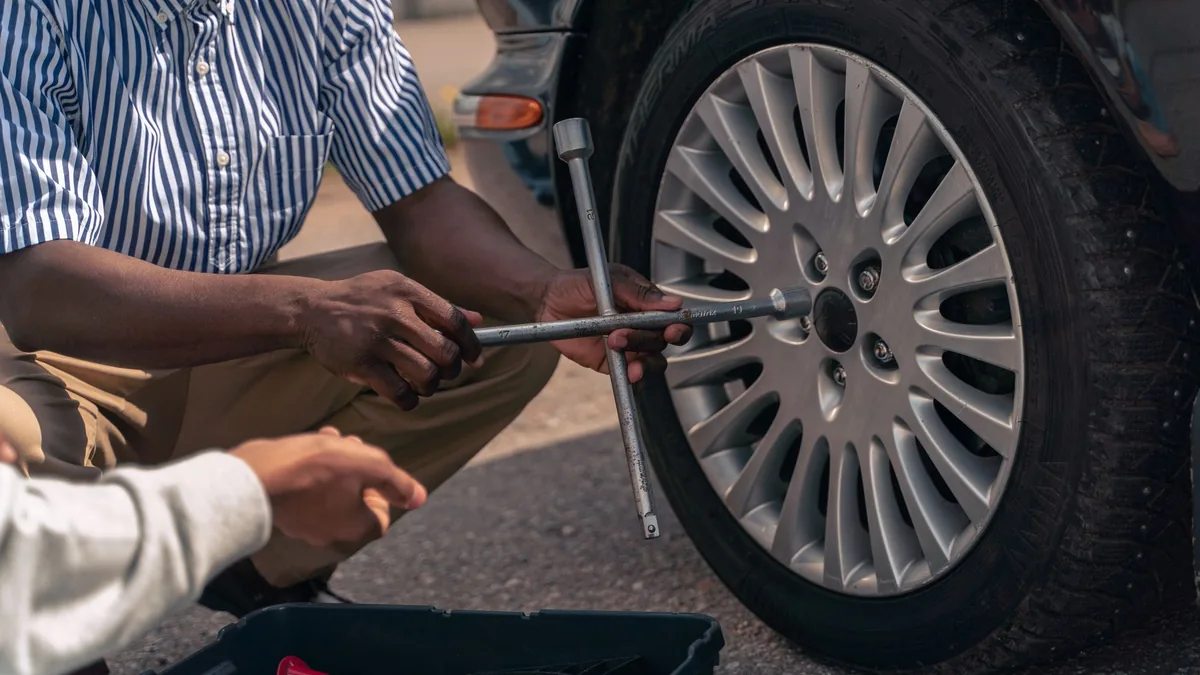
- Find the wheel spanner (wheel brace). Check it fits the wheel nuts.
- Ask about locking wheel nuts. If the car has them, the special key must be in the car. Without it, nobody can remove that wheel at the roadside.
- Look for a warning triangle and a torch. If either is missing, buy them before a long drive; they are cheap and you will want both at night.
- Photograph everything: the spare, the jack, the spanner, the locking key, and all four road tyres. Timestamped photos help if there is a later dispute about what was supplied.
If anything is missing or the spare is flat, ask for it to be sorted before you sign the handover. That is far easier than proving later that the spare was already useless.
Road tyres matter too
Look at all four for uneven wear, cuts or a tyre softer than the rest. A long, hot run at motorway speed is the worst test an underinflated tyre can face. Ask the supplier what pressures they recommend and where to check them; many fuel stations have an air point, but do not assume the next one will.
A flat tyre on the motorway: what to do, step by step
A flat tyre on the motorway is the situation where calm routine matters most, because the danger is not the tyre. It is the traffic passing a metre away.
- Hold the wheel firmly and ease off. Do not brake hard. Let the car slow, signal, and move to the left shoulder.
- Get as far left as you safely can. If an interchange, service area or wider section is close and the car is still controllable, going slowly to it is usually better than stopping in a narrow spot. Driving far on a completely flat tyre will damage the wheel, so use judgement.
- Hazard lights on. At night or in fog, keep sidelights on too.
- Everyone out on the side away from traffic, and away from the car, behind the barrier if there is one. Children and older passengers should not wait inside a stationary car on a motorway shoulder.
- Set the warning triangle well behind the car, walking along the verge, not the carriageway.
- Decide: change it, or call. If you have a good spare, the right tools, a firm level surface and enough room on the side away from traffic, you may choose to change it. If the flat is on the traffic side, the shoulder is narrow, it is dark, foggy or raining, or you are not confident, call 130 and your supplier and wait in a safe place.
- When you call 130, give your location clearly (see the next section) and say you are in a rental car with a flat tyre, how many people are with you, and whether anyone is vulnerable.
- Then call the supplier so they know, and follow their instructions on repair or replacement.
- After fitting the spare, drive gently, check the nuts again after a short distance if you can, and get the damaged tyre repaired or replaced before the next long stretch. You now have no spare.
In winter fog, the NHMP has advised travel between 10am and 8pm, the use of fog lights, and no high beams, and warns that sections may be closed temporarily, as Business Recorder reported in December 2025. If you are stuck in fog, do not try to change a tyre on the traffic side. Call and wait.
City roads are different
On a city road there is no 130 and no hard shoulder. Pull into a side street, a petrol station forecourt or a car park if you can do it safely. Call the supplier. You may find a tyre shop close by, but check your agreement before letting anyone repair or swap anything, and keep the receipt.
How to say where you are
Help is only as quick as your description. Motorways look alike at night, and "somewhere after Lahore" does not help anyone.
Before you set off, and again at every stop, get into the habit of noting:
- The motorway number (M-2, M-4 and so on) and your direction of travel ("northbound towards Islamabad").
- The last interchange, toll plaza or service area you passed, and roughly how long ago.
- Any distance sign or marker you can see from where you are standing.
- Which side of the carriageway you are on and whether you are on the shoulder.
- A pinned location from your phone's map app, which you can send by text or WhatsApp to your supplier and your family.
The Motorways of Pakistan overview lists the M-1 as Peshawar to Islamabad, the M-2 as Islamabad to Lahore, the M-3 as Lahore to Abdul Hakeem, the M-4 as Pindi Bhattian to Multan and the M-5 as Multan to Sukkur, so the motorway number alone narrows it down a lot. If you are planning a long drive, our sister platform iDrive, the network behind Pakistan Taxi, keeps an overview of motorway tolls and drive times on the M-1, M-2 and M-4, which helps you know which interchanges to expect.
Self drive emergency contacts: save them offline and share them
Your phone is the whole plan, which makes it a single point of failure. Signal can be patchy, batteries drain fast on maps and calls, and under stress it is easy to forget a number you have never dialled.
Build a one-screen contact card
Before the first drive, make a note on your phone, and a paper copy for the glovebox, with:
| Contact | What it is for | Where you got it |
|---|---|---|
| Supplier breakdown line | Punctures, breakdowns, towing, replacement car | Rental agreement |
| Supplier second contact | When the first line does not answer | Handover desk |
| Supplier accident line (if different) | Collisions, damage, reporting | Rental agreement |
| 130 | NHMP, motorways and national highways | Motorways of Pakistan (Wikipedia) |
| 1122 | Ambulance and fire | UK FCDO getting-help page |
| 15 | Police | UK FCDO getting-help page |
| Your contact person in Pakistan | Someone local who can speak for you, arrange help, collect passengers | You |
| Your contact person at home | Someone who knows your route and times | You |
| Car registration number and colour | Anyone coming to find you will ask | Handover |
Save each number as a phone contact with an obvious name ("RENTAL BREAKDOWN", not the supplier's trading name), so you can find it in seconds. Star them as favourites.
Share the plan with family
Send your contact card, the car's registration number and your route to one person in Pakistan and one at home before you leave. Tell them your planned stops and rough arrival time. Agree a simple rule, for example (this is only an example): if you have not messaged by a set time, they call you, and if you do not answer, they call the supplier.
Other habits that help:
- Download offline maps of the region you are driving, so you can still see your position without data.
- Carry a power bank and a car charger. A phone at 8% is not a plan.
- Keep some cash in rupees for tolls, a tyre repair or water while you wait.
If you are an overseas Pakistani driving family around, your local contact is often the most useful number on the list: they can speak with a mechanic in Urdu or a regional language, and drive out if needed.
After the breakdown: the paperwork you will want later
Once everyone is safe and the car is sorted or collected, spend five minutes on the record:
- Message the supplier a summary: time, place, what happened, who you called, and what they told you to do.
- Keep every receipt: tyre repair, tow, fuel you needed because of a detour.
- Photograph the damaged tyre or part and the car's condition when you hand it back or swap it.
- Note names or reference numbers from anyone you spoke to.
- Ask how the cost will be settled before you hand the car back, not after.
When self-drive is not the right call
Some trips are simply easier with someone else behind the wheel. If your route includes long night drives, winter fog on the Punjab motorways, mountain roads, or anywhere the FCDO lists as advised against, a car with a local driver removes most of this guide from your to-do list. The FCDO safety page itself recommends using experienced local drivers in mountainous areas, and only in clear weather.
If you are unsure, our help and journey planning page (planned link) explains how we handle enquiries, and you can plan a journey with Pakistan Taxi (planned link) to compare a self-drive car with a car and driver for the same dates. We will pass on what suppliers can offer; availability, prices and terms are confirmed by the supplier, not promised in advance.