
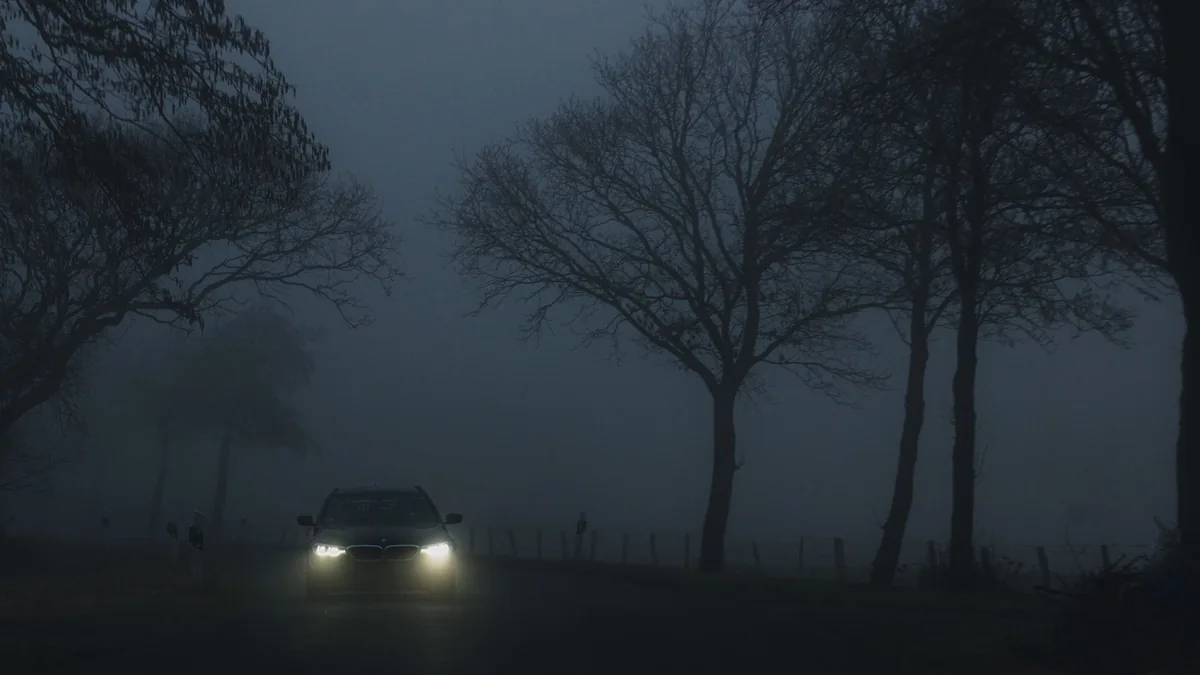
Is it safe to travel at night in Pakistan? On the main motorways, with a rested professional driver, a late run home is usually manageable, and plenty of families do it after a walima. On single-carriageway national highways it gets noticeably harder once the light goes. In some regions it is not a personal choice at all: the authorities in Balochistan have restricted night movement on several highways, and the UK Foreign Office advises against all travel to the whole province. Winter adds a third factor, because dense fog can close motorway sections overnight and leave you stuck at a toll plaza at 2am.
So the honest answer depends on three things: which road, which month, and how tired the person behind the wheel is. This guide works through each one and then gives you a simple way to choose a return time before the function starts, rather than leaving "whenever it finishes".
What official advice says about night travel in Pakistan
Start with what governments actually tell their travellers, because it is blunter than most local advice.
The UK Foreign, Commonwealth and Development Office (FCDO) says that outside the major motorways road quality is variable and that local driving standards are erratic, "especially at night". It asks visitors to take care on long road journeys and cross-country trips, and to be cautious moving around urban areas after dark, particularly on foot. You can read the full wording on the FCDO safety and security page for Pakistan.
The US State Department, which rates Pakistan at Level 3 ("Reconsider Travel") in its advisory issued in June 2026, is more specific about the dark itself. Its Pakistan country information warns that many vehicles have no working headlights or dimmers and many roads are neither lit nor signed. It recommends driving with experienced local drivers.
Neither government says "never drive at night". Both say the risk climbs after dark; the FCDO steers you towards the major motorways, and the State Department towards an experienced local driver.
Places where the question is already answered for you
Some parts of the country are covered by stronger advice that no return-time plan can override. According to the FCDO list of areas it advises against travelling to, these include:
- Balochistan, the entire province (advice against all travel)
- A long list of Khyber Pakhtunkhwa districts, including Peshawar city, Swat, Dera Ismail Khan, Kohat, Bannu and Charsadda (all travel)
- The Karakoram Highway between Mansehra and Chilas via Battagram, Besham, Dasu and Sazin, and the N45 from north of the Mardan ring road to the edge of Chitral (all travel)
- Sindh north of and including Nawabshah, Dera Ghazi Khan in Punjab, and the KP districts of Malakand, Mardan, Nowshera, Shangla and Swabi (all but essential travel)
- Areas within 10 miles of the Afghan border and of the Line of Control (all travel), plus Azad Jammu and Kashmir and the strip within 5 miles of the India border (all but essential, with exceptions such as the Grand Trunk road crossing)
If your family event is in one of these places, the question is not really whether night travel is safe. It is whether the journey should happen at all, and what your travel insurance will say if it does. Advice can change at short notice, so check the live pages the week you travel rather than relying on this list.
The Balochistan night travel ban: what it covered
The phrase "Balochistan night travel ban" comes up often because the restriction was real and widely reported. In late March 2025, Dawn reported that deputy commissioners in Gwadar, Kachhi, Zhob, Noshki and Musakhel, along with the Quetta administration, had barred travel at night on stretches of several highways after a run of attacks on passengers.
The routes named in that report included:
| Highway | Main link |
|---|---|
| N-25 | Karachi to Quetta (RCD Highway) |
| N-10 | Makran Coastal Highway |
| N-65 | Quetta to Sukkur |
| N-50 | Quetta towards Dera Ismail Khan |
| N-40 | Quetta to Taftan |
| N-70 | Multan to Loralai |
Most of the orders ran from 6pm to 6am; the N-65 restriction started an hour earlier, at 5pm, and on the Makran Coastal Highway departures were squeezed into morning windows. The report said the bans applied mostly to public transport, meaning buses and coaches. It also said the province's highways had been closed 76 times since the start of that year.
Two practical points follow. First, a ban aimed at buses is not a green light for private cars: the whole province sits under the FCDO's advice against all travel, and a family car on the N-25 at midnight is exactly the scenario that advice is written for. Second, district orders of this kind are issued, lifted and reissued locally. Nobody outside the district administration can promise you what the rule will be on the night of your function, so we do not plan leisure or celebration journeys through Balochistan, at any hour.
Night travel on motorway Pakistan versus the national highways
For most families the real choice is between two types of road, and they behave very differently after dark.
Motorways
The M-2 between Islamabad and Lahore, the M-3 and M-4 towards Faisalabad and Multan, and the other access-controlled motorways are the easiest roads in the country to drive at night. They are dual carriageways with no crossing traffic and no donkey carts, patrolled by the National Highways and Motorway Police (NHMP), with service areas at intervals. If something goes wrong, the NHMP runs the 130 helpline and FM 95 traffic radio.
That does not make them risk-free. The dangers simply shift: long straight stretches invite speed, lorries run through the night, and the thing most likely to hurt you is a driver who has been awake since the morning's mehndi preparations.
National highways
The N-5 (the old GT Road), N-55 (Indus Highway) and the other national highways are a different proposition. Towns run straight onto them, tractors and trailers pull out without lights, U-turn gaps appear in the median, and bikes carry four people with no tail lamp. The State Department's line about vehicles with no working headlights describes these roads more than it describes the motorways.
A useful rule: if the only way home after dark is a long stretch of national highway, treat that as a strong reason to stay over or leave earlier, even when the destination itself is somewhere you would happily visit.
| Factor after dark | Motorway | National highway |
|---|---|---|
| Crossing traffic and U-turns | None (access-controlled) | Frequent |
| Unlit vehicles and carts | Rare | Common |
| Lighting | Mainly at interchanges and toll plazas | Patchy, often none between towns |
| Police help | NHMP patrols, helpline 130 | NHMP also covers national highways; 130 still applies |
| Fog closures in winter | Sections closed by NHMP when visibility drops | Fog is just as thick, with no barrier to stop you driving into it |
| Best use late at night | Acceptable with a rested driver | Avoid for long distances |
For drive times and toll structures on the main routes, our sister service iDrive keeps a guide to motorway tolls and drive times on the M-1, M-2 and M-4, which is handy when you are working out whether a return trip fits before midnight.
Fog season: why a late start can end at a closed toll plaza
In the winter months, typically December and January, dense fog settles over Punjab and parts of Sindh and Khyber Pakhtunkhwa, and it is usually at its worst overnight and early morning. This matters far more to a family leaving a walima at 11pm than to anyone travelling at lunchtime.
When visibility collapses, the NHMP closes motorway sections. In January 2025, Dawn reported closures between Kala Shah Kaku, Kot Momin and Salam, between Kala Shah Kaku and Kot Sarwar, and on the M-3 from Abdul Hakeem to Darkhana, with visibility down to around 50 to 60 metres. In December 2025, Business Recorder carried an NHMP advisory asking people to plan journeys between 10am and 8pm, avoid unnecessary travel at night, use fog lights, keep a longer gap and avoid high beam, and to check conditions first on the 130 helpline or FM 95.
Read that advisory window again: 10am to 8pm. Plenty of walimas have barely served dinner by 8pm. A family that "leaves after the food" in fog season is choosing to drive in exactly the hours the motorway police are telling people to stay off the road.
What a closure means in practice:
- You reach the entry interchange and find it shut, or you are already on the motorway and get held at a toll plaza.
- Your options are to wait, or to take the parallel national highway through the same fog, alongside lorries doing the same.
- A two-and-a-half-hour run becomes an unknown, with children asleep and elders who need a washroom.
None of that is dangerous in itself, but it is exactly how tired drivers end up taking risks. In fog months, the safer default is to stay the night and leave mid-morning once the fog has lifted.
Driving home late after a wedding: the fatigue problem
Most conversations about night travel focus on the road. The bigger variable on a wedding night is usually the driver.
Think about the day your driver has had. A family wedding often means an early start collecting relatives, hours of waiting outside the hall, a baraat or rukhsati that runs late, and then a long drive in the dark. If a relative is driving, add the fact that they have been hosting, eating a heavy meal and greeting a hall full of guests.
Signs that the driver should not be starting a long journey:
- They have been awake for more than a normal working day by the time you plan to leave
- They have already done a long drive earlier the same day
- They are yawning, rubbing their eyes or going quiet before you set off
- They are a relative who has been "helping" at the function all evening
- The plan relies on "we'll stop for tea if we get sleepy"
A professional driver booked for the whole day should have been told the likely finish time and, on long days, may need a rest period before the return. That is why we ask for the return time when you plan the journey, not on the night. Our guide to wedding transport when the reception finishes late explains how overtime and late finishes are handled, and why a finish time written down in advance protects everyone.
If one car is carrying elderly parents or young children, it is worth deciding in advance that this car leaves first, whatever the rest of the family does. Splitting the group is normal; our note on event return transport when guests leave at different times shows how to set it up.
Leaving after the walima by road: how to choose a realistic return time
"We'll leave when it finishes" is not a plan. Functions rarely finish on time, goodbyes take forty minutes, and somebody always needs to drop an auntie home first. Here is a simple method for choosing a departure time that holds up.
Step 1: Work backwards from a sensible arrival time
Decide the latest time you are happy to arrive home. For most families with children or elders, midnight to 1am is a reasonable ceiling on a motorway route. On a national highway, set it much earlier, ideally so that most of the drive is done in daylight or early evening.
Step 2: Subtract the drive time, then add a buffer
Take the normal drive time and add a margin for stops, a wrong turn out of the venue and late-night traffic around the hall. As an example only: if home is three hours away by motorway and you want to arrive by 1am, you would need to be moving by about 9.30pm, which means saying goodbyes from 9pm.
Step 3: Apply the season test
In fog months, take the NHMP's 10am to 8pm window seriously. If your calculation says you would be on the motorway after 8pm in December or January, switch to staying over and returning in the morning.
Step 4: Apply the road test
If any part of the route is covered by FCDO advice against all or all but essential travel, or by a local night-movement order, do not plan to be on it after dark. Change the plan, not just the time.
Step 5: Write the time into the booking
Once you have a departure time, put it in the journey request along with a named person who will call it. That person's job on the night is to start the goodbyes at the agreed moment and get the car loaded. When you plan a city-to-city journey with us, give the event venue, the planned leaving time and the latest time you would accept, so the operator can say whether that works for the driver before anything is confirmed.
Staying over versus travelling late
Sometimes the right answer is not a better departure time but no departure at all. This comparison helps families decide quickly.
| Situation | Travel late | Stay over |
|---|---|---|
| Motorway route, under three hours, rested professional driver, no fog | Reasonable | Optional |
| Long national-highway stretch after dark | Poor idea | Better |
| December or January on the Punjab or upper Sindh plains | Risk of closure and diversion | Better |
| Driver has been on duty since early morning | Poor idea | Better, or change driver |
| Route touches an area under FCDO "all travel" advice or a local night order | Do not plan it | Do not plan the trip at all |
| Elderly relatives or small children who need a proper bed | Tiring | Usually kinder |
| Morning flight out of Pakistan the next day | Tempting but risky | Stay near the airport city instead |
Staying over has costs of its own: a hotel or a relative's spare room, a driver's overnight arrangements, and a second morning on the road. But it also gives you a daylight drive, a rested driver and a clear view of any fog. If you do stay, book the return as a separate leg; our guide to booking an intercity return on a different day covers what to tell the operator.
If you must travel late anyway
There are nights when you have to go: a flight, an exam, a hospital appointment. If so:
- Stick to motorways, even if the map says a highway is shorter
- Agree rest stops in advance at motorway service areas rather than roadside stalls (see asking for breaks and stops on an intercity journey)
- Save the NHMP helpline, 130, in every phone in the car
- Share live location with someone at home and agree a "we've arrived" message
- Keep water, phone chargers, a warm layer and any regular medicines in the cabin, not the boot
- Ask the driver to use dipped headlights and keep a long gap in fog, as the NHMP advises
A checklist for the family organiser
Copy this into the family WhatsApp group a week before the function.
- Route check: Which roads will we use home? Motorway, national highway, or both?
- Advisory check: Does any part of the route or the venue sit in an area covered by FCDO advice against travel? Check the live page, not a screenshot from last year.
- Season check: Is this fog season? If yes, plan for a morning return.
- Driver check: Who is driving, and what else are they doing that day?
- Time check: What is our agreed departure time, and who will call it?
- Split check: Which car leaves first with elders and children?
- Fallback check: Where would we sleep if the motorway closes or the function overruns badly?
- Contact check: Does everyone have the driver's number, the 130 helpline and each other's live locations?
Questions families ask about late returns
Is the motorway safe at 2am?
It is the better road to be on at that hour, but "safe" depends on the driver being rested and the weather being clear. The hazards most within your control are fatigue, speed and keeping a sensible distance from heavy lorries.
Are private cars allowed on Balochistan highways at night?
The March 2025 orders reported by Dawn applied mostly to buses and coaches. That does not make private travel advisable: the FCDO advises against all travel to Balochistan, and district orders can change without notice.
Should overseas visitors drive themselves home from a wedding?
The US State Department recommends driving with experienced local drivers, and the FCDO says UK drivers must carry the 1968 international driving permit as well as their UK licence. After a long function in an unfamiliar country, handing the keys to a professional is the sensible choice.
Can we change the return time on the night?
You can ask, and the operator will tell you what is possible for that driver. What nobody can promise is that a much later finish will be covered at short notice, which is why agreeing a realistic time in advance matters.
When you know the date, the venue and a departure time you are comfortable with, you can plan your journey (planned link) and our team will come back to you with what is available for that return.