
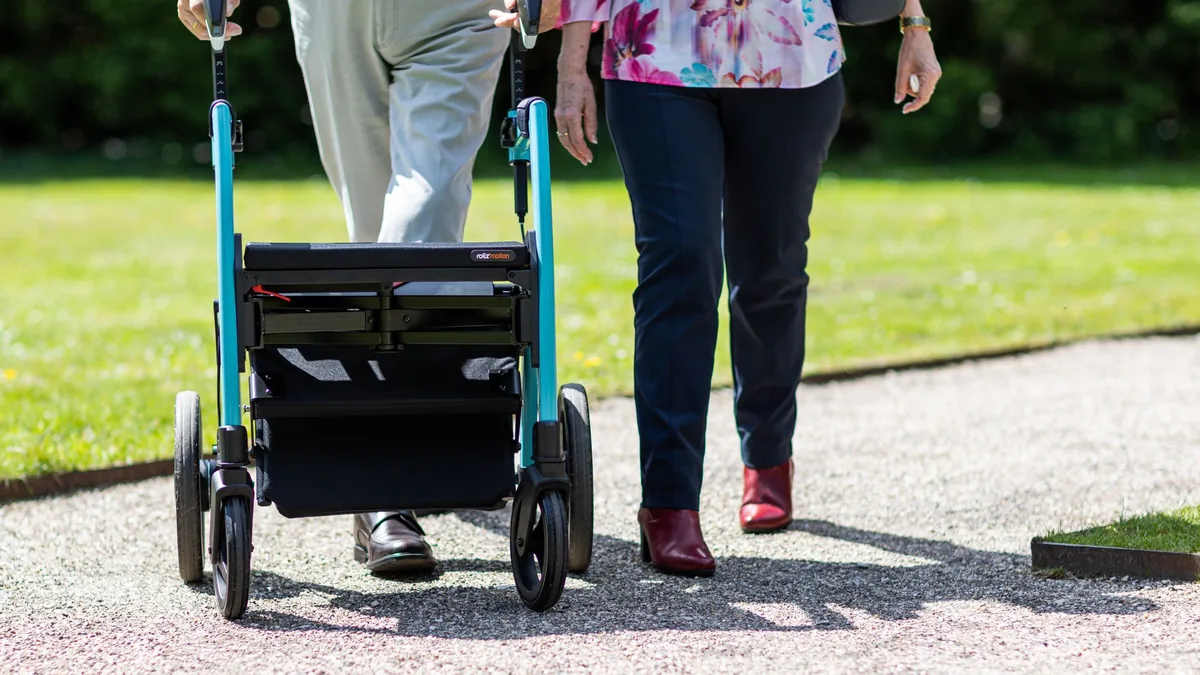
If you are travelling to Pakistan with elderly parents and one of them walks with a stick, a rollator or a folding frame, the flight is rarely the hardest part. Airlines have a formal assistance process. The road journey afterwards usually has none, so it falls to you to build one. That means four things, sorted before anyone packs: tell whoever arranges the car the exact folded size of the walking aid, decide whether the pickup is at the front door or on a main road, choose a vehicle with a seat your parent can actually sit down into, and plan stops where the toilet is a short, flat walk from where the car parks. Then decide which adult sits beside your parent and gets out first at every stop.
Travelling to Pakistan with elderly parents: check safety and health first
Before you plan any route, check the UK government's Pakistan travel advice from the FCDO. At the time of writing it advises against all travel to the whole of Balochistan, to many districts of Khyber Pakhtunkhwa (Peshawar among them, plus stretches of the Karakoram Highway and the N45), within 10 miles of the Afghan border and within 10 miles of the Line of Control. It advises against all but essential travel to Azad Jammu and Kashmir, to Sindh north of and including Nawabshah, to Dera Ghazi Khan in Punjab, to several more Khyber Pakhtunkhwa districts, and within 5 miles of the Indian border (with exceptions for the Wagah crossing and the Kartarpur Corridor). The motorway run between Lahore and Islamabad is not on those lists, but the advice changes, so read it again in the week you travel.
The FCDO health page for Pakistan is blunt on three points that matter for an older traveller:
- Medicines: it says there are often shortages of medicine in Pakistan, and that some imported medical supplies may be restricted.
- Healthcare: local facilities are below UK standards, especially in remote areas; private care is available in the major cities but expensive. It stresses insurance that covers local treatment and unexpected medical evacuation.
- Air quality: it flags air pollution as a health hazard, worst from October to February, with Punjab and particularly Lahore among the worst affected.
If your parent has a heart or lung condition, that winter smog point is worth raising with their GP before you fix dates.
The arrival leg: book assistance, then plan the kerb
Airline assistance does not end at the aircraft door. The UK Civil Aviation Authority's guidance on how to request help at the airport says you should ask when you book, or at least 48 hours before departure, through the airline, travel agent or tour operator, and that there must be a free way to request it. It lists what assistance can include: getting from the drop-off point to the terminal, an airport wheelchair to the gate, help through security, boarding and seating. It also notes that a mobility aid can normally be used up to the gate before going into the hold. Keep the written confirmation.
Those UK rules protect the departure end. On arrival in Pakistan, ask the airline directly what help will meet the aircraft and take your parent through immigration and baggage reclaim, and whether they will be brought to the arrivals hall or handed over earlier. Do not assume; get the answer in writing with the booking reference.
Now plan the handover to the car, because the airline's help stops at the terminal and the driver's starts at the kerb.
- Share the flight number, not just the time. The driver or booking team can track delays and adjust.
- Say how your parent will come out. Walking with their own frame, in an airport wheelchair, or with a relative pushing a trolley.
- Agree one meeting point and one phone number. A single named person at arrivals, with a charged phone that works locally.
- Ask how far the car can wait from the exit. At a large airport the walk from the arrivals door to where cars can stand is not always short. Ask, and plan a seat or a wheelchair for the waiting time if needed.
Our guide to arranging an airport pickup for parents while you are abroad covers the planning from the family's side.
Tell the booking team about the walking aid, with measurements
"Mum has a walker" tells a booking team almost nothing. There is a world of difference between a single walking stick, a lightweight folding frame and a four-wheeled rollator with a seat and a basket. Each one takes a different amount of boot space, and a rollator in particular can eat the corner a suitcase was meant to use.
Measure it at home, folded, before you leave. Write down three numbers: length, width and depth. Then add:
- What type it is: stick, crutches, folding frame, rollator, or a folding wheelchair kept for longer distances.
- Whether it folds flat or only partly. Some rollators fold side to side and stay tall.
- Its weight, roughly. This decides who lifts it in and out.
- Whether your parent needs it the moment they step out. If so, it cannot go under three suitcases.
Put all of this in the journey notes when you plan the trip, alongside the luggage count. A folding walker in the car boot should be the last thing loaded and the first thing out, which means the luggage has to fit around it rather than on top of it. If the numbers do not work, you are better off learning that a week before than at the kerb. Our note on what to tell the booking team about family luggage has a fuller packing list.
A walking stick or crutches can often ride in the cabin, by your parent's feet or against the door, so they have it the second the car stops. Ask that it stays with them, not in the boot.
Door-to-door or the main road: decide before the day
Many family homes in Pakistan sit on narrow lanes, in older mohallas, or behind a gate on a street a larger car cannot turn into. That is often the first surprise for a family who assumed "pickup from home" means the front step.
Here is the trade-off, laid out plainly.
| Question | Pickup at the door | Meeting on a main road |
|---|---|---|
| Walking distance for your parent | Shortest, often just the gate | Can be a long, uneven walk |
| Kerb height and surface | Known to the family | Unknown, may be a high kerb or open drain edge |
| Whether a larger vehicle can reach | Depends on lane width and turning space | Usually easier |
| Time to load a walking aid and bags | Calm, off the traffic | Rushed if the car is stopped in a live lane |
| Who needs to be told | The driver needs clear directions and a landmark | Everyone needs the same meeting point |
For a parent who uses a frame, door-to-door is almost always worth the extra effort in directions. If the lane genuinely cannot take the car, choose the nearest point where it can stand off the traffic, and have a relative walk your parent there slowly with a chair ready, rather than a spot on a busy road where the driver will feel pressure to move on.
Whichever you choose, give the driver a landmark as well as an address, and a local number for someone who is physically at the house. A pin dropped on a map helps, but a nephew standing at the gate helps more.
Seat height: why some cars are easier to get into
This is the point families most often overlook, and the one your parent will feel most.
A low saloon asks your parent to lower themselves down and back, then twist their legs in. A very tall 4x4 asks them to climb up, often with a step, and pull on a grab handle. Neither suits someone with weak knees or hips. The easiest seat is roughly at the height of the back of their thigh when standing, so they can turn, sit back and swing their legs in without dropping or climbing.
When you plan, say plainly what your parent can and cannot do:
- Can they step up onto a running board, or not at all?
- Can they bend low into a saloon?
- Do they need to sit in the front for leg room or to avoid travel sickness?
- Do they need a sliding door, because a hinged rear door opening fully onto a narrow lane is not an option?
These answers point to a vehicle type rather than a model, and it is fine to ask for a type and have the booking team come back on what is actually available. Our page on family vehicles for longer journeys (planned link) explains the usual choices. If your parent uses a wheelchair for longer distances, iDrive, the network behind Pakistan Taxi, lists accessible vehicle options you can ask about; availability varies by city and date, so ask early rather than assume.
Helping an elderly parent in and out of a car
The risky moment is the few seconds between standing and sitting. A calm routine, done the same way every stop, takes the guesswork out of helping an elderly parent in and out of a car. Agree it with your parent first; they know their own body better than you do.
Getting in
- Park or ask the driver to stop on the flattest ground available, with the door clear of drains, kerb edges and bikes.
- Move the seat back, and slightly recline the backrest if your parent needs more room for their head.
- Your parent walks up with the frame until the backs of their legs touch the seat, facing away from the car.
- One hand goes back to the seat or door frame, not to the open door, which can swing.
- They sit down first, then lift their legs in one at a time, or both together with help.
- Only now fold the frame and hand it to whoever is loading it.
Getting out
- Open the door fully, and bring the walking aid to the door, unfolded and with the brakes on if it is a rollator.
- Your parent swings both legs out first and puts their feet flat on the ground.
- They shuffle forward to the edge of the seat before standing.
- They push up from the seat, not by pulling on the frame, then take the frame once they are steady.
- Give them a moment standing before they start walking; some people feel light-headed after a long sit.
A small cushion can raise a low seat a little. Keep it in the cabin, not the suitcase.
Rest breaks for elderly passengers: plan the stops, not just the stopping
What makes or breaks the day is where the stops happen.
The NHS guidance on deep vein thrombosis lists being over 60 as a risk factor, and for journeys of four hours or more advises loose clothing, plenty of water, avoiding alcohol and moving around when you can. That alone makes a regular stretch-and-walk stop sensible. Your parent's own doctor may have specific advice; ask them about the length of road day you are planning.
Choosing where to stop
What matters for a walking aid is not the number of stops but how close the toilet and a seat are to where the car can park. A roadside tea stall may be charming, but if the only washroom is up a step or across uneven ground, it will not work.
The Lahore to Islamabad M-2 is a useful example. According to the Wikipedia article on the M-2 motorway, it runs about 375 km and has five service areas on each carriageway, at Sukheki, Sial, Bhera, Kallar Kahar and Chakri, with washrooms, mosques and food outlets, typically 60 to 80 km apart. You cannot cross the motorway to reach the other side's services, so plan stops for your direction of travel. Service areas like these are generally a better bet than an unplanned stop in a town. Layouts differ, though, and facilities can change, so you cannot assume a step-free washroom at any given site.
When you plan, tell the booking team:
- Roughly how often your parent needs to stop, based on real experience, not optimism.
- What each stop must have: a toilet close to parking, somewhere to sit, shade in summer.
- Whether prayer times matter for your parent, and how long they need at a mosque.
- That a short stop still takes time. Getting in and out with a frame can add ten minutes each end. Build that in as an estimate, not a fixed number.
Our guide on asking for breaks and stops on an intercity journey explains how to write stops into the plan so the driver is expecting them.
Medication, water and heat on the journey
The road day is where a small medication slip becomes a large problem, because the suitcase with the tablets is at the bottom of the boot.
Medicines
- Keep the full day's medicines, plus a spare day, in a small bag that rides in the cabin with your parent.
- Bring enough for the whole trip and a margin. The FCDO warns that medicine shortages are common in Pakistan, so do not plan to top up locally.
- Carry a written list of every medicine, its dose and the times it is taken, in English. If you can, add the generic names as well as UK brand names.
- If a dose falls during the drive, set a phone alarm. Travel days scramble routines.
Water and food
Pack more water than seems necessary, and something light to eat that does not need a stop. The FCDO health page points travellers to care when buying bottled water. Some older people drink less on travel days to avoid needing the toilet; good planned stops are what let them keep drinking.
Heat
From late spring through summer, heat is the risk families most often underestimate. The NHS guidance on coping in hot weather names older people, especially those 65 and over, and people on several medicines, as among the most vulnerable. It advises regular cold drinks and extra fluids, while avoiding alcohol, caffeine and hot drinks.
On the road, that translates into a few practical asks:
- A vehicle with working air conditioning, and a word with the driver to have it running before your parent gets in.
- Stops in shade where possible, with the engine and cooling kept on while your parent sits.
- Travel in the cooler part of the day for longer journeys, if your plans allow.
- A cool cloth and a small fan in the cabin bag.
In winter, the concern flips to smog in Punjab. If your parent has breathing problems, carry any inhalers in the cabin bag and ask their doctor about travel during the October to February period the FCDO highlights.
Who travels with your parent, and what each person does
A car full of loving relatives is not the same as a plan. At every stop, somebody has to be doing each job, and if nobody has been given it, three people will reach for the frame while the medicine bag stays in the footwell.
Before the journey, agree roles:
| Role | What they do | Where they sit |
|---|---|---|
| The steady hand | Stays next to your parent, helps them stand and sit, walks beside them | Next to your parent |
| The frame handler | Gets the walking aid out, unfolds it and has it waiting at the door | Near the boot side, or front passenger seat |
| The scout | Walks ahead at a stop to check the washroom, steps and seating | Anywhere |
| The contact | Keeps in touch with the driver or booking team, and with family at the destination | Front passenger seat if possible |
In a small group one person may cover two roles. If your parent is travelling with only one companion, that person needs to know every step in advance, and the driver should know it is a one-helper journey so they can hold the door or keep the car in a safe place a little longer.
Our guide to planning intercity travel with older relatives goes further into choosing travel days and handling a journey that has to be broken overnight.
If the trip carries on to Saudi Arabia
Plenty of families fold an Umrah into a Pakistan visit, which means a second set of airports and long road transfers, often in stronger heat. The same principles hold. Our sister company Saudi Cab Co has written a separate guide to travelling with older passengers in Saudi Arabia, covering the vehicle choice and stops on that side of the trip.
A short checklist for the week before you fly
- [ ] Airline assistance confirmed in writing for every flight
- [ ] FCDO advice re-read; insurance covers treatment and evacuation
- [ ] Medicines for the whole trip plus spare, with a written list
- [ ] Walking aid measured folded and noted with the luggage
- [ ] Seat and door needs described; pickup point and landmark agreed
- [ ] Stops chosen for close toilets, seating and shade
- [ ] Cabin bag packed: water, snacks, the day's medicines, a cushion
- [ ] Roles assigned for every stop
Planning the journey with us
When you have the measurements, the addresses and the rough plan, you can plan the journey with Pakistan Taxi (planned link) and put all of it in the notes: the walking aid, the seat needs, the stops and who is travelling. The booking team will reply on what vehicle and arrangement they can offer for your dates. Nothing is fixed until they confirm it, which is one more reason to start early for a parent whose comfort depends on the details.