
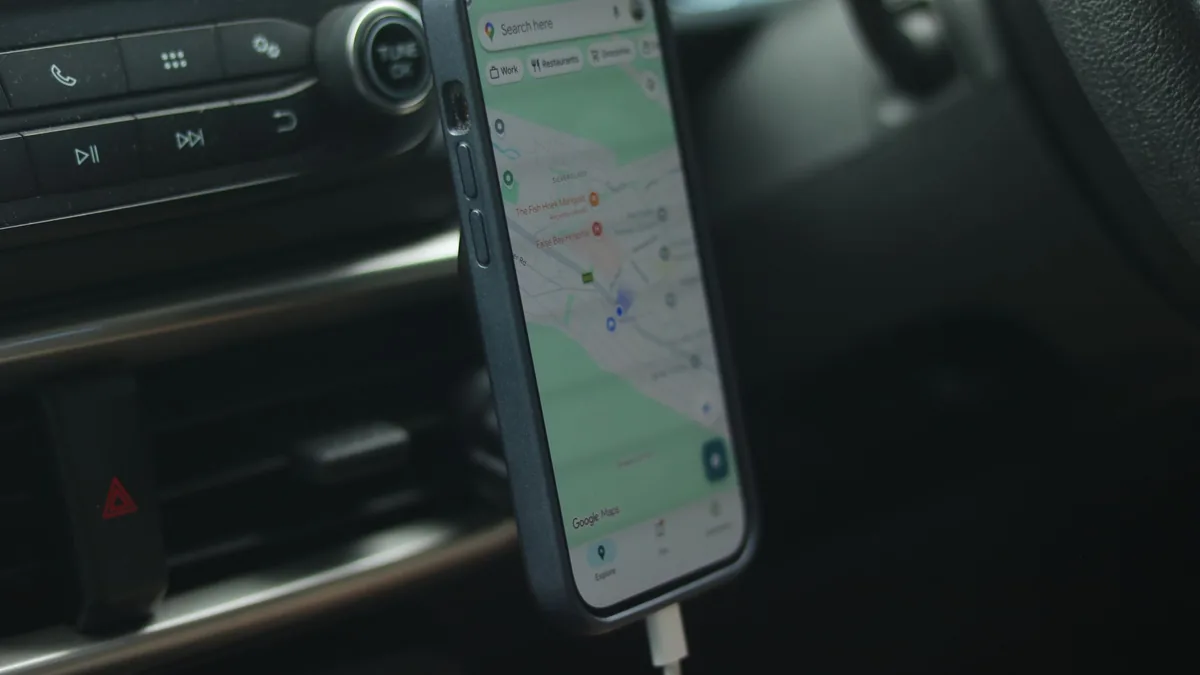
Two cars travelling together work best when they are not glued bumper to bumper. The safe version is simple: both cars leave from the same place at roughly the same time, each driver knows the full route and the final address, and the group agrees two or three named places to regroup along the way, such as a motorway service area or a petrol station just before the last turn-off. Between those points, each car drives at its own safe pace and keeps normal distance from the traffic around it, including the other family car. One passenger in each car handles the phone, so no driver has to.
If your group is small enough to fit one larger vehicle with its luggage, that is often simpler than two cars. If it isn't, or if part of the family needs to leave earlier or return on a different day, two cars make sense. The rest of this guide covers how to decide, how to split people and bags, where to regroup, and how to handle arrivals and returns that don't happen at the same time.
One car or two for a big family?
Before you plan a two-car trip, check whether you need two cars at all. One vehicle means one driver to brief, one pickup, one arrival, and nobody sitting in a service area car park wondering where the others went. Two vehicles give you flexibility, and sometimes they are the only option that fits everyone.
Here is a quick way to think it through.
| Your situation | Usually better | Why |
|---|---|---|
| Up to around 7 people, moderate luggage, same plan all day | One family vehicle | One pickup, one arrival, no regrouping to manage |
| 8 or more people, or heavy luggage from an overseas trip | One van, or two cars if a van can't reach the address | A van keeps everyone together; two cars suit narrow streets or split plans |
| Part of the group returns the same evening, the rest stay on | Two cars | Each car runs to its own return time |
| Elderly relatives who need frequent stops, plus younger travellers in a hurry | Two cars with shared regroup points | Each car travels at the pace its passengers need |
| Pickups from two different cities or areas before a shared destination | Two cars | Each collects its own passengers, then both meet up |
| Wedding or event with a fixed arrival time | Depends on the event | See the section on arriving together below |
The passenger numbers above are a rough guide, not a rule. A seven-seat vehicle carrying five adults and four large suitcases is more cramped than it sounds, because the seat count says nothing about boot space once every seat is in use. Our guide to comparing a group van with several cars goes through that choice in more depth.
When one larger vehicle wins
A single van or large family vehicle usually wins when:
- everyone starts and finishes at the same addresses;
- nobody needs to leave early or stay on;
- the destination can take a larger vehicle (some old city lanes and tight residential streets cannot);
- you want the whole family to walk in at the same moment without any timing effort.
When two cars win
Two cars usually win when:
- the group is too large, or carries too much luggage, for one vehicle;
- passengers are starting from different places;
- part of the family has a different schedule on the way back;
- you want some resilience, so that if one vehicle is held up, at least half the group still reaches an important event on time.
That last point is underrated. If a single van picks up a puncture outside Sheikhupura, everyone is late. With two cars, the delay only touches half the family, and the other half can let the hosts know what is happening.
Splitting passengers and luggage between the cars
How you split the family decides how smooth the day feels. The easy mistake is to fill the first car with whoever is ready and pile everyone else into the second. A few minutes of thought the night before avoids most of the friction.
Split by plan, not by who is standing nearest
Start with the return. If some relatives are coming back the same night and others are staying for a few days, put each group in the car that matches its plan. That way nobody has to swap cars, bags or seats at the far end, and each driver knows from the start what their day looks like.
Next, think about pace and comfort:
- Elderly relatives and young children often need more stops. Put them together, with a calm adult who can decide when to pull in.
- Anyone who gets car sick does better in the front seat of the smoother, less crowded car.
- At least one confident adult per car should know the destination address, the host's phone number and the regroup plan. Don't rely on one "organiser" in car one.
Luggage: keep each person's bags in their own car
It sounds obvious, but it goes wrong constantly after airport arrivals. Suitcases get loaded wherever there is space, and later someone discovers their medicines, documents or wedding clothes are in the car that has already turned off towards another relative's house.
A simple rule works: each passenger's bags travel in the car that passenger is in. If that doesn't fit, move a passenger, not just a bag. Keep a small bag with passports, CNICs or NICOPs, medicines, phone chargers and a change of clothes on the lap or at the feet of its owner, not in the boot.
For heavier loads, such as overseas families arriving with several large cases each, tell the operator the number and size of the bags when you enquire. Mention anything bulky, such as a wheelchair, a pushchair or boxed wedding gifts, at the same time.
A split checklist
Before the day, write down (a shared note on the family group chat is fine):
- Car 1 passengers, and their luggage count.
- Car 2 passengers, and their luggage count.
- The lead contact in each car and their mobile number.
- The driver's name and number for each car, once confirmed.
- The final address, with a landmark and a map pin.
- The regroup points, in order.
- The return plan for each car, if it differs.
If you are organising a larger event with more than two vehicles, a written list becomes essential. Our guide to building a pickup manifest for several vehicles shows one way to lay it out.
Keeping cars together on a long drive without convoy driving
This is where families often get it wrong, with the best intentions. The instinct is to keep the second car right behind the first so nobody gets lost. On a motorway, that means tailgating, cutting across lanes to stay close, and drivers watching the car in front instead of the road. It is tiring and it is unsafe.
Pakistan's motorways and national highways are policed by the National Highways and Motorway Police (NHMP), and a family convoy gets no special allowance from them or from anyone else on the road. Keep to the lane you need, leave a proper gap, and do not follow another car through a gap it has taken. The family car in front is traffic like any other.
Road conditions are the other reason to spread out. The UK government's Pakistan safety and security advice notes that local driving standards are erratic, especially at night, and that road quality outside the major motorways is variable. The US State Department's Pakistan country information adds that many vehicles lack working headlights and many roads are not lit or signed, and recommends travelling with experienced local drivers. Two drivers each concentrating on the road are far safer than one driver concentrating on another car's tail lights.
A family convoy on the motorway: what "together" should mean
For a family convoy on the motorway, "together" should mean:
- Same departure time, give or take a few minutes.
- Same route, agreed in advance and loaded into both drivers' navigation.
- Same regroup points, named and in order.
- No obligation to stay in sight of each other between those points.
If one car falls behind, it simply carries on to the next regroup point. Nobody slows down in the fast lane or stops on the hard shoulder to wait.
Choosing a meeting point for two cars
A good meeting point for two cars has four things: it is easy to find, easy to enter and leave, safe to wait at, and it has toilets and somewhere to sit. On the main motorways, the service areas tick all four boxes.
On the motorway
On the M-2 between Islamabad and Lahore, a route of about 375 km, the service areas include Chakri, Kallar Kahar, Bhera, Sial and Sukheki, according to the M-2 motorway entry on Wikipedia, which puts the average spacing between them at roughly 60 to 80 km. Facilities typically include a mosque, washrooms, food outlets and fuel. Service areas exist on both sides of the carriageway, so make sure both drivers know which direction's facility you mean.
Pick your regroup points by the needs of the slowest car, not the fastest. On a hypothetical family run from Islamabad to Lahore, for example, you might agree:
- First regroup at Kallar Kahar for tea and a stretch.
- Second regroup at Bhera or Sial, depending on how the children are doing.
- Final regroup somewhere just before your exit, so the cars arrive at the house together.
That is an example, not a prescription. Your own points depend on your route, your start time and who is on board.
Off the motorway
On national highways and city roads, choose a large fuel station with parking, a well-known restaurant car park, or a landmark both drivers can find on a map. Avoid meeting on the roadside, at a junction, or "just after the flyover". Send a map pin to both drivers and to the lead contact in each car.
The final regroup before arrival
The last regroup point matters most. If you want to arrive as one family, stop 10 to 20 minutes out from the destination, let the slower car catch up, and drive the final stretch together at normal town speeds. This is also the place to straighten clothes, sort out which gifts go in first, and phone the hosts with an arrival time.
Phone contact between the cars and the drivers
Communication is what replaces tailgating. Set it up before anyone leaves.
Who holds the phone
In each car, name one passenger as the contact person. That person:
- keeps the family group chat or a direct call open with the other car's contact;
- passes messages to the driver in plain words ("they're 15 minutes behind, we'll wait at Bhera");
- shares live location if the family uses it;
- calls the host when the arrival time is clear.
The driver should not be texting, calling or reading messages while driving. If a driver needs to speak to the other driver, the contact person can put the call on speaker, or it can wait for the next stop.
What to agree in advance
- The signal for trouble. Agree that a missed call or a short message such as "stopped, all fine" or "stopped, need help" gets an answer at the next safe moment.
- What happens if contact drops. Mobile signal can be patchy on some stretches. If there's no reply, carry on to the next agreed regroup point and wait there, rather than turning back.
- Emergency numbers. NHMP's helpline is 130, and the Motorways of Pakistan entry on Wikipedia describes it as available around the clock. The US State Department lists 15 for police assistance. Save both in every phone, along with each driver's number.
- Chargers. Every car should have a working charger or power bank for the contact person's phone.
Driver-to-driver contact
When the cars are arranged through an operator, ask for both drivers' names and numbers once they are assigned, and share each driver's number with the contact person in the other car. Drivers often coordinate between themselves at stops, which is useful. But the family should still have its own plan, so everyone isn't relying on one driver's phone.
Arriving together at a family home or event
Arrival is usually the reason people want two cars to travel together in the first place. Nobody wants half the family standing at the gate while the other half is still somewhere on the motorway.
At a family home
For a family home, the final regroup point does most of the work. A few other details help:
- Give both drivers the same address, landmark and map pin. In many Pakistani neighbourhoods the house number alone won't get a stranger to the right gate.
- Tell the hosts where the cars can park. Two cars arriving in a narrow street at once can block it; one may need to drop passengers and move on.
- Unload in order. Elderly relatives first, then bags. If both cars are unloading at once, one person per car should check nothing is left behind in the boot or door pockets.
At a wedding or event
Events are less forgiving, because the arrival time is fixed and the venue may be busy with other guests. Plan the regroup point with a buffer and treat the arrival as its own mini-plan:
- Confirm which gate or entrance to use and whether there is a drop-off area.
- Arrange a meeting spot outside the venue if the drop-off area is congested.
- Decide in advance whether the cars wait, park or leave after drop-off.
For bigger occasions, such as a baraat or several families travelling to the same venue, our group travel service page explains how to put the whole party in one enquiry, rather than arranging each car separately.
Different return times for each car
Two cars rarely come home together. One part of the family may leave straight after dinner, while the other stays for the next day's function. Planning each car's return separately saves a lot of late-night phone calls.
Plan the return at the start
When you enquire, describe the return for each car, even if it is only approximate:
- Car 1: returning the same evening, earliest departure around a certain time.
- Car 2: staying overnight, returning the following afternoon.
If one car is only needed one way, say so. If a car will wait at the destination, mention roughly how long, because waiting time and a driver's rest are part of how the operator plans the journey.
Late finishes
Evening events often run late. If you know a function may finish after dark, think about whether the return should happen that night at all, given the FCDO and US State Department cautions about night driving. Our guide on wedding transport when the reception finishes late covers how to plan for overruns.
Where the route leaves the main motorways
Two-car family trips sometimes carry on to villages or northern areas after the main event. Be clear-eyed about where that onward leg goes. The FCDO's main Pakistan travel advice page advises against all travel to Balochistan and to several districts of Khyber Pakhtunkhwa, and against all but essential travel to other areas, including Azad Jammu and Kashmir. It also says advance permission from local or federal authorities is needed to travel in Khyber Pakhtunkhwa, Balochistan and several districts of Azad Kashmir. Check the latest advice for every place on your route before you plan the onward leg, and on mountain roads follow its advice to use experienced local drivers and travel only in clear weather.
A short plan you can copy
Use this as a template for your own family trip. Fill it in, then share it with everyone.
- Date and departure time:
- Pickup point(s):
- Car 1: passengers, luggage count, lead contact, driver name and number.
- Car 2: passengers, luggage count, lead contact, driver name and number.
- Route: motorway or highway, entry and exit points.
- Regroup points: 1, 2 and final, with map pins.
- Arrival: address, landmark, parking note, host's number.
- Return: Car 1 time and destination; Car 2 time and destination.
- Emergency numbers: NHMP 130, police 15, each driver, each lead contact.
If you'd rather someone help you work it out, you can plan your family journey with Pakistan Taxi (planned link) by describing the group, the luggage and the return plans. We'll come back to you with vehicle options and the details that need confirming; nothing is booked until both sides have agreed the arrangements. For groups that may suit a single larger vehicle, the group van range at iDrive, the network behind Pakistan Taxi, shows the kinds of vans people usually compare.