
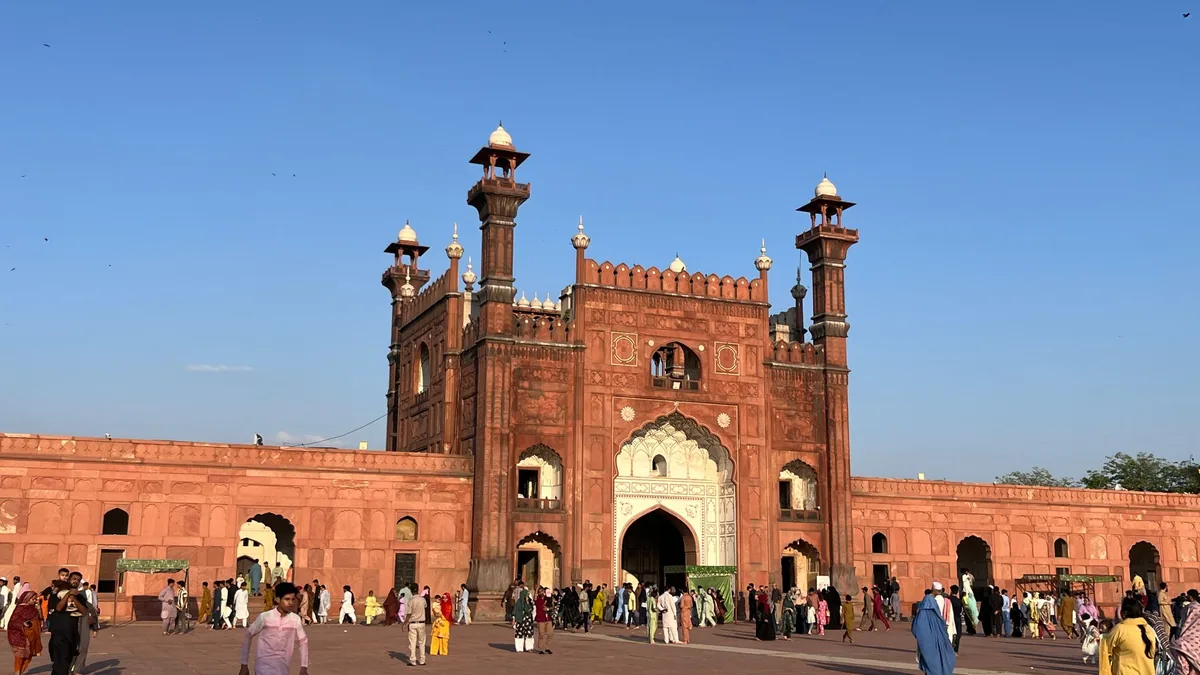
For a group, a Walled City of Lahore tour works best when you pick one of two ends, not the middle. Get dropped at Delhi Gate on the east side if you want to walk the old royal route past the Shahi Hammam and Wazir Khan Mosque. Get dropped by the Lahore Fort and Badshahi Mosque on the north-west side if your party includes elders, small children or anyone who tires quickly. The vehicle cannot follow you into the lanes, so the plan rests on three decisions made before anyone gets out: which end you start at, which end you finish at, and one exact pickup time at one named landmark. Get those right and the rest of the day looks after itself. Leave them vague and you will spend the last hour on the phone, trying to describe a doorway in a street of identical doorways.
Why the car stays outside the old city
The Walled City is small on a map and dense on the ground. The Walled City of Lahore Authority (WCLA) describes an area of about 2.6 square kilometres that still works as one of the largest wholesale and retail markets in Asia, with a separate bazaar at each of its historic gates, and warns that you cannot see it all in one day (WCLA: the Walled City). The inner streets were laid out centuries before motor traffic. They are narrow, winding and lined with houses and shops. Much of the time they are full of handcarts, motorbikes, deliveries and shoppers.
In practice, that means:
- A car or van can get you *to* a gate or to the fort side, but not usefully *through* the old city.
- There is rarely anywhere for a vehicle to wait at the kerb while a group gets itself together. Drop-offs need to be quick.
- Your driver will usually set you down, move off to wherever parking is possible, and come back at the agreed time.
That last point matters more than anything else in this guide. Plan the day as a drop-off and a separate pickup, not as a car that follows you around.
The two sensible starting points
Delhi Gate: for the walkers
Delhi Gate faces east, towards Delhi, and opens straight into the bazaar that leads to Wazir Khan Mosque. The Mughal-era gate was destroyed by the British after 1857 and rebuilt later in the 19th century. It is now a working two-storey gatehouse with room for a handful of shops, and the Akbari Mandi spice market sits right beside it.
Starting here puts you at the head of the Shahi Guzargah, the royal passage Mughal nobles once used on their way to the fort. Its stretch between Delhi Gate and Wazir Khan Mosque was cleared of encroachments and restored in a project that began in 2012, with the first phase completed in 2015. Within a few minutes of the gate you reach:
- Shahi Hammam — a Mughal bathhouse right beside Delhi Gate, built in 1635 by Wazir Khan, restored between 2013 and 2015 by the Aga Khan Trust for Culture and WCLA, and given a UNESCO Award of Merit in 2016. Visitors walk through on raised walkways above the original floors, so it is manageable for most people.
- Wazir Khan Mosque — about 260 metres west of Delhi Gate, facing Wazir Khan Chowk. Its tilework is the reason many people make the trip at all.
That first stretch, gate to mosque, is short enough for nearly anyone who can walk a few hundred metres on an uneven, busy street. Beyond the chowk the route carries on through the bazaars towards the fort. That longer section is where family groups tend to split: the keen walkers want to press on, and the rest want to sit down.
The Fort and Badshahi Mosque side: for everyone else
The other end of the old city is its monumental quarter. The Lahore Fort's Alamgiri Gate opens onto the Hazuri Bagh garden, which in turn faces the Badshahi Mosque. The tomb of the poet Muhammad Iqbal is here too, next to the mosque's entrance. For a Lahore Fort and Badshahi Mosque visit, this is the drop-off to aim for: it puts the big sights within one compact cluster, and it is also where Fort Road Food Street begins.
It is not effortless, though. The fort covers more than 20 hectares, and the Badshahi Mosque courtyard alone is about 25,600 square metres of open paving. "Short walk" is relative when that paving has been in the afternoon sun for four hours.
Which end suits your group?
| Your group | Start at | Finish at | Why |
|---|---|---|---|
| Mostly fit adults, keen on the old streets | Delhi Gate | Fort and Badshahi Mosque side | Walk the Shahi Guzargah one way, no backtracking |
| Grandparents, a wheelchair user, or toddlers | Fort and Badshahi Mosque side | Same place | Big sights close together, one meeting point |
| Mixed group that will split | Delhi Gate for walkers; fort side for the rest | Fort side for all | Two drop-offs, one reunion at dinner time |
| Short visit before a flight or event | Fort side | Same place | Fewest moving parts, easiest to time |
If you are splitting a mixed group, that third row usually needs two vehicles or one vehicle making two drops. Our guide to choosing a group van or several cars walks through that trade-off.
Delhi Gate Lahore parking and drop-off: what to expect
Delhi Gate Lahore parking is the question drivers raise first, and the honest answer is: do not plan around a guaranteed space next to the gate. Treat the gate as a drop-off point, then let the driver find wherever parking is possible nearby and return at the time you agree. The same applies on the fort side.
To make the drop-off quick and safe:
- Get everyone ready before you arrive. Water bottles, sun hats, phones, the elders' medicines and a small bag of snacks should be in hands, not in the boot.
- Decide who carries what. One adult holds the group's cash and the tickets; another holds the phone with the driver's number.
- Get out on the kerb side. Traffic around the old city is heavy and mixed. Children stay with one named adult as they step out.
- Leave large bags in the vehicle only if the driver is staying with it. If the car is going off to park, take what you need and nothing more.
- Say the pickup plan out loud before the doors close. Time, place, and what happens if someone is late (see below).
If you are coming straight from a flight into Allama Iqbal International, go to the hotel or family home first. Arriving in the old city with suitcases, jet lag and three children makes a hard day of something that should be enjoyable.
Walking distances for elders and children
Old Lahore sightseeing with family goes wrong in one predictable way: somebody overestimates how far Nani can walk on hot stone. Rather than quote a total step count that will be different for every group, think in terms of legs: short stretches with a rest point at each end.
| Leg | Rough scale | Rest points |
|---|---|---|
| Delhi Gate to Shahi Hammam | A few minutes on foot | Hammam interior, raised walkways |
| Shahi Hammam to Wazir Khan Mosque | About 260 m from the gate in total | Wazir Khan Chowk, mosque courtyard |
| Wazir Khan Chowk onward to the fort | A much longer walk through crowded bazaars | Shops and chowks along the way; few benches |
| Hazuri Bagh between the fort and the mosque | A short walk across the garden | Garden, shaded edges |
| Inside Lahore Fort | Large site of 20+ hectares; choose a few areas | Pavilions and shaded arcades |
| Badshahi Mosque courtyard | Mosque about 170 m each side; courtyard about 25,600 sq m of open paving | Arcades around the courtyard |
Some practical rules that save the day:
- Pick the stretch, not the whole route. For grandparents, Delhi Gate to Wazir Khan Mosque and back, or the fort side on its own, is a complete and satisfying visit.
- Plan one sit-down every 45 minutes or so. The chowk, the hammam, the Hazuri Bagh and a tea stop all count.
- Shoes come off at the mosques. Wear slip-ons, and take socks for anyone who finds the stone too hot in summer.
- Dress modestly for the mosques. Women should bring a scarf; everyone should cover shoulders and knees.
- Children and crowds. Agree a "stand still" rule. If a child loses sight of the group, they stop exactly where they are and wait. Write a parent's phone number on a card in the child's pocket.
- Wheelchairs and buggies. Streets are uneven, crowded and have steps in places. The fort side is the more realistic choice. A light folding chair is easier than a heavy one.
Timing matters as much as distance. In the summer months, start early or go in the late afternoon and stay into the evening. Midday on open courtyards is hard on everyone.
A walled city of Lahore tour on foot: the Shahi Guzargah walk
If your group chooses the walking route, the Shahi Guzargah walk is the spine of it. It is the old royal road running from Delhi Gate into the heart of the city, and it gives you a clear line to follow instead of a maze. A simple version for a group:
- Drop-off at Delhi Gate. Take a minute to look at the gatehouse and the spice market beside it. This is also a good place for a group photo before people start drifting.
- Shahi Hammam. Allow time to walk the raised walkways and look at the frescoes that the restoration uncovered. It is the easiest indoor stop on the route and a good first rest.
- Wazir Khan Chowk and the mosque. Sit in the square, then go into the mosque. Shoes off, heads covered for women, voices down during prayer times.
- Decide at the chowk. This is your natural fork. Walkers who want more can carry on through the bazaars towards the fort side. Anyone who is flagging can head back the short way to Delhi Gate for an early pickup.
- Regroup on the fort side. If you walk the whole route, you finish where the monumental quarter and the food street are, which is where your vehicle should meet you.
Keep the group small enough to move through crowds without stopping every few metres. For a large family, two groups with a leader each, walking a few minutes apart, is calmer than one long line.
Official WCLA tours and timings
You do not have to guide the day yourself. The Walled City of Lahore Authority runs a set of themed tours, and joining one lets your group follow a trained guide while you concentrate on getting everyone in and out. WCLA currently lists tours including (WCLA tours):
- Nashta Tour on the Royal Trail — a morning walk based around Chowk Wazir Khan with a traditional Lahori breakfast. For families, this is the one that pairs best with a Delhi Gate drop-off.
- Roshan Galiyan Androon Di — an evening tour introduced in 2022, held on Sunday nights, with traditional performances and qawwali.
- Bhatti meets Taxali — a monthly guided tour around the Bhati and Taxali gate areas, with cultural performances and food.
- Yatra — a monthly Sunday tour of Sikh heritage sites, including Gurdwara Guru Arjan Dev Ji and the Samadhi of Maharaja Ranjit Singh, with Sikh guides.
- Photography walks — guided walks for people who want to photograph the old city.
WCLA's own tour page does not publish full start points, prices or exact start times for every tour, and schedules change. Confirm the date, the start time and the exact meeting point with WCLA before you plan the transport around it. Once you have that meeting point, it becomes your drop-off, and the tour's finishing point becomes your pickup.
WCLA also looks after the Lahore Fort itself, which UNESCO inscribed on the World Heritage List in 1981 together with the Shalimar Gardens (UNESCO: Fort and Shalamar Gardens in Lahore). Opening hours and ticket arrangements for the fort are set by the authorities and can change, so check them close to your visit rather than relying on an old blog post.
Setting one exact pickup time and landmark
This is where most group outings in the old city come apart. "Pick us up near the fort around seven" sounds clear in the car. At seven, with the food street filling up and three phones on low battery, it is not.
What a good pickup instruction contains
- One landmark that nobody can confuse: for example, "outside Delhi Gate, on the side facing away from the old city" or "the Fort Road side of the food street". Avoid "near the mosque": there are several.
- One exact time, not a range. "7:15" is better than "7 to 7:30".
- One person in the group who talks to the driver. Everyone else talks to that person.
- A back-up plan: what the driver does if you are not there at 7:15 (wait how long? call whom?), and what you do if the driver cannot stop (walk on to where?).
A simple template to send the driver
Here is an example message you might send, adapted to your own plan:
Pickup: 7:15 pm, [landmark you have agreed], [date].
Group: 6 adults, 2 children, 1 elderly passenger who needs the front seat.
Contact on the day: [name], [phone number with country code].
If we are late, please wait and call [name]. If you cannot stop at the landmark, message us where you are and we will come to you.
Send it in writing, not just on a call, and send a pinned location if you can. The same template works for the drop-off in the morning.
Build in slack
Plan the pickup at least 20–30 minutes later than you think you will be ready. Groups leave the old city slowly: someone wants one last photo, the children need the toilet, the tea arrives late. If you have an onward commitment (a wedding function, a train, a flight), work back from that and add more.
Finishing with Fort Road Food Street in the evening
Many families plan the day around dinner, and the geography makes that easy. Fort Road Food Street runs between Fort Road and the Hazuri Bagh gateway, with the Badshahi Mosque as its backdrop. It was rebuilt and opened in January 2012, and WCLA took over its upkeep in 2013. Plan for the vehicle to wait on Fort Road rather than expecting to stop among the tables.
A day that ends here tends to look like this:
- Afternoon: drop-off at Delhi Gate, Shahi Guzargah walk, rest at Wazir Khan Chowk.
- Late afternoon: walkers continue towards the fort side; anyone tired takes a short ride round to meet them (this is where a second pickup or a second vehicle earns its keep).
- Sunset: Hazuri Bagh, the Badshahi Mosque courtyard, the view back to the fort.
- Evening: dinner on the food street.
- Pickup: at one agreed point on the Fort Road side, at one exact time.
Evenings on and around the food street can be crowded. Keep children close, and agree the pickup point before you sit down to eat, not after, when everyone is full and slow and the phones have gone quiet.
Staying safe and sensible in the old city
Lahore is not one of the places the UK Foreign, Commonwealth & Development Office advises against visiting. In Punjab, its advice against all but essential travel covers Dera Ghazi Khan only. The FCDO does warn of an ongoing risk of terrorism across Pakistan and asks visitors to be careful around protests, rallies, security checkpoints, tourist sites and religious gatherings and sites, particularly in urban areas (FCDO travel advice for Pakistan). Read the current advice before you travel. It changes, and your travel insurance may depend on it.
For a group visit, that translates into ordinary good habits:
- Avoid the old city on days of large rallies or processions, and check local news the morning of your visit.
- Keep phones, cash and passports close, and leave what you do not need at the hotel.
- Know who has the driver's number and the pickup plan. That person should not also be the one minding three children.
- If the situation around you changes, go to your pickup point early and call the driver, rather than waiting for the agreed time.
Planning the transport for your visit
If you would rather not sort the vehicles yourself, you can send us your plan through plan your journey (planned link) and tell us the group size, the drop-off and pickup points and the times. For a day that includes the old city and other stops, a car and driver for the day keeps one driver and one number for everyone. Larger family groups, or visits tied to a wedding or reunion, fit our events and groups service or group travel. Your request is an enquiry: the team will come back to you to confirm what vehicles are available and what the journey would involve before anything is arranged.
Pakistan Taxi is an iDrive brand. If you are already in Lahore and want a wider look at getting around the city, iDrive, the network behind Pakistan Taxi, covers taxi and car hire in Lahore.